ChannelDraw · Exhibition · Brooklyn · November 2026
Football
Rebels
Eleven stories of resistance,
illustrated by Gianluca Costantini
The exhibition
Football and dissent
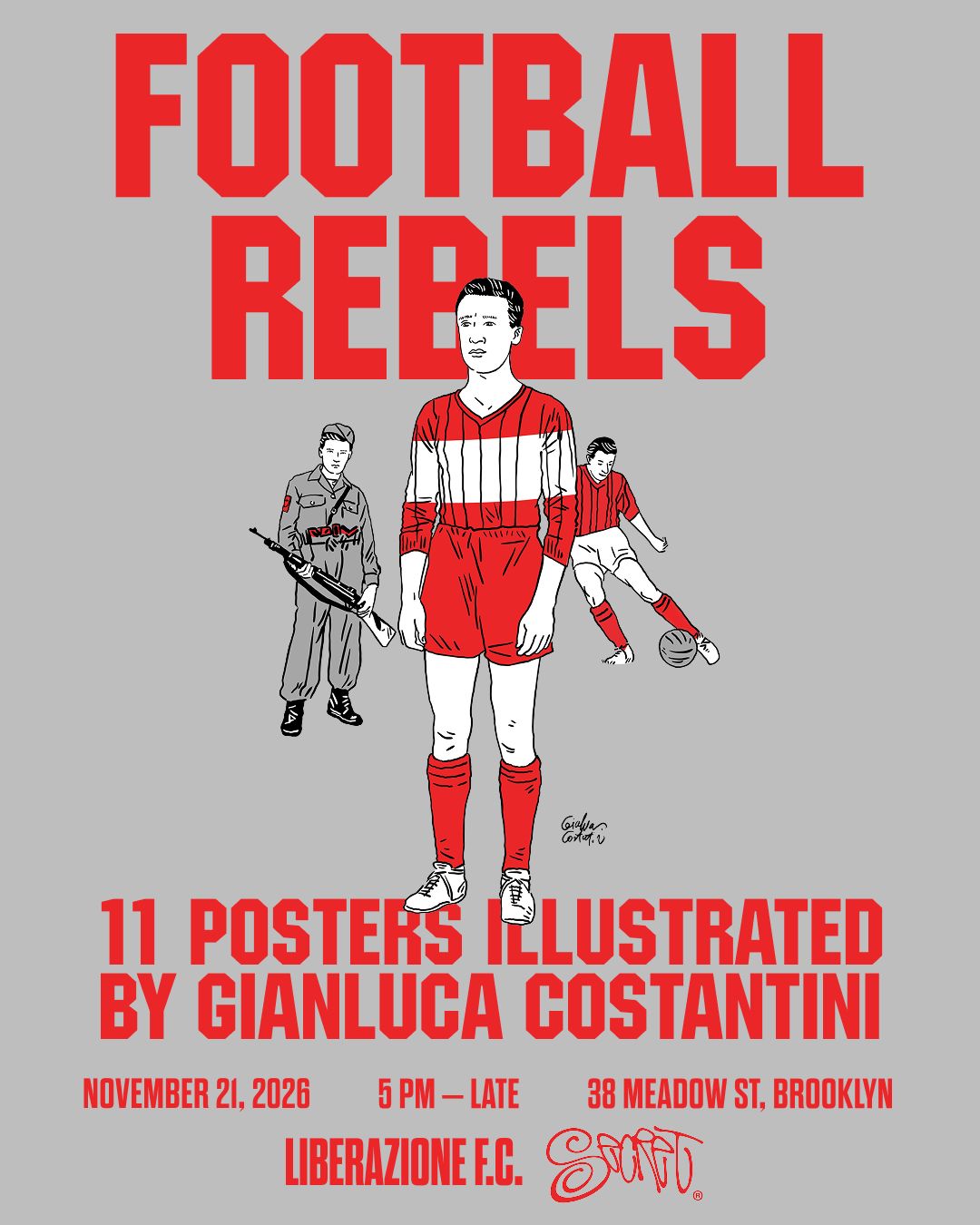
On November 21, 2026, Liberazione presented Football Rebels at Secret Futebol Club in Brooklyn.
The exhibition brought together eleven drawings by Gianluca Costantini, pairing each with a story of dissent from the pitch or the stands.
At its heart was Bruno Neri, the Fiorentina player who refused to give the Fascist salute in 1931 and later joined the Italian Resistance. The Brooklyn event launched the Curva Bruno Neri in his memory, a gathering point for people who see football as a place to organize against authoritarianism.
The illustrations
Eleven posters
Italy
Bruno Neri and the partisan footballers
The setting gave Neri’s refusal its force. The new ground, designed by Pier Luigi Nervi, was named after Giovanni Berta, whom the regime commemorated as a Fascist martyr. The ceremony placed a routine football gesture inside an official display of loyalty. In the photograph of the lineup, Neri’s arms are beside his body while the players next to him salute. The photograph records the gesture without telling us what he was thinking.
Neri left his hometown club for Fiorentina in 1929 and played for Lucchese and Torino before returning to Faenza. He also appeared for Italy. In July 1944, as the war reached the Tuscan-Romagnol Apennines, he died fighting near Marradi. Faenza’s municipal council named the local stadium after him in 1946, bringing the memory of the Resistance back into a place where people gathered to watch football.
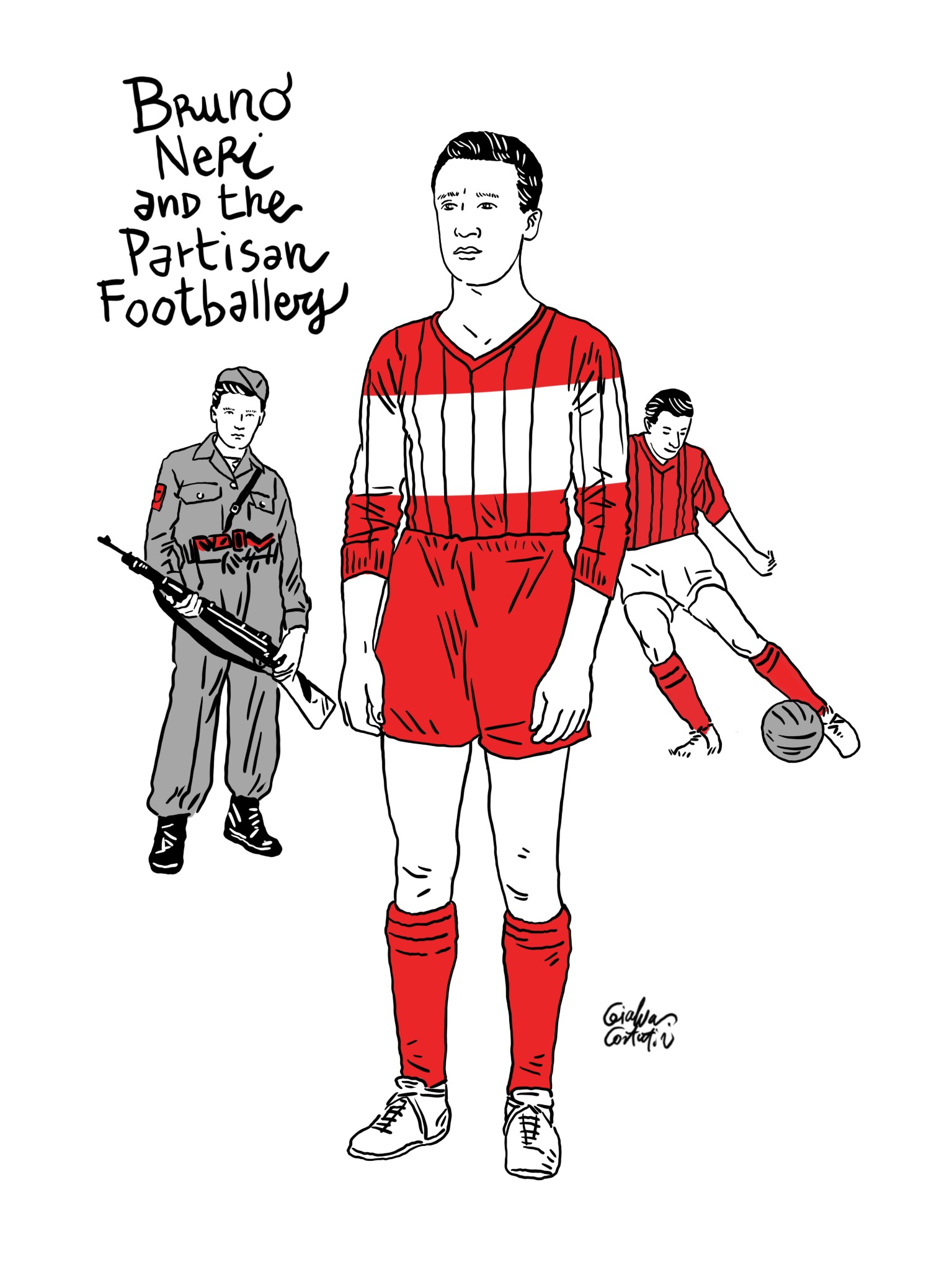
Costantini gives Neri three bodies: the player standing still, the partisan carrying a rifle and the footballer in motion. The standing player is the largest figure. His lowered hands make the gesture visible even though the rest of the 1931 lineup is absent. In Brooklyn, Liberazione took Neri’s name for the Curva Bruno Neri, using the word for a stadium terrace to give that memory a collective home.
France
Rino Della Negra and Red Star FC
Della Negra grew up in Argenteuil, in a family of Italian origin. He belonged to a generation of young workers whose lives moved between the factory, neighbourhood clubs and the football pitch. His signing for Red Star, based in working-class Saint-Ouen, tied that local story to a club with a following beyond his own neighbourhood. Under occupation, a demand that he leave for compulsory labour in Germany brought a different choice.
The FTP-MOI brought immigrant fighters into the French Resistance. Della Negra was captured in 1943 and executed with fellow members of the Manouchian group in February 1944. He was twenty. In his last letter he asked his brother to pass on his goodbye to everyone at the club. The club returned to Mont-Valérien in 2024 when the group was honoured, and Della Negra’s portrait was displayed in the memorial crypt alongside those of his comrades.
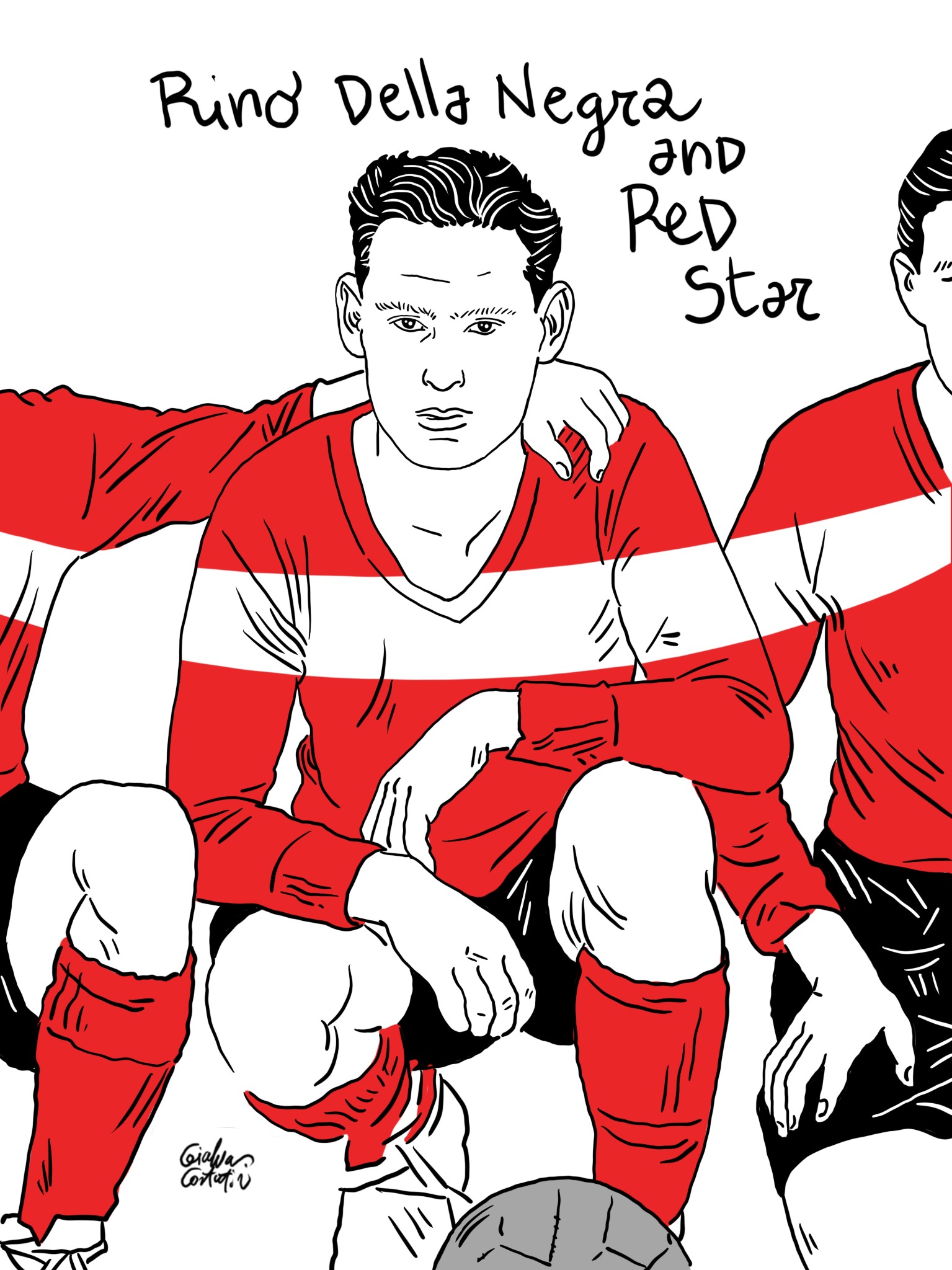
In the drawing, a teammate’s hand rests on Della Negra’s shoulder. Other players are cut off at the edges, as if the image extended beyond the paper. The composition reads as a team photograph, placing the young man among the people he asked to be remembered to. The story remains visible to supporters at Stade Bauer, where a stand carries his name.
Algeria
Rachid Mekhloufi and the FLN team
Born in Sétif in 1936, Mekhloufi joined Saint-Étienne in 1954 and helped the club win the French league in 1957. He had already played for France when he became one of the professionals who left in 1958, shortly before the World Cup in Sweden. The decision meant giving up an established place in French football while the outcome of the war in Algeria was still uncertain.
The departing footballers assembled in Tunis, where the FLN team became a public representative of the independence movement. Without FIFA recognition, it relied on invitations and played outside the established international competition system. Its tours gave audiences a chance to encounter an Algerian team before Algeria had an independent national federation. Every lineup and fixture announced a country that had yet to gain independence.
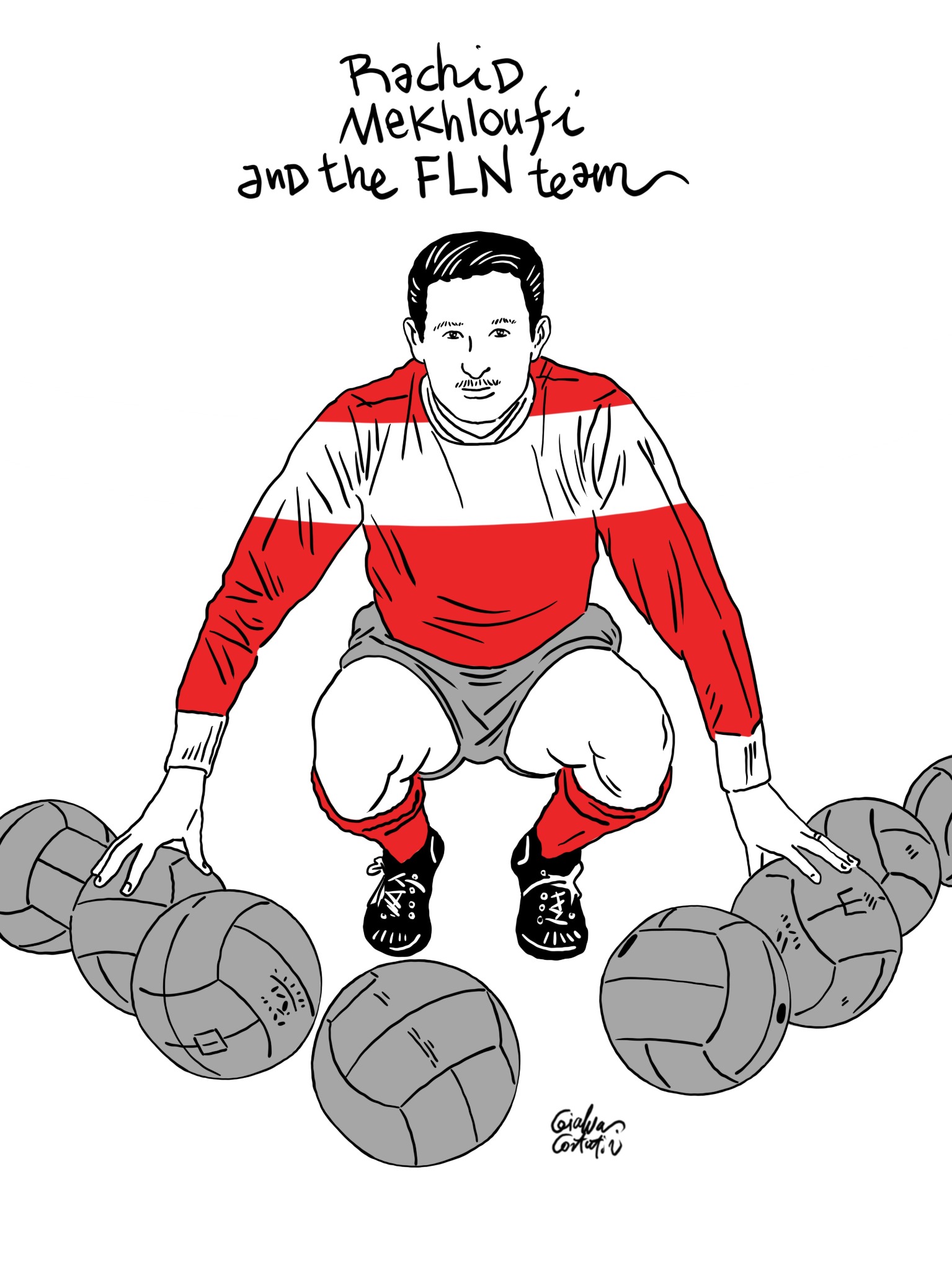
After independence in 1962, Mekhloufi returned to Saint-Étienne, won further titles and later coached Algeria. In the drawing, he crouches behind several footballs, facing the viewer. The pose keeps the emphasis on his trade as a player. The words above him supply the political context and put the FLN team alongside his individual name. The Algerian Ministry of Sports remembered both careers when he died in November 2024, aged eighty-eight.
Chile
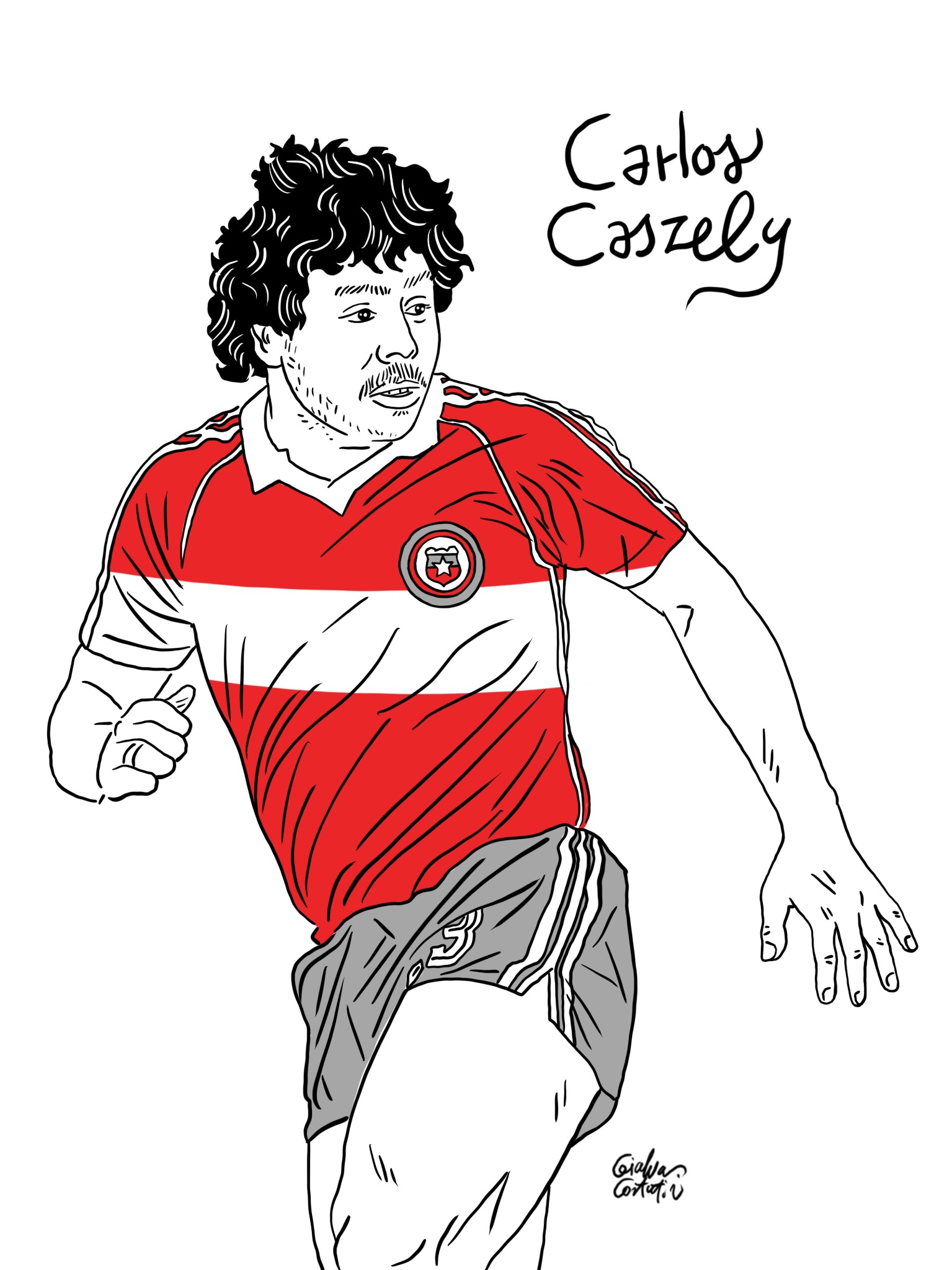
Carlos Caszely
Caszely was a star of the Colo-Colo side that reached the final of the 1973 Copa Libertadores. In a later interview, he remembered the Estadio Nacional through two experiences: the joy of playing there and the pain of knowing people who were held there after the coup. The same ground that drew a huge crowd for a club match became a place of detention within months.
The scheduled qualifier against the Soviet Union gave that change an international audience. The Soviet team asked for a different venue and stayed away when the match remained in Santiago. A Chilean goal without opposition turned the appearance of a football match into part of the story. Caszely’s decision to withhold a handshake from Pinochet, before the next year’s World Cup, was another moment when an ordinary sporting ritual became politically legible.
The 1988 plebiscite asked Chileans whether to extend Pinochet’s rule. The campaign brought his mother’s testimony into Chilean homes, and voters ultimately rejected the extension. Olga Garrido described what she had suffered in detention. Caszely appeared with her and identified himself as her son, lending a familiar public face to an account that was hers to tell. In Costantini’s portrait, he wears Chile’s shirt while running. That choice brings the story back to the relationship between representing a country and speaking about what its government had done.
Brazil
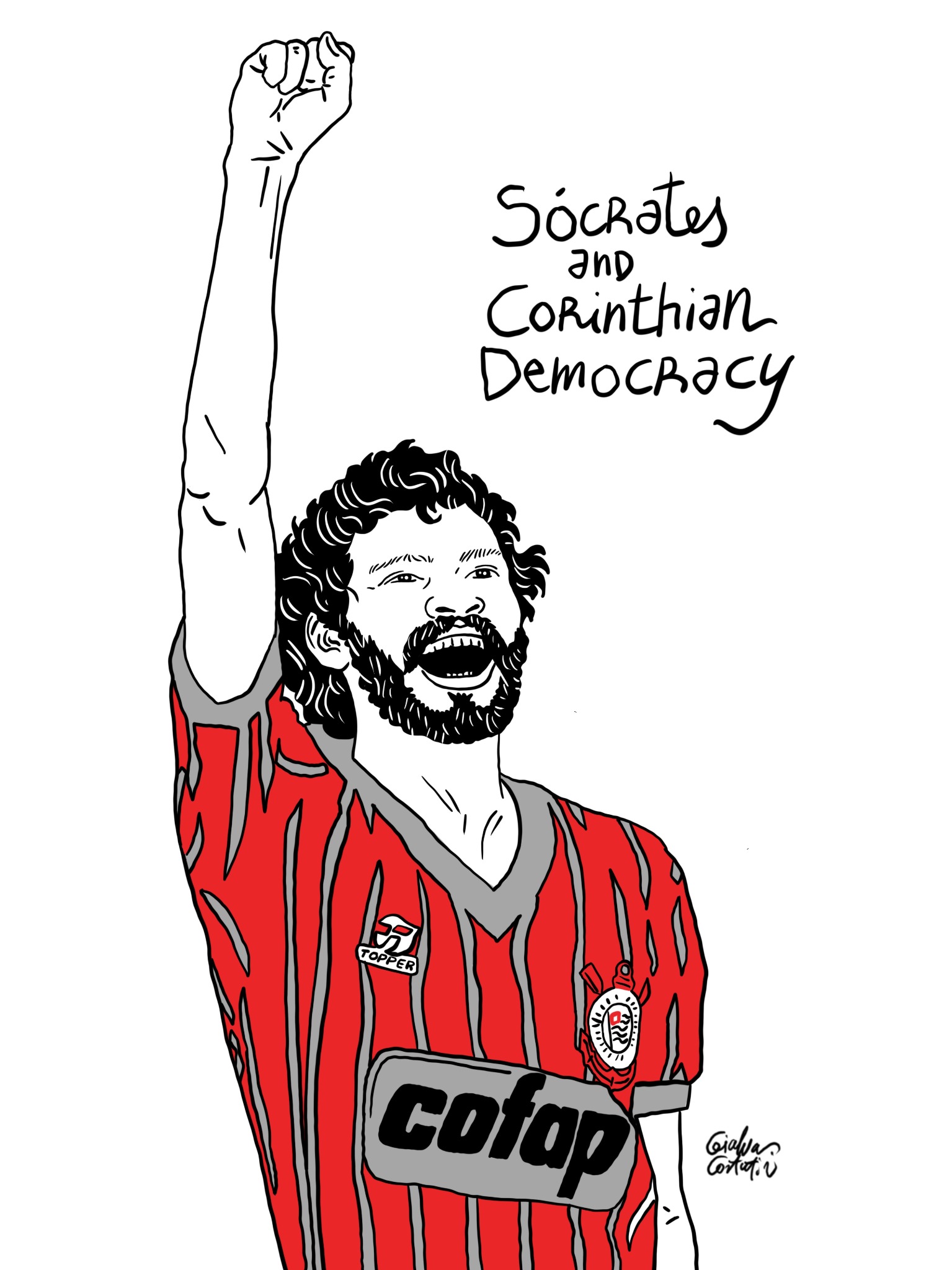
Sócrates and Democracia Corinthiana
The experiment at Corinthians took shape during Brazil’s transition away from military rule. Inside the club it concerned the daily exercise of authority: who decided how the squad prepared, how it travelled and when players had to report for pre-match confinement. The vote extended to staff who normally had little say in decisions. Inside an institution accustomed to taking orders, the practical details were a large part of the point.
In 1982, the players used the backs of their shirts to urge people to vote on the fifteenth of November. In the following year they carried a banner onto the pitch at the São Paulo state championship final declaring their commitment to democracy whether they won or lost. Sócrates also lent his visibility to Diretas Já, the mass campaign for direct presidential elections. When the proposed amendment failed in 1984, he went to play in Italy.
Costantini draws Sócrates in his club shirt with a raised fist. The composition gives one player the centre of the page, while the story behind him includes Wladimir, Casagrande, Zenon, club staff and supporters. The zine traces that history into the terraces through Gaviões da Fiel, a supporters’ association founded under the dictatorship and willing to use its public presence to defend electoral democracy decades later.
UNESP research on Democracia Corinthiana · Universidade Federal Fluminense
Germany
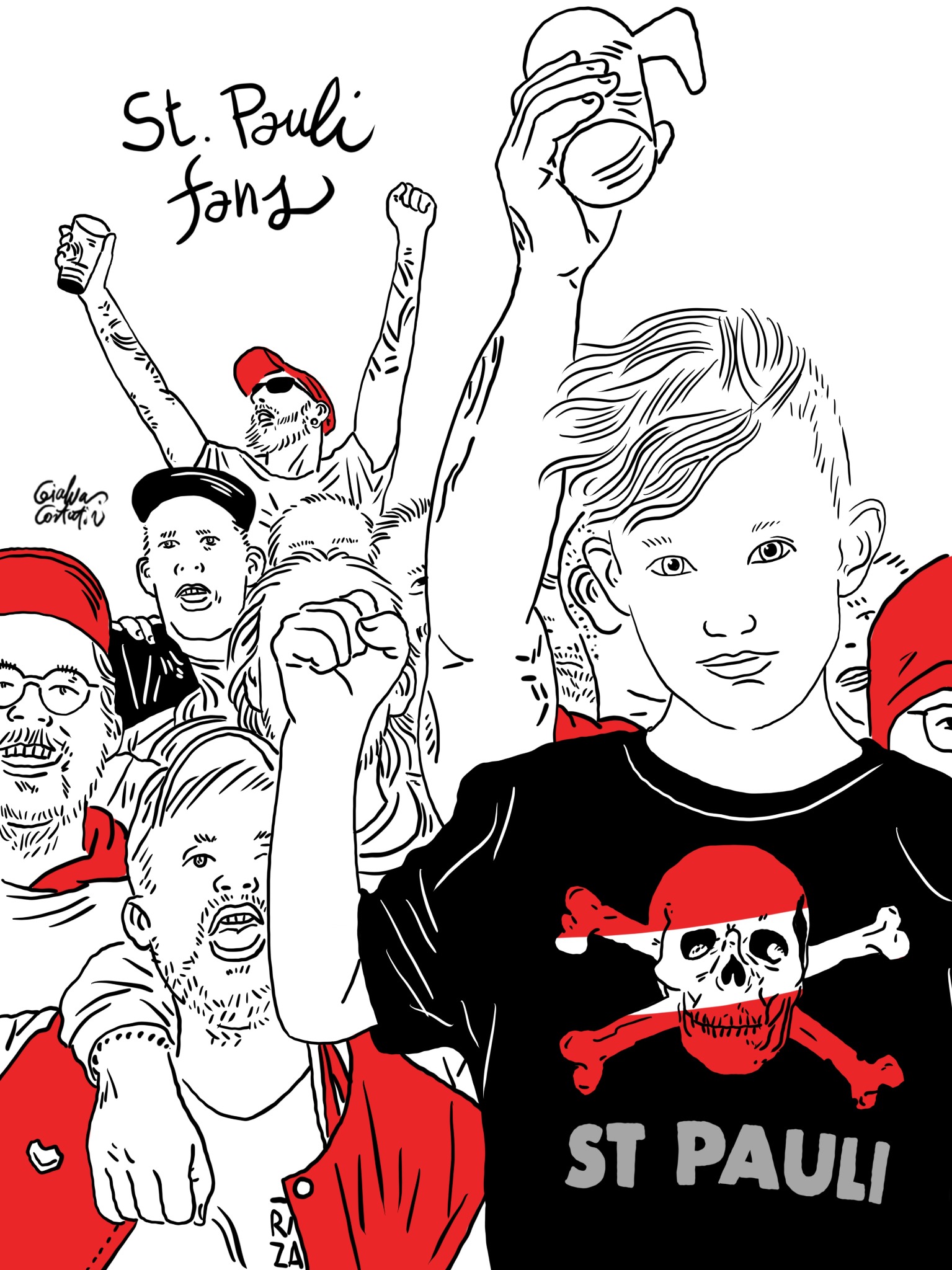
FC St. Pauli supporters
The FC St. Pauli Museum traces the skull and crossbones to two related strands of neighbourhood history. Around 1986, a Hafenstraße resident known as Doc Mabuse brought a pirate flag from the local fair to the Millerntor on a broomstick. The flag took hold on the Gegengerade, the long stand opposite the main stand. Around the same time, screen printer Steph Braun created another skull design for a neighbourhood shirt.
The independent Fanladen, founded by supporters in 1990, helped circulate Braun’s design. As people began to associate the shirt and the flags with the same football community, the skull acquired a life beyond either object. The club adopted the trademark at the end of the decade. By then the image had moved from the street into the stands and from the stands into the club’s public identity.
The zine follows the political side of that relationship, from supporters pressing for action against racist and neo-Nazi displays to refugee football and disagreements over Palestine solidarity. Costantini’s drawing places the skull on a child’s shirt amid a crowd of raised arms. It also shows a cup held high in the foreground. The view from among the spectators keeps the emphasis on the people who made the symbol a part of football culture.
Egypt
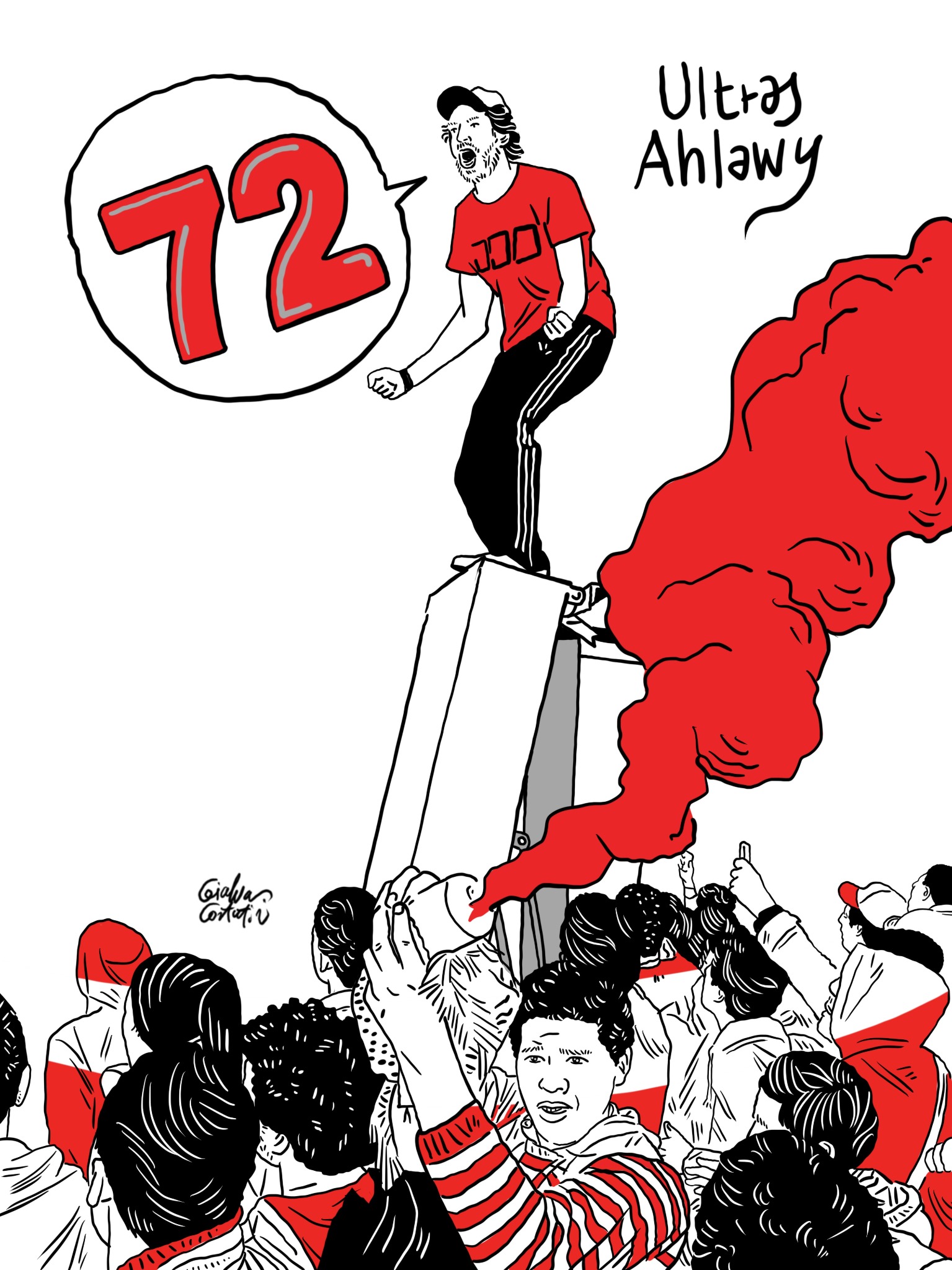
Ultras Ahlawy
The ultras grew up under the long presidency of Hosni Mubarak, when the stands offered young people an unusual space to gather in large numbers. They learned to coordinate chants and banners and to act together in encounters with police. In 2011, members from opposing Cairo clubs carried that experience into demonstrations. The people who found themselves on the same side in Tahrir Square were accustomed to facing each other across a football ground.
The disaster in Port Said followed a league match between Al-Masry and Al Ahly on February 1, 2012. Seventy-two Al Ahly fans died. Many supporters believed the security failures were linked to a desire for revenge for their role in the uprising. The group’s subsequent demonstrations demanded justice for the dead, and the anniversary became an important date in the supporters’ own calendar. Ultras Ahlawy announced its dissolution in 2018, after years of restrictions and arrests.
The number 72 dominates the drawing. Costantini puts it in a speech balloon above a crowd, giving a count the force of something shouted aloud. Red smoke moves across the image while spectators look towards the person raising his voice. It is a tribute to the people the supporters lost and a record of the way they kept those losses present in public.
United Kingdom
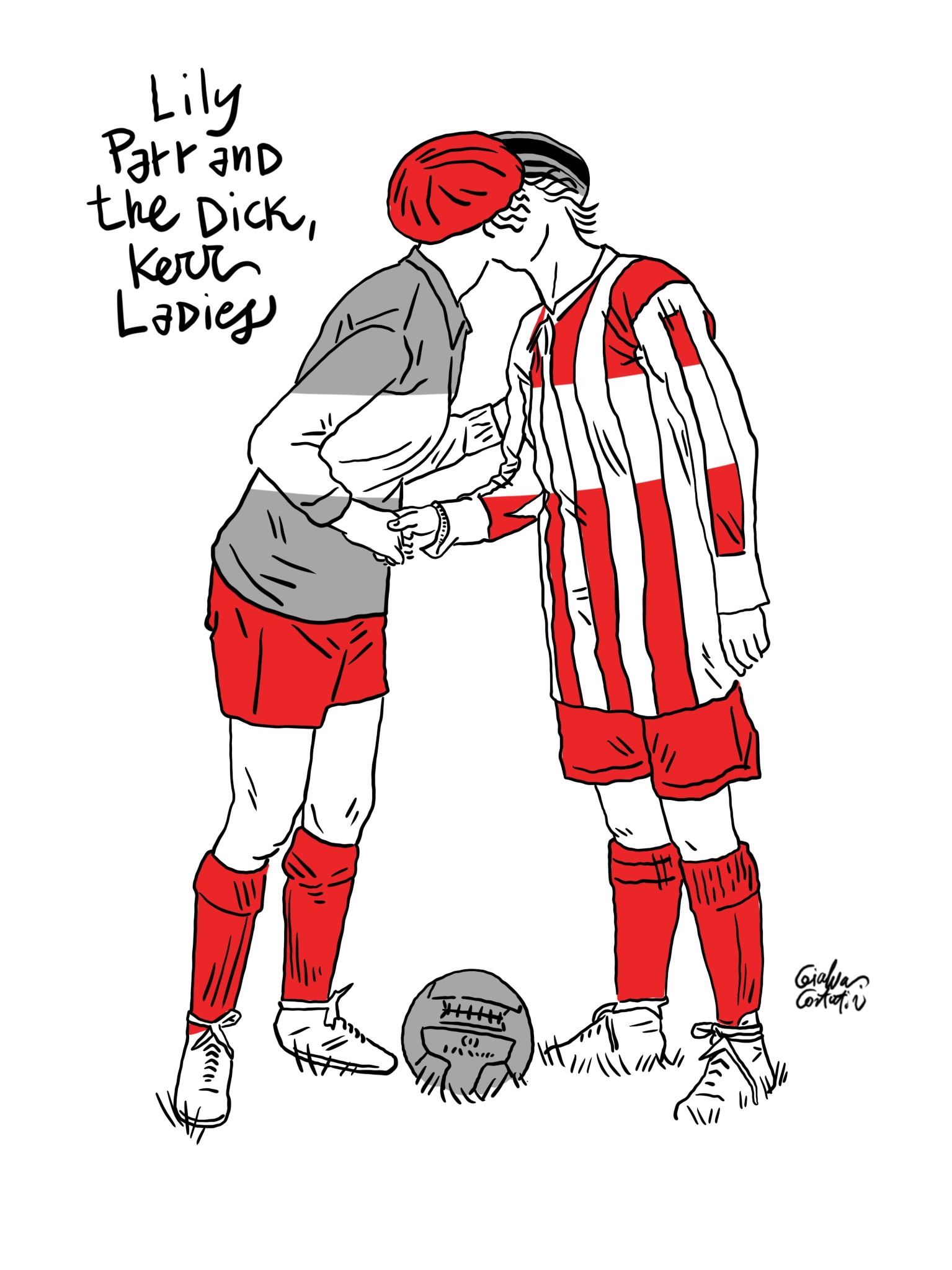
Lily Parr and the Dick, Kerr Ladies
The Dick, Kerr Ladies took their name from the Preston engineering works where women had been employed during the First World War. Playing together at work became the basis for a team whose matches drew thousands and raised money for charity. Parr joined as a teenager and became known for her powerful shooting. The National Football Museum records that by 1921 the side had already played 123 games in front of more than a million spectators.
The Boxing Day match against St Helens Ladies in 1920 brought about 53,000 spectators to Everton’s Goodison Park. Within a year the Football Association had ordered its affiliated clubs to stop making their grounds available for women’s football. The ban stayed in place for until 1971. The team kept playing on grounds it could use, and Parr was still active decades after the FA took its decision.
In later life Parr lived with her partner, Mary. The museum inducted her into its Hall of Fame in 2002 and unveiled a statue in 2019. The exhibition drawing shows two players close together, centred on their faces and joined hands with a football at their feet. The gesture leaves room for intimacy in a story often told through attendance records, prohibitions and goals.
National Football Museum · Lily Parr · National Football Museum · The Lily Parr statue
Afghanistan
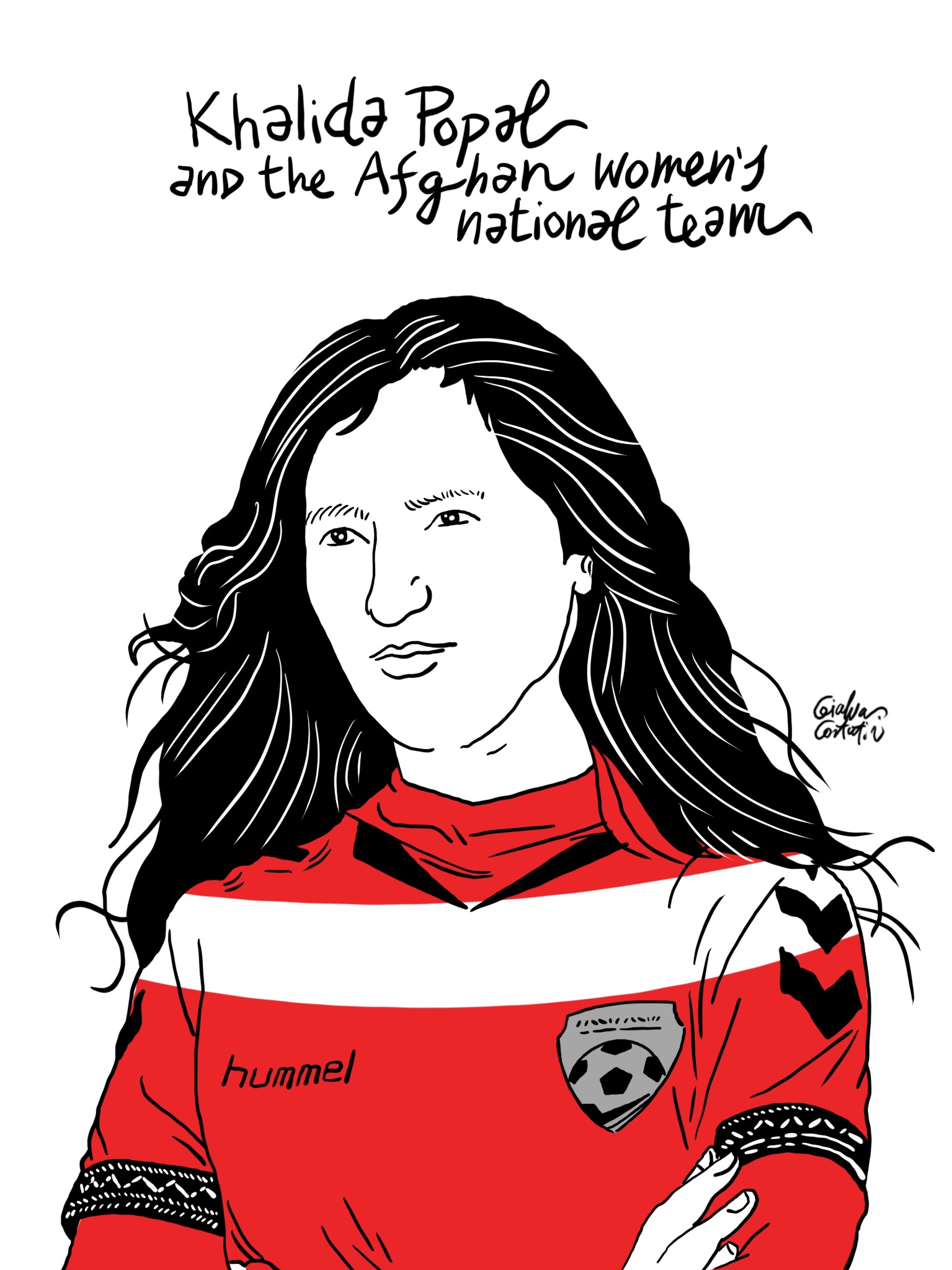
Khalida Popal and the Afghan women’s national team
Popal helped establish the national team in 2007 and became its captain. Finding a place to train meant dealing with pressure on players and their families as well as with the ordinary practical demands of building a team. After threats drove her into exile, she continued the work from Denmark. Her Girl Power Organisation develops sport programmes with particular attention to women and girls from refugee and minority communities.
The Taliban’s return in August 2021 made the immediate question one of safety. Popal helped coordinate the evacuation of national players, members of youth teams and relatives. The United Nations credits the wider effort with helping more than six hundred people at risk. Exile scattered the players across different countries, creating a second problem: how could they stay together as a national side and play under Afghanistan’s name?
In April 2026 FIFA amended its governance rules to allow a representative team to be recognised in exceptional circumstances. The decision opened a path to official international competition for Afghan women, including players in Afghan Women United. Costantini gives Popal a direct, steady gaze and a recognisable national-team shirt. In a story shaped by displacement, those details put the right to belong to and represent a team at the centre of the portrait.
United Nations · Khalida Popal · FIFA · April 2026 governance reform
United States
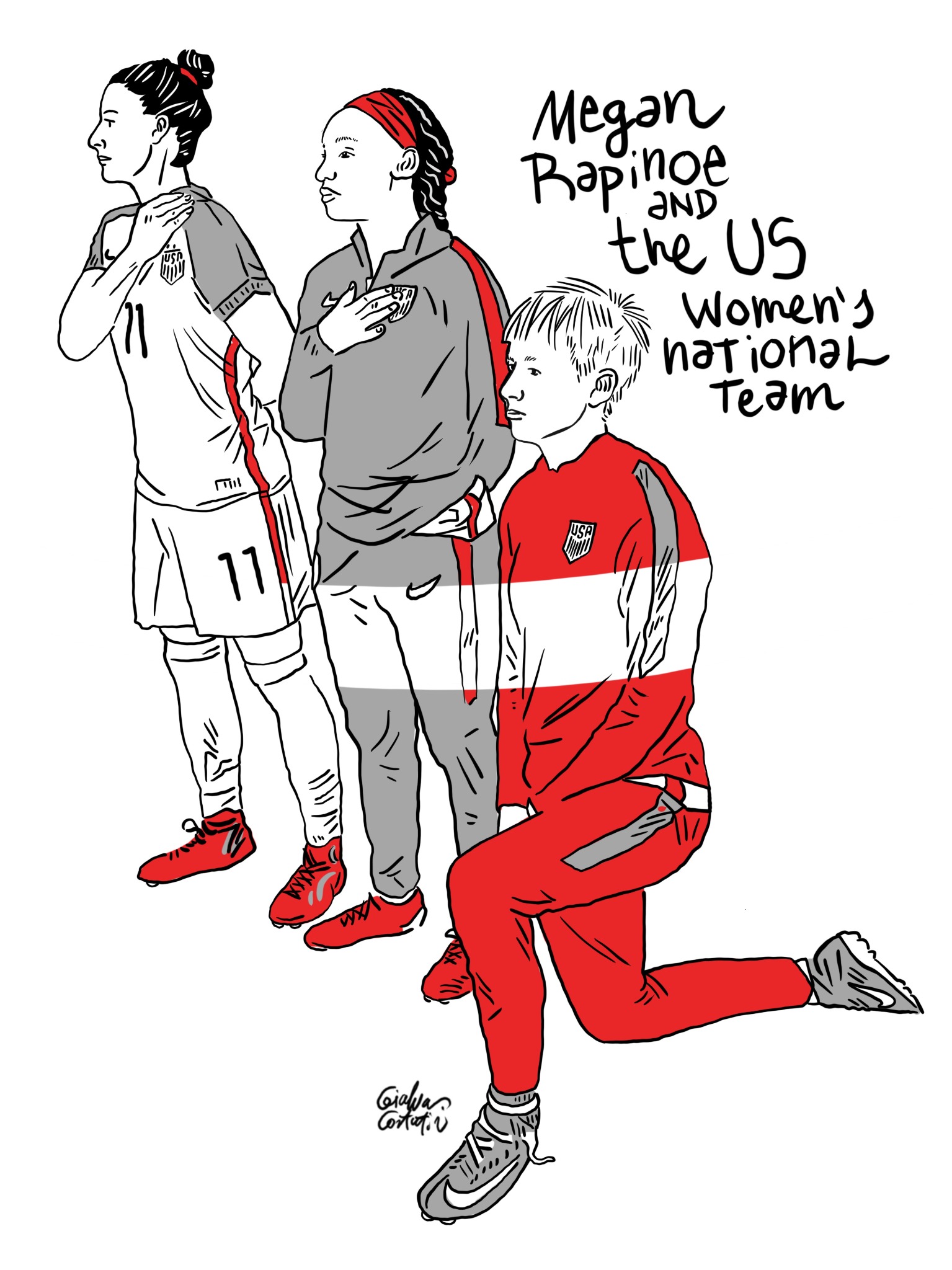
Megan Rapinoe and the US women’s national team
Five national-team players brought an equal-pay complaint in 2016. Three years later, the players sued their federation. When the United States won the 2019 World Cup in Lyon, spectators made the dispute audible with chants for equal pay. The campaign exposed how fees, bonuses and tournament prize money could yield different outcomes even when women were winning at the highest level.
The settlement reached in 2022 provided compensation and was followed by collective bargaining agreements covering the two senior national teams. The new arrangements applied equal pay terms and created a system for sharing World Cup prize money. The result came through the work of the players as a group and through negotiations over the contracts that would govern future teams.
Costantini depicts a different protest in the same shirt. In September 2016, Rapinoe knelt during the national anthem in solidarity with Colin Kaepernick, who was protesting racial injustice and police violence. She did so with her club and later with the national team, including before a match against the Netherlands. In the drawing, two teammates stand while Rapinoe is down on one knee. The difference in posture gives a quiet action its force and recalls how much attention a player can draw before a ball is kicked.
Equal-pay settlement filed in federal court · WBUR / NPR · Interview with Megan Rapinoe
Italy
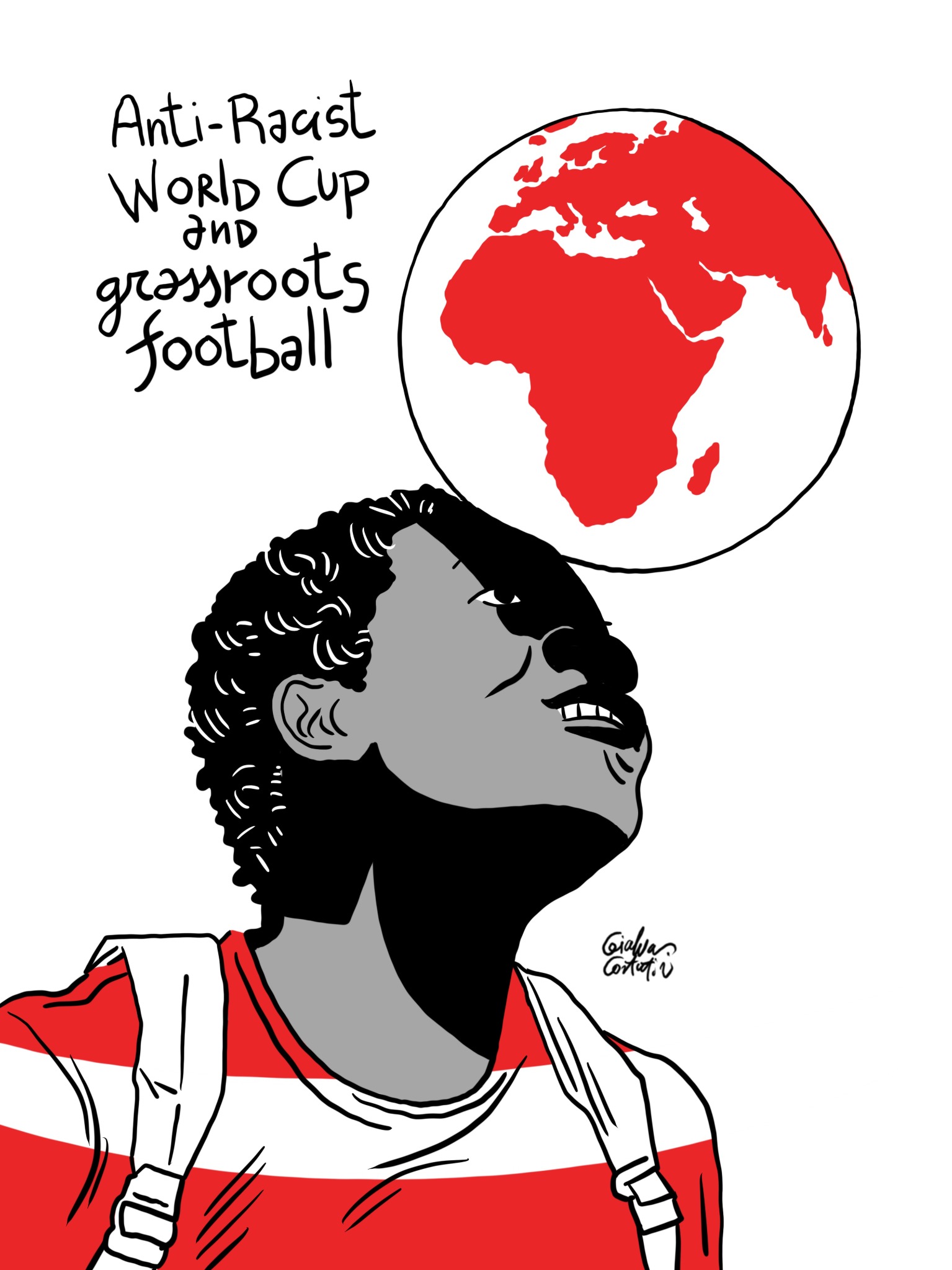
Mondiali Antirazzisti and grassroots football
The first Mondiali Antirazzisti took place in 1997. Progetto Ultrà and UISP worked with Istoreco, the historical institute for the Resistance in Reggio Emilia, to put organised supporters and migrant communities in the same event. The participants could play football, camp, listen to music and join discussions together. The decision to make the tournament non-competitive helped make those encounters as important as the score.
The grassroots clubs in the zine show what that idea can mean beyond a festival. In Turin, Paco Rigore reclaimed an abandoned public facility and made it available for neighbourhood sport. In Milan, St. Ambroeus was built with refugees and put anti-racist and anti-fascist commitments into its statutes. These are local projects with their own histories. What connects them to the tournament is the work of creating places where people can decide together how they want to play.
In the drawing, a world map takes the place of the ball, suspended above a player in a red shirt. The image makes the connection between a game played locally and the routes by which people arrive on the same pitch. The exhibition’s Curva Bruno Neri carries that idea into the stands, where a community can also organise around the kind of football it wants to see.
UISP · History of the Mondiali Antirazzisti · Italian Ministry of Labour · Integration practices
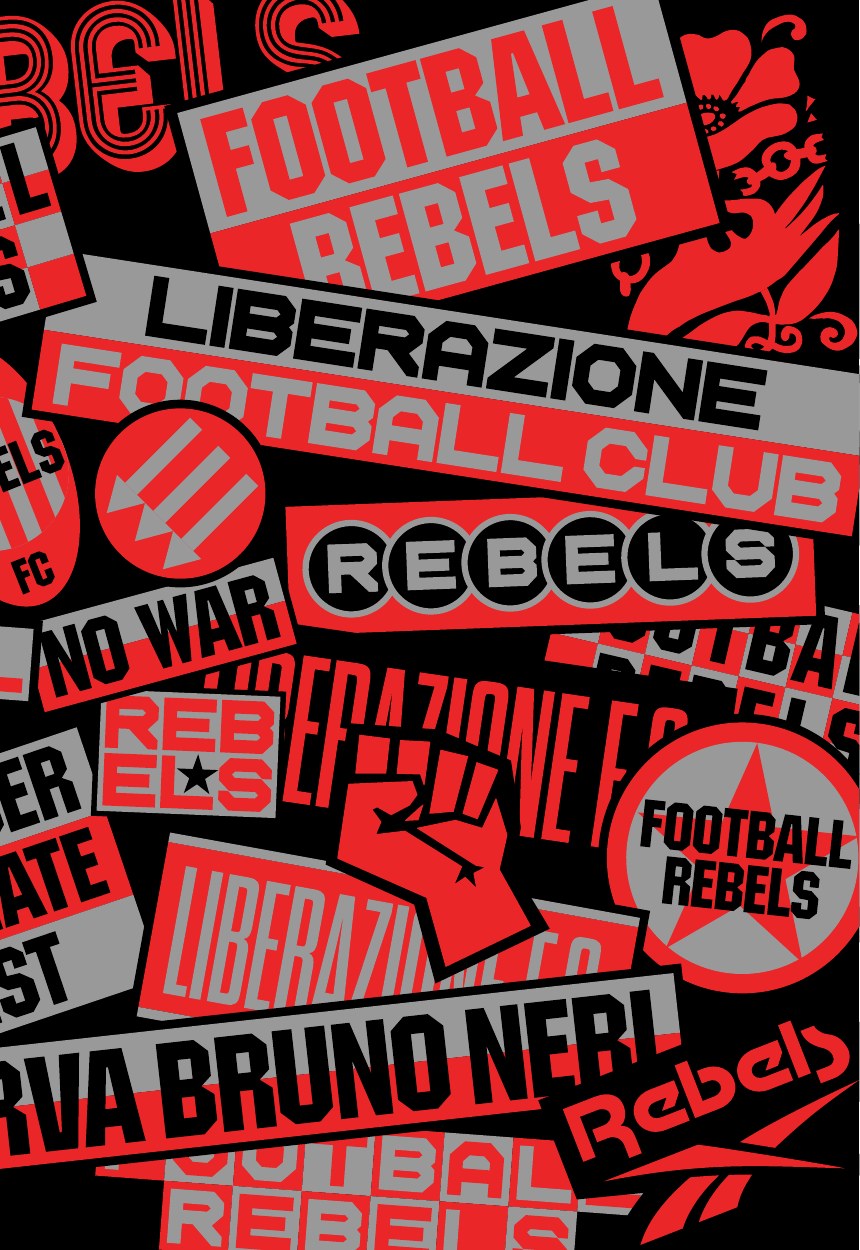
The publication
The exhibition zine
In 1931, as his Fiorentina teammates raised their arms in the Fascist salute, Bruno Neri kept his hands at his sides. Decades later, in São Paulo, Sócrates and his Corinthians teammates brought democracy into the dressing room by voting on how the club was run. The Football Rebels zine puts these gestures side by side, tracing what happens when players and supporters challenge the rules imposed on them.
Across eleven stories, the focus moves from the pitch to the terraces and back again. Lily Parr and the Dick, Kerr Ladies drew crowds of tens of thousands before the Football Association barred women’s teams from its affiliated grounds. Khalida Popal’s story follows the Afghan women’s national team into exile and through its fight to compete again. In Cairo, the figure 72 in the Ultras Ahlawy poster carries the memory of Al Ahly supporters killed at Port Said.
Produced for the Brooklyn exhibition, the zine pairs Gianluca Costantini’s illustrations with original texts by Iuri Moscardi and Yuri Serafini. It opens with Neri, the footballer and partisan whose name Liberazione gave to the Curva Bruno Neri.
The organisers
Liberazione
Liberazione is a New York collective founded by Italian immigrants. Its April 25 festival brings Italy’s Liberation Day to New York as a public occasion to remember the Resistance and ask what that history means today.
At the 2026 festival, political theorist Nadia Urbinati and historian Silvana Patriarca spoke about the partisans, the people who took part in the Resistance and the principles that informed Italy’s republican constitution. Julissa Bisono of Make the Road New York connected those questions to organising in the city today. Iuri Moscardi moderated the discussion, and an evening of music raised funds for Make the Road New York.
For Football Rebels, Liberazione took that conversation into football culture with Secret Futebol Club. The Brooklyn event brought together eleven illustrated stories of resistance and launched the Curva Bruno Neri, an antifascist supporters’ group named for the Fiorentina player who refused the Fascist salute and later joined the partisans.


The Brooklyn hosts
Secret Futebol Club
Secret Futebol Club grew out of pickup football in New York. Since 2011, Ricardo Carlota and Austin Costeira have built a network that spreads by word of mouth and meets for free, community-organised games in Brooklyn.
At its East Williamsburg studio on Meadow Street, the club brings the people who play together into other kinds of projects. Secret Radio broadcasts from the studio and gives musicians and DJs a place to share their work. The space also hosts workshops, exhibitions and screenings, drawing on the skills of people in the same football community.
That studio hosted Football Rebels on November 21, 2026, when Secret Futebol Club and Liberazione brought the eleven posters and their stories to Brooklyn.
Explore the Secret Futebol Club community · Read the Brooklyn Magazine profile


Photos from the Secret Futebol Club community archive.
Exhibition credits
- Project and curation
- Liberazione · Gabriele Audasso, Irene Bissoli, Suna Bonometti, Simone Garibaldi, Marco Grasso, Enrico Grosso, Mario Lenoci, Iuri Moscardi, Vittorio Perotti, Yuri Serafini and Simone Zbudil Bonatti
- Creative direction
- Vittorio Perotti
- Zine texts
- Iuri Moscardi and Yuri Serafini. The descriptions above are adapted from the exhibition zine.
- Panel illustrations
- Gianluca Costantini
- Exhibition poster illustration
- Enrico Grosso
- In collaboration with
- Secret Futebol Club and Ricardo Carlota