The arrest of a local reporter under Turkey’s disinformation law shows how vague legislation can turn an editorial decision into a criminal case
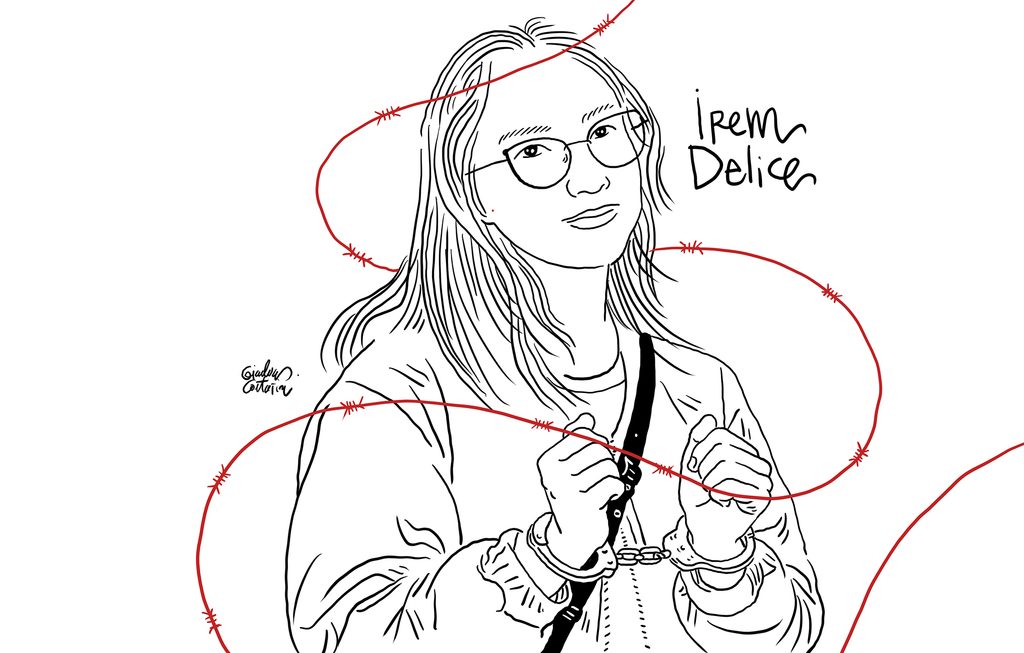
Turkish journalist İrem Delice, a reporter for the local news outlet Aydın Denge, was jailed on August 29, 2026, on suspicion of “publicly spreading disinformation.” Her case began with something seemingly ordinary: a local news report announcing the death of a woman named Gülşen Erdoğan.
The headline read: “Erdoğan passed away.”
The woman had no connection to Turkish President Recep Tayyip Erdoğan. She simply shared his surname.
On August 26, Turkish police detained Delice along with three other members of Aydın Denge: publisher Emin Aydın, responsible news editor Yeşim Ülker, and reporter İslam Keleş. Authorities opened an investigation under Article 217/A of the Turkish Penal Code, arguing that the headline could amount to publicly disseminating misleading information because readers might associate the surname Erdoğan with the president. The four journalists were initially released under judicial supervision. After prosecutors appealed the decision, however, Delice — who had written the report — was sent to prison on August 29.
The newspaper has rejected the suggestion that it intended to deceive its readers. Publisher Emin Aydın described the article as a routine local death report and acknowledged that a headline or accompanying image can be misunderstood, while insisting that an editorial choice cannot by itself establish criminal intent. At the time the Committee to Protect Journalists reported on the case, it remained unclear whether the investigation would lead to a trial.
The Committee to Protect Journalists (CPJ) has called for Delice’s immediate release and for Turkey to repeal the legislation under which she is being held. CPJ’s Turkey representative Özgür Öğret said that the authorities were once again using a vague law to criminalize journalism and deprive a journalist of her freedom.
The case goes far beyond a single headline.

Article 217/A was introduced in 2022 as part of Turkey’s so-called disinformation legislation. It provides prison sentences of up to three years for publicly disseminating false information concerning matters including security, public order and public health when the information is deemed capable of causing fear, anxiety or panic. Press freedom organizations warned from the beginning that the broad wording of the provision could allow legitimate reporting to be treated as a criminal offence. According to figures cited by CPJ, since the law came into force at least 83 journalists have faced 114 charges related to alleged disinformation.
Delice’s arrest is therefore not an isolated episode. In May 2026, CPJ reported the arrest of Yelis Ayaz, publisher and editor-in-chief of the local newspaper Aydınpost, also on suspicion of spreading disinformation. In July, CPJ and 26 other press freedom and human rights organizations condemned the detention and arrest of at least 11 journalists in Turkey in the weeks preceding the NATO summit in Ankara.
For years, Turkey has used an expanding combination of criminal law, anti-terror legislation, internet regulation and judicial orders against journalists, media organizations, activists and critical voices.
It is a history that also intersects directly with ChannelDraw.
In 2016, during the repression that followed the attempted coup, Turkish authorities included Gianluca Costantini and his online work in a court order seeking to block Twitter accounts, websites and digital content accused of promoting terrorism or threatening public order. A political drawing had effectively become evidence of an alleged security threat. Twitter did not comply with the request concerning Costantini’s account, but the ChannelDraw blog remained blocked in Turkey. Ten years later, ChannelDraw reconstructed that story in “Ten Years Later: When a Drawing Became ‘Terrorism’”, examining how digital censorship has become embedded in the country’s system of political control.

Related book
L’ammaestratore di Istanbul
A graphic biography by Elettra Stamboulis and Gianluca Costantini about Osman Hamdi Bey—painter, archaeologist and founder of Istanbul’s modern museum institutions—and the relationship between art, cultural identity and political power.
The repression has repeatedly targeted journalists in particular. In 2022, ChannelDraw documented the detention of 21 journalists in Diyarbakır in “Freedom for Dicle Fırat Journalists”, part of a much broader pattern of investigations, prosecutions, intimidation and censorship directed at independent media.
The İrem Delice case illustrates how this system can operate at its most basic level. There was no investigative exposé involving state secrets, no leak of confidential documents and no accusation of violence. There was a local newspaper, the death of a woman named Erdoğan and a headline whose ambiguity was enough to trigger a criminal investigation.
Whether an editorial decision was careless or open to misunderstanding is a question that can be debated within journalism. Turning that decision into grounds for imprisonment is something entirely different.
When laws designed to fight “disinformation” are written broadly enough to transform an ambiguous headline into a criminal offence, they do more than punish one journalist. They create uncertainty for every reporter and editor deciding what can safely be written, published or shared.
And censorship does not always need to remove a story after publication. Sometimes it is most effective when journalists begin wondering, before publishing, whether the next headline could put them in prison.
Sources
- Committee to Protect Journalists — Journalist İrem Delice arrested in Turkey on suspicion of “spreading disinformation”, September 2, 2026.
- Committee to Protect Journalists — İrem Delice, journalist profile and case record.
- Committee to Protect Journalists — Turkey archive, including recent cases involving the use of disinformation legislation and arrests of journalists.


CHANNELDRAW STUDIO · INDEPENDENT PUBLISHING
Active Art Yearbook
A year of drawings, stories and civic engagement. Discover the Channeldraw annual volumes.
Explore the yearbooks →ChannelDraw is independent and reader-supported. Your support helps us continue documenting artists, journalists and activists whose voices are threatened or censored.
Other ways to support ChannelDraw
You can also support our independent work by joining us on Patreon or Substack, or b


