Visual reporting in immigration courts and on the streets
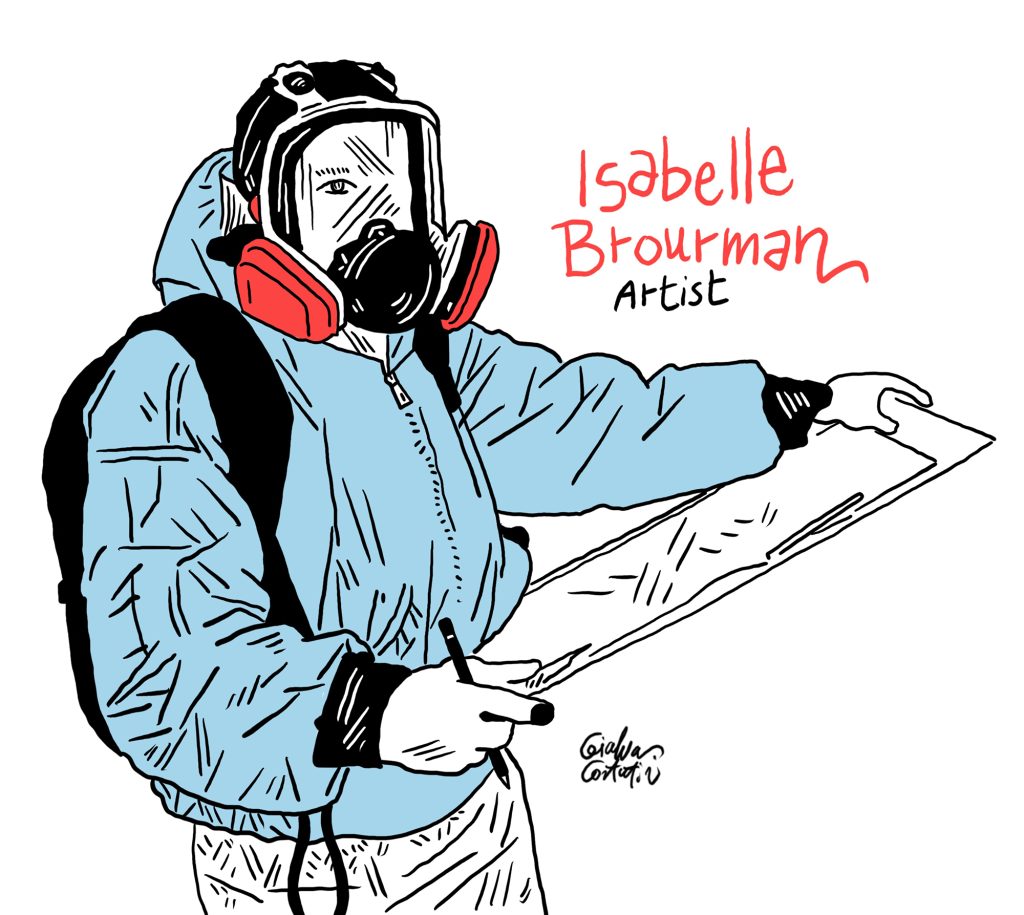
Isabelle Brourman is an American artist and illustrator who uses drawing as a form of direct witnessing, working in places where visual access is restricted or tightly controlled. She is best known as a courtroom sketch artist, a role that has allowed her to document high-profile trials in the United States, but in recent years her work has increasingly focused on power, repression, and vulnerability within judicial spaces and on the streets.
In New York, Brourman spent months observing and drawing inside immigration courts, particularly at 26 Federal Plaza. In these spaces, where photography and video recording are prohibited, her sketches often become the only visual record of what takes place. She documented the long waits endured by families, the tension inside courtrooms, and the constant presence of ICE agents in hallways, ready to make arrests immediately after hearings. Her drawings show parents separated from their children, lawyers trying to shield their clients, and moments in which legal procedure abruptly turns into detention.

Photo by Dean Moses – Amny
Brourman has described this work as a turning point in her practice: no longer simply depicting what happens before a judge, but bearing witness to a system that operates in corridors, waiting areas, and moments of uncertainty and fear. Her fast, layered line captures the emotional atmosphere of these spaces, revealing how law and bureaucracy translate into lived experience.
This commitment to being present and drawing in real time also brought her to Minneapolis, where she was observing a protest marked by heavy tension and a strong federal law-enforcement presence. Brourman was not participating in the demonstration; she was sketching what she saw around her. During the confrontation, a federal officer fired a crowd-control round that struck her drawing board. The sketchbook absorbed the impact, preventing far more serious physical harm.
The incident, captured on video and widely shared, quickly became a powerful image: an artist’s tool turned into a shield. It was not just an isolated accident, but a clear indication of the risks faced by those who document protests and state violence, even when they do so with pencil and paper rather than cameras.
Brourman’s work occupies a fragile but essential space between art, journalism, and civic testimony. Her drawings do not aim for detached neutrality; instead, they make visible the tensions, fears, and power imbalances that shape courts and streets alike. What happened in Minneapolis underscored how drawing today can be an act of exposure and danger, and at the same time a way to insist on the right to observe, record, and remember.


