Where is Jesus? David Neuhaus on Gaza and the image of a dead child in his mother’s arms
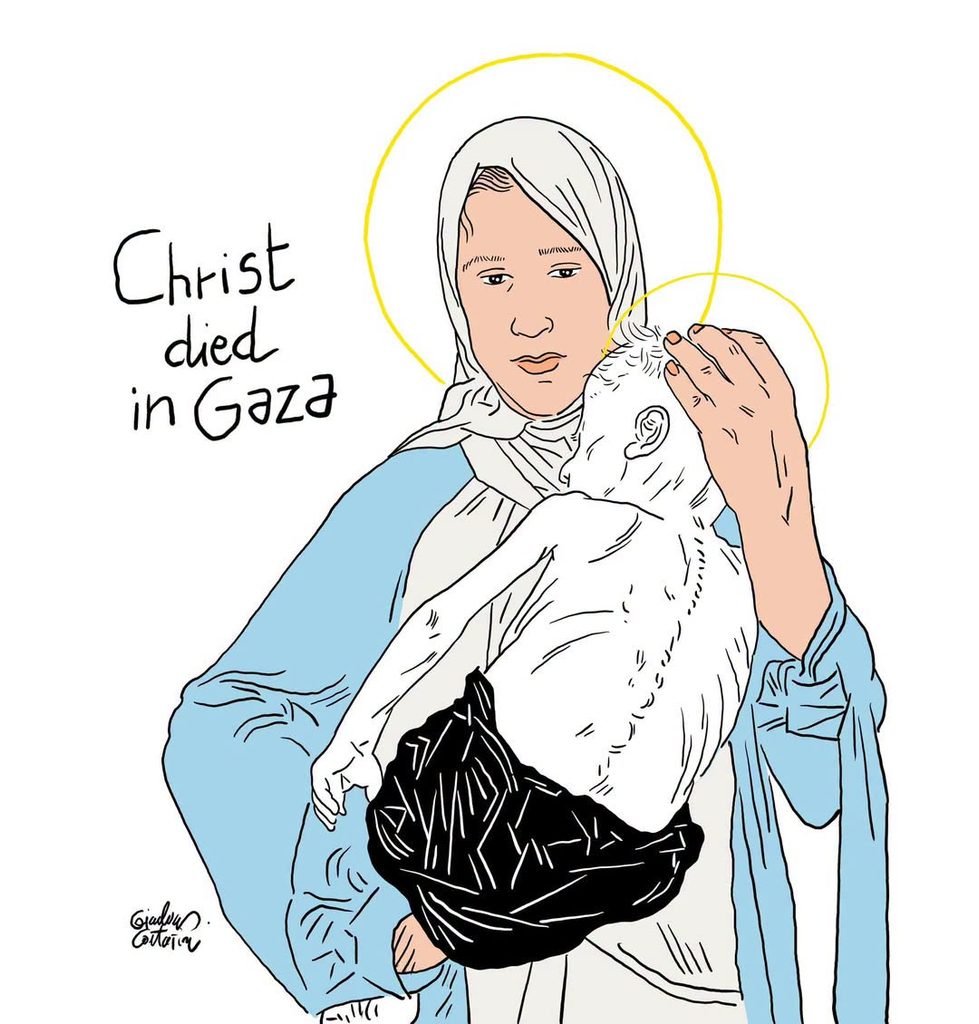
During an online meeting organized by Priests Against Genocide, Jesuit priest David Neuhaus reflected on Gaza, faith and the responsibility to stand with those who suffer. At the center of his words was also a drawing by Gianluca Costantini: a Palestinian mother holding the body of her dead child, transformed into an image of Christ and a contemporary Pietà
“Where is Jesus?”
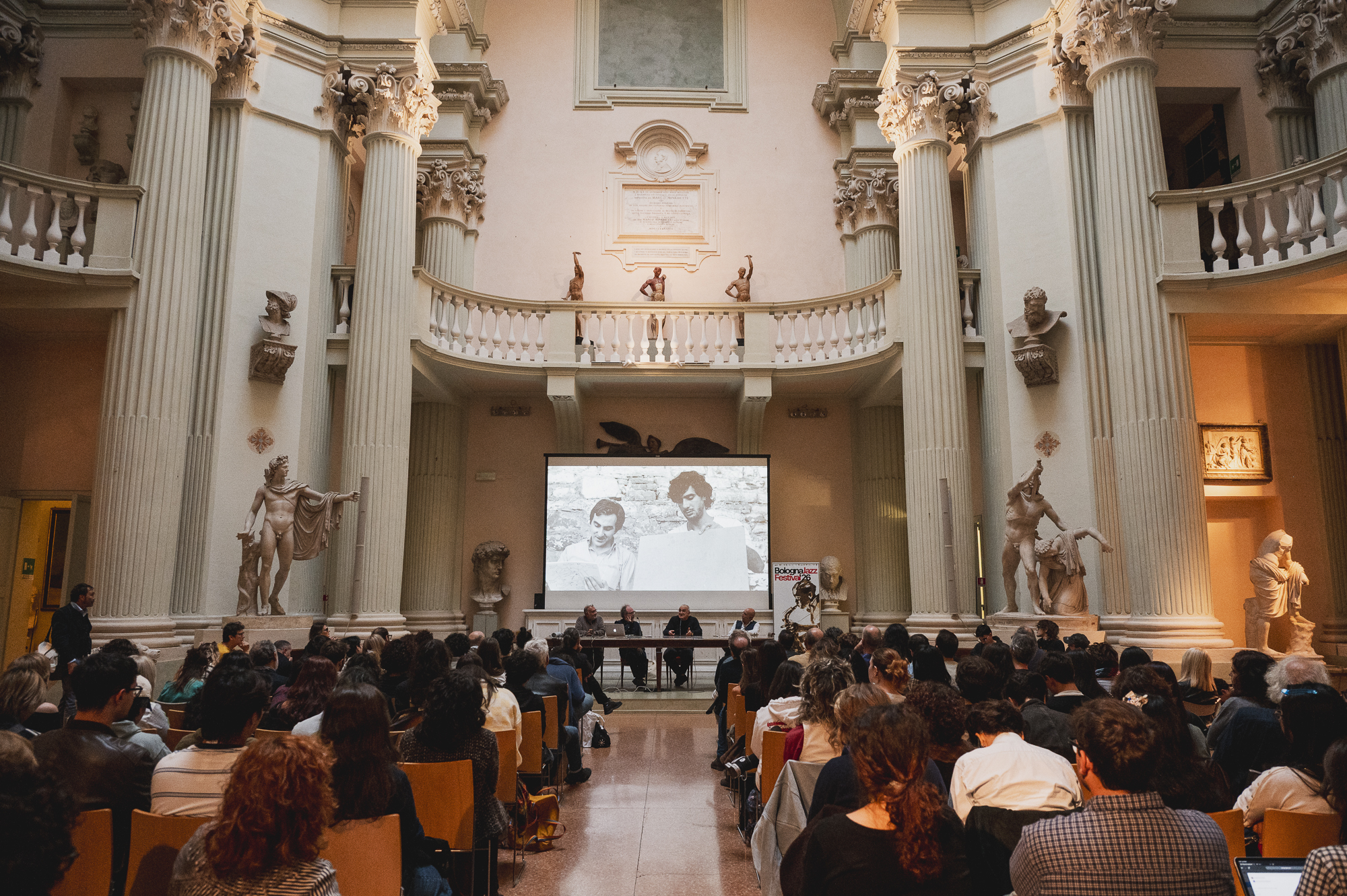
This is the question that Father David Neuhaus SJ placed at the center of his intervention during an online meeting organized by Priests Against Genocide, the international network of Catholic priests, bishops and cardinals created to denounce the destruction of Gaza and to call for justice and peace in Palestine.
The meeting brought together Cardinal Álvaro Ramazzini, Professor Omer Bartov, Dean’s Professor of Holocaust and Genocide Studies at Brown University, and Father David Neuhaus SJ, a South African-born Israeli Jesuit who lives in Jerusalem and has long been engaged in dialogue between Israelis and Palestinians and in reflection on the Christian presence in the Holy Land.
Priests Against Genocide was launched in 2025 by Catholic priests who felt that remaining silent in the face of what was happening in Gaza was no longer possible. Since then, the network has expanded internationally, combining prayer, public testimony and political demands with a commitment to international law and the protection of civilian life.
During the online conversation, Neuhaus returned repeatedly to a fundamental question: what does it mean for a Christian to look at Gaza today?
For him, the answer cannot simply be reduced to choosing between competing nationalisms.
“In other words, we are not preaching a sermon about Palestinian nationalism or Israeli nationalism. What we are preaching is: Where is Jesus?”
It was at this point that Neuhaus referred to a drawing I created for Priests Against Genocide.
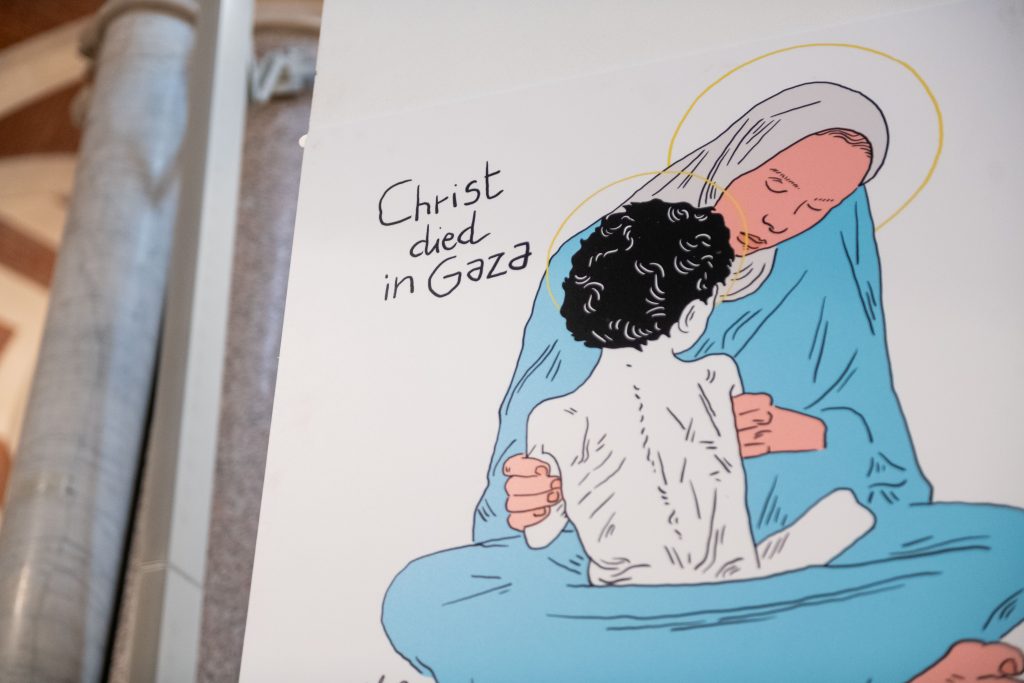
The image shows a Palestinian mother holding the lifeless body of her child in her arms. It is an image rooted in what has happened repeatedly in Gaza, but at the same time it inevitably evokes one of the oldest images in Christian art: the Pietà, Mary holding the dead body of Christ.
Neuhaus described the drawing as an important and “iconic” representation for Priests Against Genocide, reading the child in the mother’s arms explicitly as Jesus:
“I think this iconic representation of Priests Against Genocide is very important, showing Jesus as a dead child held in the arms of his mother in Gaza.”
His words give the image a meaning that goes beyond illustration. The question is no longer simply what the drawing represents, but whom we are able to recognize in the person represented.
For Neuhaus, entering fully into reality means looking for Christ among those who are suffering: among the poor, the persecuted, the hungry and those in prison. It means refusing to transform Gaza into an abstraction, a geopolitical argument or a succession of statistics.
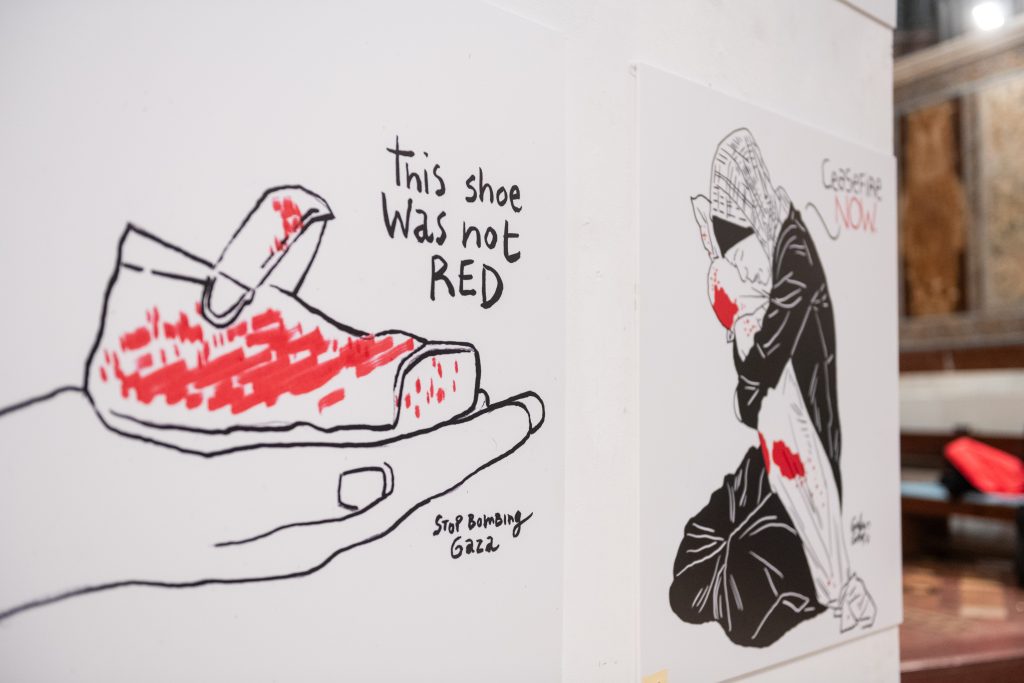
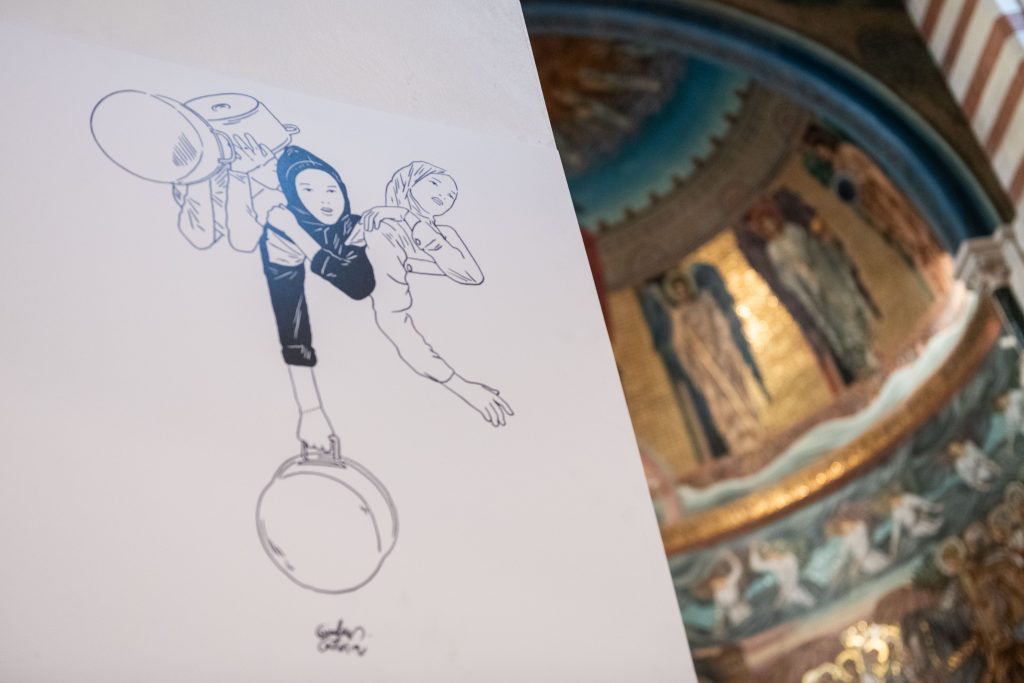
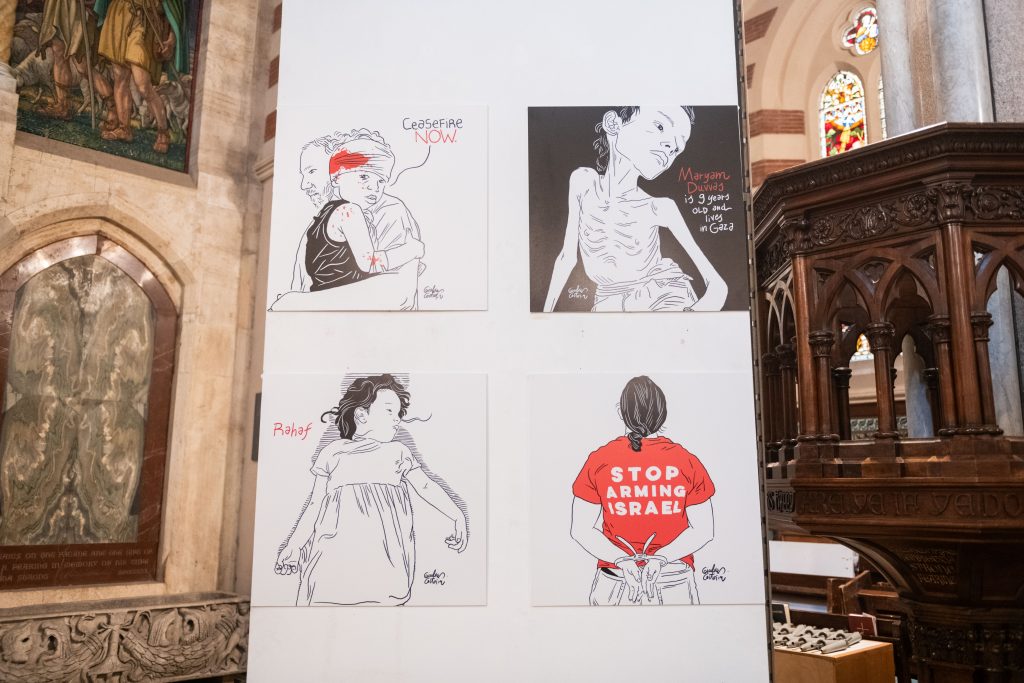
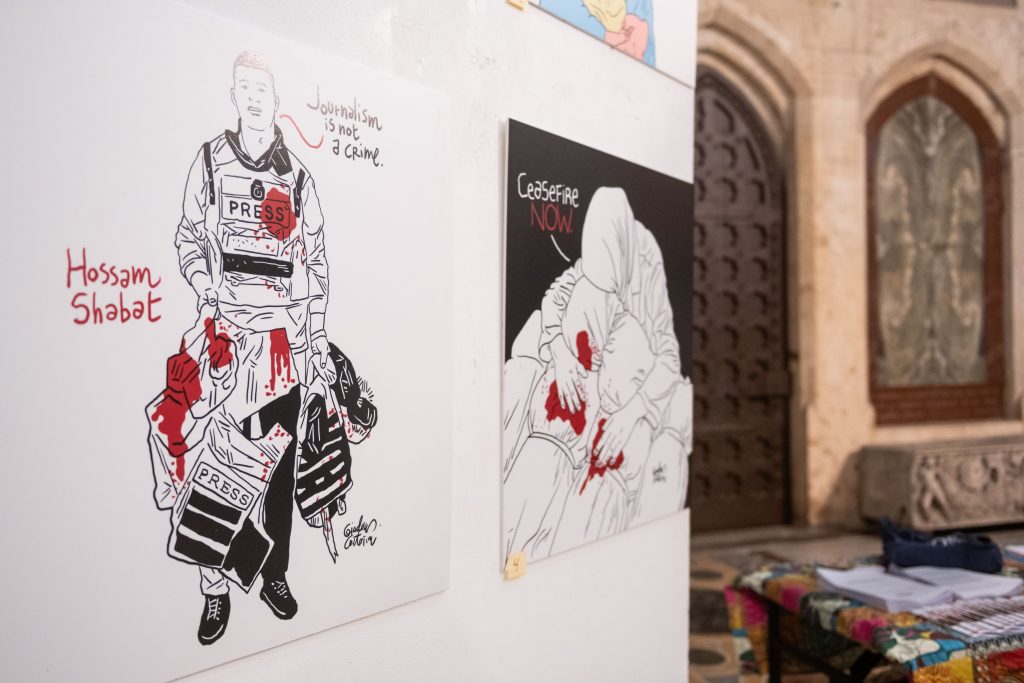
This idea is particularly close to the work I have developed in recent years around Gaza. In the project Christ Died in Gaza, exhibited at St. Paul’s Within the Walls in Rome, images of Palestinian victims were placed in dialogue with the iconography of the Passion. Not to superimpose one history onto another, but to ask what those images of suffering mean when they are brought back into the present.
Neuhaus’s words pose essentially the same question.
If Christianity teaches believers to recognize Christ in the hungry, the prisoner, the persecuted and the person stripped of dignity, where should Christians look for him today?
Neuhaus also spoke about Palestinians held in Israeli prisons and recalled the importance of Pope Francis’s appeals for prisoners and his meetings with their families. His argument was that this position should not be understood primarily as partisan allegiance, but as the recognition of structures of domination and of the people who suffer under them.
CHANNELDRAW STUDIO · INDEPENDENT PUBLISHING
Active Art Yearbook
A year of drawings, stories and civic engagement. Discover the Channeldraw annual volumes.
“This is not a question of taking one side or another, but of recognizing where these mechanisms of conquest exist in our world, so that we can stand clearly on the side of the victims of conquest, whoever they may be.”
Towards the end of his intervention, Neuhaus returned to another element that has always been central to the work of ChannelDraw: names.
A statement such as “I support Palestinian freedom” can immediately be interpreted through political categories, he observed. Telling the story of an individual human being changes the encounter.
Naming people, telling their stories and showing their faces restores something that war and political language constantly threaten to erase.
“The names, naming the people, telling the stories of what is actually happening.”
For Neuhaus, what must be recovered is precisely the humanity that is being crushed. Genocide, in his reflection, is not only an abstract historical or legal concept: it becomes visible in the daily destruction of individual human lives.
This is also the principle behind much of the work published on ChannelDraw: drawing a face means first of all giving a person back a name, a history and a presence. The same approach has guided projects dedicated to journalists killed in Gaza and the images that, once released and shared, have entered demonstrations, vigils, churches and public spaces in different parts of the world.
Neuhaus then introduced an uncomfortable historical comparison, one that carries particular weight in his own biography and in the history of Christianity. Living in Israel, he said, he often hears the question: where was the Church when Jews were dying in Auschwitz?
There were Christians and priests who spoke out and who shared the fate of the persecuted, even entering the gas chambers with them, he recalled. But there were not enough.
The question, therefore, cannot remain confined to the past.
Are there enough priests today standing beside those who suffer, those who are hungry and those who are imprisoned?
The drawing of the Palestinian mother holding her dead child returns at this point with a different force. It does not provide an answer. It asks the same question as Neuhaus.
Where is Jesus?
Perhaps the image asks us first to look at the child.
ChannelDraw is independent and reader-supported. Your support helps us continue documenting artists, journalists and activists whose voices are threatened or censored.
Other ways to support ChannelDraw
You can also support our independent work by joining us on Patreon or Substack, or by purchasing a ChannelDraw Yearbook. Every contribution helps us keep ChannelDraw independent and continue documenting stories that need to be seen.