Palestinian journalist Salman al-Khatib was attacked while documenting demolitions in the West Bank, forcing him to remove his PRESS vest and put away his camera for his own safety
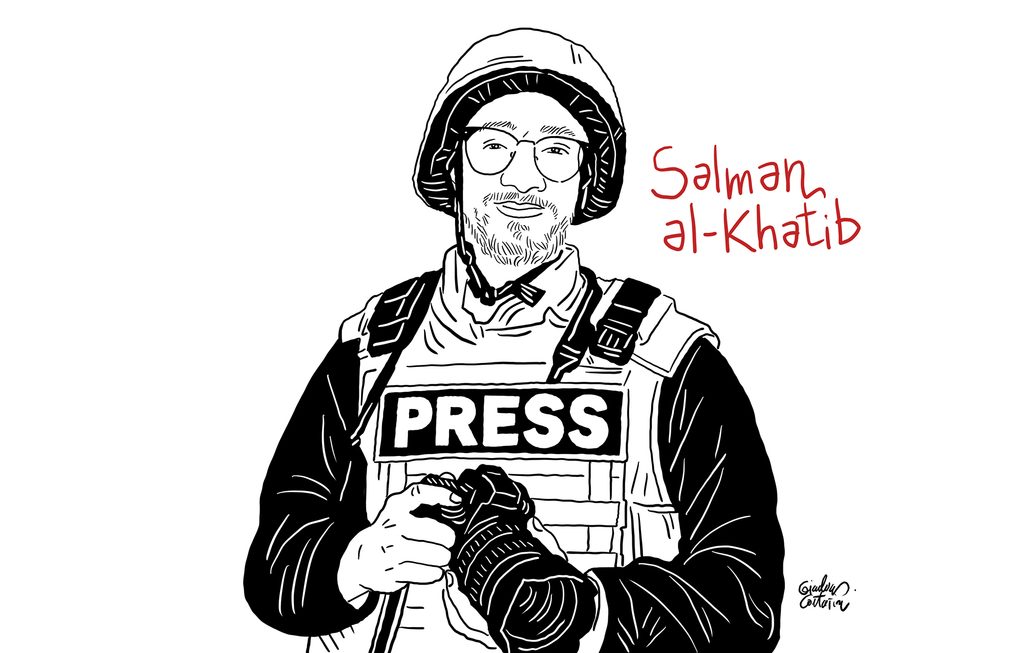
On August 31, 2026, Palestinian freelance journalist Salman Mohsen al-Khatib was doing what journalists are supposed to be able to do: document what was happening. He and several colleagues had travelled to an area between Birzeit and Atara, north of Ramallah in the occupied West Bank, after receiving information that Israeli forces were demolishing two residential buildings.
Before the journalists could complete their reporting, however, their presence itself became the target. According to testimony collected by the Palestinian Center for Development and Media Freedoms (MADA), a young Israeli settler approached al-Khatib and blocked his path. The settler sprayed pepper spray in his face and prevented the other journalists from moving toward the demolition site. He then pursued the group while carrying a stick and pepper spray.
Some of the reporters eventually managed to reach a position closer to the demolitions. Minutes later, the settler returned. According to al-Khatib’s account, he pushed the journalists and then assaulted al-Khatib again, kicking him and striking him with a stick. Among the journalists present were Al-Ghad TV correspondent Diaa Houshiya and freelance photographer Mutasim Saqf al-Hait, who was working for Quds News Network.


CHANNELDRAW STUDIO · INDEPENDENT PUBLISHING
Active Art Yearbook
A year of drawings, stories and civic engagement. Discover the Channeldraw annual volumes.
Explore the yearbooks →The situation became more threatening when a second settler arrived. An Israeli military vehicle also appeared at the scene. According to the Committee to Protect Journalists (CPJ), the journalists ultimately abandoned their assignment and hurried back toward their vehicles.
For al-Khatib, what happened next is perhaps the most disturbing image of the entire episode. He removed his helmet and the vest marked PRESS, put away his cameras and equipment, and remained in ordinary clothes. According to his testimony, he felt that the settlers were increasingly focusing their attention specifically on him. The equipment that should have identified and protected his role as a journalist had become something he feared could expose him to further violence.
“We felt afraid and in real danger, and that a serious problem could happen at any moment,” al-Khatib later told CPJ.
Al-Khatib is a 27-year-old Palestinian freelance journalist and photographer whose work documents everyday life and violence in the occupied West Bank, including settler attacks and Israeli military operations. His photographs have circulated internationally. Only a few weeks before the August 31 attack, he had documented the aftermath of a settler attack against the Naif al-Kaabneh Bedouin community near Taybeh.
There is something particularly significant about what happened to him. Al-Khatib had gone to Birzeit to make images of an event. Instead, his own experience became part of the story he was trying to document.
His case is also part of a much wider pattern. CPJ examined at least 16 incidents of settler violence, threats or obstruction against journalists in the West Bank during the first eight months of 2026, involving at least 35 Palestinian, Israeli and international journalists. In eleven of those incidents journalists were physically assaulted, while at least five reporting assignments had to be abandoned or cut short because of threats or violence.
CPJ also documented cases in which journalists said Israeli soldiers or police were present or nearby but did not intervene. In several incidents, reporters were clearly identifiable through their press vests, helmets, cameras or other journalistic equipment.
The significance of the word PRESS therefore changes. It is supposed to identify someone who is there to observe, document and report. But for journalists working in the West Bank, being recognisable as a reporter can become part of a calculation about personal safety: whether to wear the vest, whether to keep filming, when to put away the camera and when continuing to document becomes too dangerous.

This is a question that runs through much of my work on journalism and freedom of the press. In In the Crosshairs of Memory, I have used portraiture to construct a visual archive of journalists and media workers killed while documenting the war in Gaza. The project tries to preserve their faces and stories against the transformation of individual lives into statistics.
In the Crosshairs of Memory

The same question is at the centre of my work on the wider crisis in Palestine: what happens when the person whose job is to witness violence becomes a target of that violence? Over the past years, drawing has become for me a way of following these individual stories and connecting them to a broader defence of press freedom.
Drawing Resistance: My Journey Documenting Palestine’s Crisis

The portraits have also travelled outside ChannelDraw, entering exhibitions, demonstrations and publications. In 2025, they were part of Safe and Free Press in the Middle East – Reporting from Gaza, presented at the European Parliament in Strasbourg, a project dedicated to journalists who have lost their lives or continue to risk them while reporting from the region.
Safe and Free Press in the Middle East: Reporting from Gaza
Salman al-Khatib survived the attack. His story therefore belongs to a different part of this visual memory: not only journalists who have been killed, but also those who continue to work while facing intimidation, assault and the possibility that simply being recognised as a journalist can expose them to danger.
On August 31, al-Khatib went out with his camera to document the demolition of Palestinian homes. According to his testimony, he was sprayed, pushed, kicked and struck with a stick. Eventually he put away his camera, removed his helmet and took off the vest marked PRESS.
The photographs could no longer be taken.
And that moment — a journalist forced to hide the very signs that identify his profession in order to feel safer — is itself an image worth remembering.
ChannelDraw is independent and reader-supported. Your support helps us continue documenting artists, journalists and activists whose voices are threatened or censored.
Other ways to support ChannelDraw
You can also support our independent work by joining us on Patreon or Substack, or by purchasing a ChannelDraw Yearbook. Every contribution helps us keep ChannelDraw independent and continue documenting stories that need to be seen.


