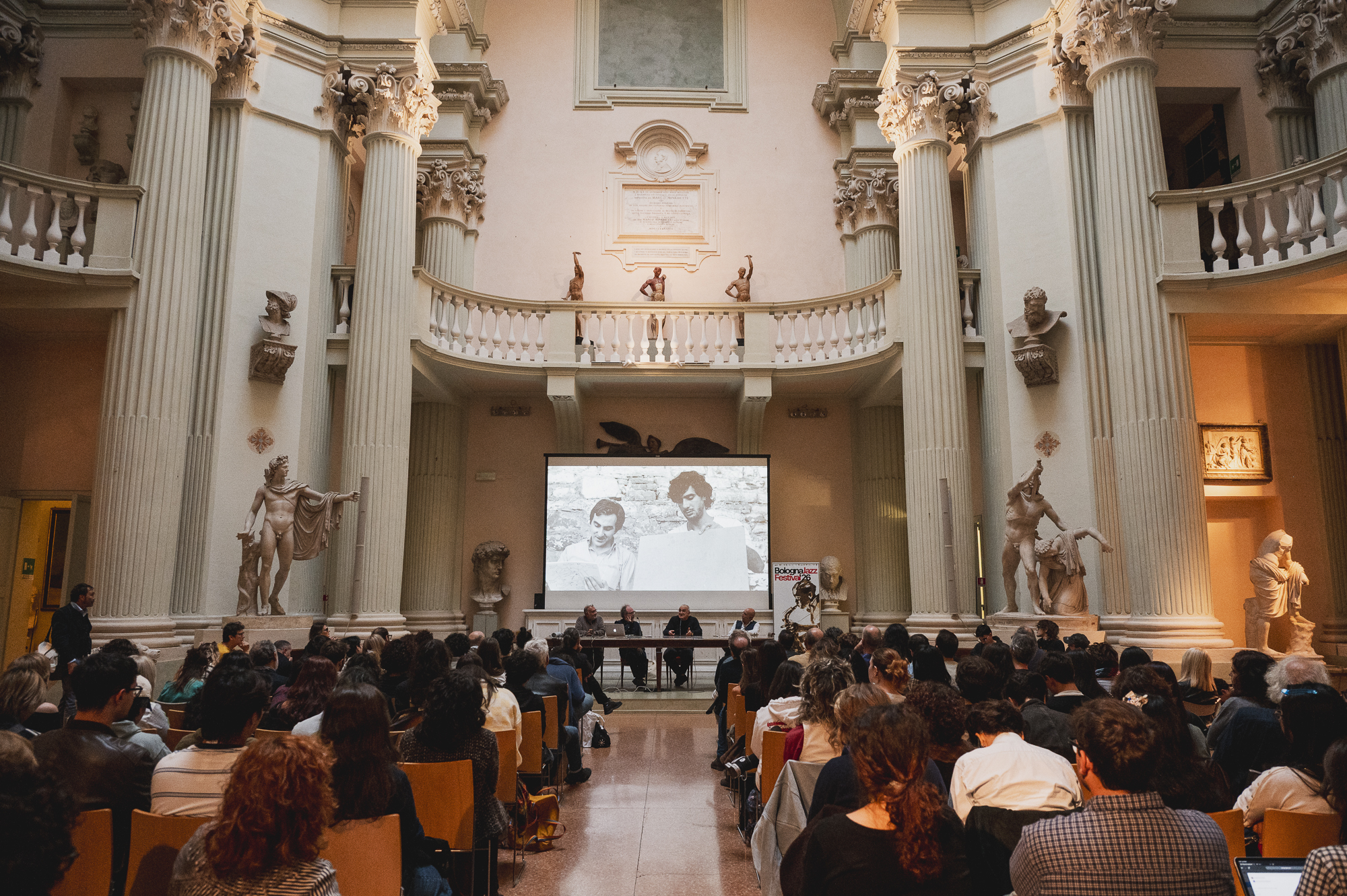
From the cultural revolution of Cannibale and Frigidaire to the creation of Ranxerox, Tanino Liberatore has spent nearly fifty years challenging the boundaries between comics, painting, illustration, music and cinema. On October 19, the legendary Italian artist will be at the Academy of Fine Arts in Bologna for a public conversation with Gianluca Costantini, as part of Bologna Jazz Festival 2026.

On Monday, October 19, 2026, the Academy of Fine Arts of Bologna will welcome Tanino Liberatore, one of the most innovative and internationally recognized figures in the history of Italian comics, for a public meeting in its Aula Magna. The event, organized as part of the Bologna Jazz Festival 2026, will bring together Liberatore, Academy Director Enrico Fornaroli, Vanni Masala, Head of Special Projects at the festival, and artist and professor Gianluca Costantini, who will introduce the artist and guide a conversation about his work, his extraordinary visual language and the cultural transformations that shaped his career.
The occasion is particularly significant because Liberatore has been invited to create the visual identity of this year’s Bologna Jazz Festival, continuing a collaboration that, since 2013, has brought some of the most important names in contemporary illustration into dialogue with music. His drawings will accompany the festival throughout the city, appearing on posters distributed by CHEAP, the Bologna-based public art project that uses the urban landscape as an exhibition space, as well as on Tper buses circulating through the streets. The initiative, developed in collaboration with Hamelin, reflects an understanding of illustration not merely as decoration but as an autonomous artistic language capable of transforming the visual identity of a cultural event.
To understand the importance of Tanino Liberatore, however, it is necessary to return to the Italy of the 1970s, a period in which political conflict, cultural experimentation and the emergence of new forms of independent publishing profoundly transformed the relationship between art and society. Born Gaetano Liberatore on April 12, 1953, in Quadri, a small town in Abruzzo, he studied at the Art High School in Pescara, where he met Andrea Pazienza, a friendship that would become one of the most important relationships in the history of Italian alternative comics. The two artists belonged to a generation that rejected the traditional separation between high culture and popular imagery, approaching drawing as a territory in which artistic experimentation, political provocation, humour and personal expression could coexist without restrictions.
After moving to Rome to study architecture, Liberatore began working in graphic design, advertising and record illustration, gradually developing the extraordinary technical precision that would become one of the defining characteristics of his work. Rome was then experiencing an intense period of cultural and political transformation, with independent publications, experimental music, radical artistic movements and alternative forms of communication challenging established institutions. It was in this environment that Liberatore encountered Stefano Tamburini and the group of artists responsible for Cannibale, the underground comics magazine launched in 1977 and associated with Andrea Pazienza, Filippo Scòzzari and Massimo Mattioli.
The significance of Cannibale extended far beyond the publication of unconventional comic strips. Its pages represented a deliberate rupture with the narrative and visual conventions that had dominated Italian comics, opening the medium to influences from American underground comix, punk culture, political satire, experimental cinema and contemporary art. At a time when comics were still frequently associated with children’s entertainment or traditional adventure narratives, these artists demonstrated that the medium could become an instrument of cultural criticism, capable of confronting sexuality, violence, consumerism, political conflict and the contradictions of modern society through an entirely new visual vocabulary.
It was within this atmosphere of experimentation that Ranxerox emerged, a character initially conceived by Stefano Tamburini and developed through a creative process involving several artists before becoming inseparably associated with Liberatore’s extraordinary graphic interpretation. Originally called Rank Xerox, the character was an artificial being constructed from the components of a photocopier, an almost indestructible android whose violent adventures unfolded in a dystopian urban landscape dominated by technological excess, social fragmentation and moral collapse. The choice of a photocopier as the origin of the character was particularly revealing: an everyday machine associated with the reproduction of images and information became the foundation of a monstrous body, suggesting a world in which technology was no longer simply an instrument serving humanity but had become an autonomous and potentially destructive force.
Liberatore transformed this conceptual premise into one of the most recognizable visual creations in European comics. His representation of Ranxerox combined an almost obsessive attention to anatomical detail with an exaggerated and disturbing physicality, creating a character whose muscles, skin and mechanical components appeared simultaneously realistic and impossible. The extraordinary precision of his drawing intensified rather than softened the violence of the narrative, producing a constant tension between the seductive beauty of the image and the brutality of the events represented. In this contradiction lies one of the essential characteristics of Liberatore’s art: his ability to use technical perfection not to reassure the viewer but to produce discomfort, ambiguity and fascination.
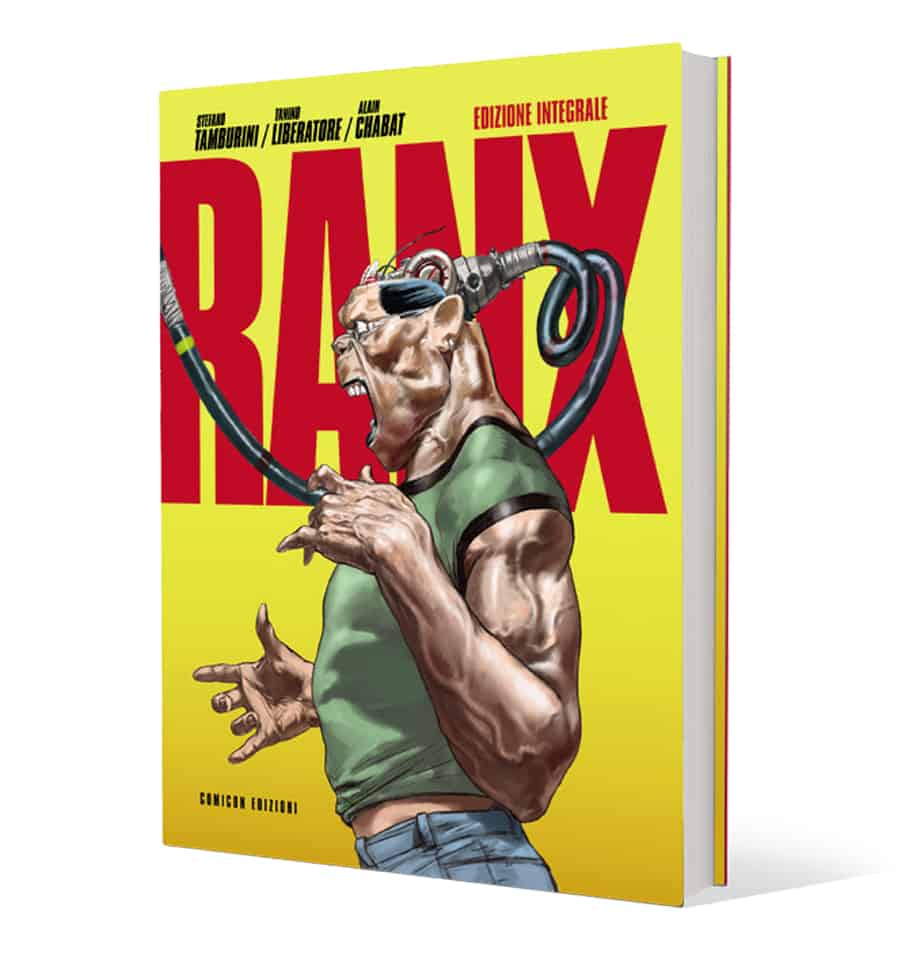
The relationship between Ranxerox and Lubna, the young girl who becomes the centre of the android’s emotional universe, further complicated this dystopian vision, introducing an unsettling contrast between tenderness, dependency, desire and violence. Rather than offering a conventional science-fiction narrative in which technology could be clearly distinguished from human experience, the series explored a world where bodies, machines and emotions had become inseparable. In retrospect, these stories anticipated many of the themes that would later become central to cyberpunk culture, particularly the transformation of the human body through technology, the fragmentation of urban society and the collapse of traditional distinctions between the organic and the artificial.
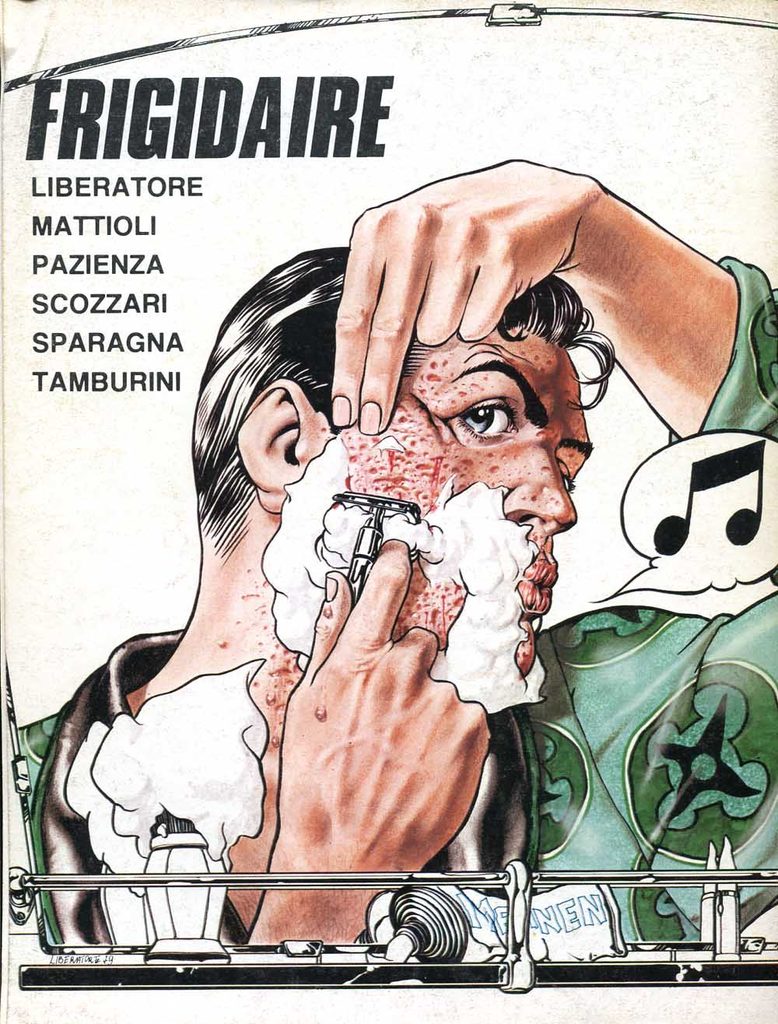
The publication of Frigidaire in November 1980 provided Liberatore and his collaborators with an even more ambitious platform for artistic experimentation. Founded by Vincenzo Sparagna, Stefano Tamburini, Filippo Scòzzari and other figures associated with the Italian underground, the magazine became an extraordinary meeting point for comics, photography, journalism, music, graphic design and political commentary. Its importance cannot be understood solely through the careers of the artists it published, because Frigidaire represented a different conception of cultural production, one in which the boundaries between artistic disciplines were deliberately dissolved and the magazine itself became a laboratory for investigating new forms of visual communication.
Within this context, Liberatore and Tamburini developed some of the most celebrated Ranxerox stories, including Ranxerox a New York and Buon compleanno Lubna, works that consolidated the artist’s reputation and introduced his drawings to an increasingly international audience. The extraordinary richness of his compositions, the sophisticated use of colour and the almost photographic treatment of surfaces distinguished his work from much of the contemporary comics production, while the radical nature of the stories connected it to the broader cultural transformations taking place across Europe and the United States.
The international circulation of Ranxerox, particularly through publications such as Métal Hurlant in France and Heavy Metal in the United States, demonstrated that the Italian underground movement was not an isolated phenomenon but part of a much larger transformation in the language of comics. During the same period, artists working in New York were developing alternative approaches to graphic storytelling, often connecting comics to punk culture, political activism and the social conflicts of the Lower East Side. Although these movements emerged from different historical and political circumstances, they shared an understanding of comics as an independent artistic medium capable of addressing subjects and adopting visual forms that mainstream publishing frequently avoided.

This relationship between artistic experimentation and social transformation is also central to the research developed by ChannelDraw, particularly through its ongoing exploration of New York’s political underground comics scene. In a recent interview with Seth Tobocman published by SOLRAD, Gianluca Costantini investigated how drawing became a means of confronting political conflict, preserving collective memory and constructing alternative forms of communication. While Liberatore’s artistic interests were not primarily directed toward the same kind of political documentation, his work emerged from a comparable determination to challenge the established conventions of the medium and expand its expressive possibilities.
In 1982, Liberatore moved to France, where his international career developed through collaborations with major publications and an increasingly diverse range of artistic projects. His work appeared in magazines such as Métal Hurlant, L’Écho des Savanes and À Suivre, while his reputation as an illustrator extended beyond the world of comics into music, advertising and painting. The move to France also placed him within a cultural environment that had long recognized comics as an important artistic language, offering opportunities for experimentation and international circulation that were not always available within the Italian publishing industry.
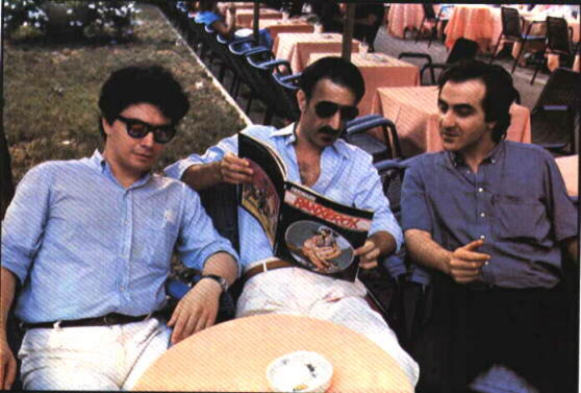
One of the most remarkable encounters of this period was with Frank Zappa, the American musician whose work combined extraordinary technical sophistication with satire, experimentation and a persistent refusal to accept conventional artistic boundaries. In 1983, Liberatore created the cover for Zappa’s album The Man from Utopia, producing an image that captured the musician’s irreverent personality through the same combination of anatomical exaggeration, grotesque humour and visual precision that characterized Ranxerox. The collaboration revealed a profound affinity between two artists who approached their respective disciplines with exceptional technical knowledge while constantly questioning the cultural expectations surrounding them.
Zappa’s description of Liberatore as the “Michelangelo of comics” became one of the most frequently repeated definitions of the Italian artist, although the comparison deserves to be understood beyond the obvious reference to anatomical virtuosity. Like the great Renaissance masters, Liberatore possesses an extraordinary ability to construct the human figure through an understanding of volume, movement and physical tension, but his artistic universe belongs unmistakably to the contemporary world, where the body is subjected to technological transformation, commercial representation and increasingly unstable forms of identity. His figures often appear almost sculptural, yet their exaggerated perfection reveals a deeply modern anxiety about the relationship between physical beauty, artificial construction and the violence embedded in contemporary imagery.
The death of Stefano Tamburini in 1986 marked a profound rupture in the history of Ranxerox and in the creative environment from which the character had emerged. Tamburini had been much more than a writer or collaborator: his experimental approach to publishing, graphic design and visual communication had played a fundamental role in shaping the identity of the Italian underground. His disappearance, followed two years later by the death of Andrea Pazienza, contributed to the end of an extraordinary cultural season, although the influence of that generation would continue to transform Italian comics for decades.


CHANNELDRAW STUDIO · INDEPENDENT PUBLISHING
Active Art Yearbook
A year of drawings, stories and civic engagement. Discover the Channeldraw annual volumes.
Explore the yearbooks →Liberatore’s friendship with Pazienza remains one of the most fascinating aspects of this history, not only because of the artistic importance of both figures but also because it reflects the intense personal relationships that sustained the underground movement. In 1985, Pazienza dedicated La leggenda di Italianino Liberatore to his friend, transforming him into a comic-book character and creating a work that combined affection, irony and the extraordinary freedom of expression that characterized his artistic language. The story remains a revealing testimony to a generation in which friendship, artistic collaboration and cultural experimentation were deeply intertwined.
Following the decline of the original underground magazines, Liberatore continued to expand his artistic practice, exploring painting, illustration and cinema while maintaining the unmistakable visual identity that had made his work internationally recognizable. His involvement in film production demonstrated the adaptability of his imagination to different media, particularly in projects requiring an elaborate conception of bodies, costumes and fictional environments. In 2003, he received the César Award for Best Costume Design for Alain Chabat’s Asterix & Obelix: Mission Cleopatra, a recognition that confirmed his ability to transfer the expressive richness of his drawings into the three-dimensional world of cinema.
His collaboration with Chabat also extended to the continuation of Ranxerox through Amen!, the third major chapter in the character’s history, which explored new narrative possibilities after the disappearance of Tamburini. The project demonstrated that Ranxerox had become more than a character associated with a specific historical moment: he had evolved into an enduring visual symbol whose contradictions continued to resonate with the technological and cultural transformations of contemporary society.
Another significant stage in Liberatore’s artistic development came with Lucy – L’espoir, a graphic novel written by Patrick Norbert and published in France in 2007, later released in Italy by COMICON Edizioni in 2017. Set in prehistoric times, the work represented an ambitious departure from the urban dystopia of Ranxerox, allowing Liberatore to investigate the origins of humanity through an entirely digital drawing process. The transition to digital technology was particularly interesting in the context of an artist whose reputation had been built on extraordinary manual precision, because it demonstrated that his relationship with drawing was never limited to a particular technique but involved a continuous investigation into the possibilities of visual representation.
The contrast between the prehistoric world of Lucy and the technological nightmare of Ranxerox reveals an underlying continuity in Liberatore’s artistic interests. Both works investigate the human body as a site of transformation, vulnerability and conflict, whether through the emergence of early humanity or the construction of an artificial being whose physical existence challenges the distinction between life and machinery. Across these apparently distant subjects, Liberatore maintains a persistent fascination with anatomy, movement, materiality and the expressive potential of the figure.
Nearly five decades after his first experiments with Cannibale, Liberatore’s work continues to occupy a distinctive position in the history of European visual culture. His influence extends beyond the artists who have directly adopted elements of his technique, because his career contributed to transforming the cultural perception of comics at a moment when the medium was struggling to establish itself as an autonomous form of artistic expression. By combining an exceptional command of drawing with an uncompromising willingness to explore controversial subjects and unconventional narratives, he demonstrated that comics could achieve a visual and conceptual complexity comparable to that of other established artistic disciplines.
His presence at the Academy of Fine Arts of Bologna therefore offers an opportunity to reflect not only on the achievements of an individual artist but also on the historical significance of a generation that transformed Italian comics through independent publishing, artistic experimentation and an extraordinary collective energy. The experiences of Cannibale and Frigidaire remain particularly relevant for younger artists today, at a time when the production and circulation of images are increasingly influenced by digital technologies, commercial platforms and rapidly changing forms of visual communication.
The relationship between drawing and music provides another important perspective through which to approach Liberatore’s career. His collaboration with Frank Zappa, his work for record covers and his current contribution to Bologna Jazz Festival reveal a sustained dialogue between different artistic languages, united by a shared interest in rhythm, improvisation, experimentation and the relationship between technical discipline and expressive freedom. In this sense, the encounter between Liberatore and jazz is not simply the result of a contemporary commission but reflects an artistic trajectory in which music has repeatedly intersected with visual imagination.
For the students of the Academy, meeting Liberatore also means confronting a conception of drawing that refuses the opposition between technical mastery and artistic freedom. His work demonstrates that an extraordinary knowledge of anatomy, perspective and representation does not necessarily lead to conventional realism but can instead become the foundation for radical experimentation. The precision of his images is never an end in itself: it serves to construct worlds in which reality is intensified, distorted and transformed until it reveals dimensions that ordinary representation would leave invisible.
On October 19, the conversation with Gianluca Costantini will provide an opportunity to explore these questions directly with the artist, retracing the cultural environment of the Italian underground, the creation of Ranxerox, the relationships with Andrea Pazienza and Stefano Tamburini, and the development of a career that has moved continuously between comics, illustration, music and cinema. The meeting will also offer a chance to discuss how an artist whose work emerged from the radical experimentation of the 1970s continues to engage with contemporary visual culture without abandoning the distinctive language that has defined his artistic identity.
From the provocative pages of Cannibale and Frigidaire to the international success of Ranxerox, from his collaboration with Frank Zappa to his illustrations for Bologna Jazz Festival, Tanino Liberatore’s career represents an extraordinary exploration of the possibilities of drawing. His work reminds us that the history of comics is inseparable from the broader history of contemporary art, music, publishing and cultural experimentation, and that the most significant artistic transformations often emerge when established boundaries between disciplines are challenged rather than respected.
The meeting with Tanino Liberatore will take place on Monday, October 19, 2026, at 5:00 PM, in the Aula Magna of the Academy of Fine Arts of Bologna, Via delle Belle Arti 54.
Further information is available on the official event page of the Academy of Fine Arts of Bologna.
ChannelDraw is independent and reader-supported. Your support helps us continue documenting artists, journalists and activists whose voices are threatened or censored.
Other ways to support ChannelDraw
You can also support our independent work by joining us on Patreon or Substack, or by purchasing a ChannelDraw Yearbook. Every contribution helps us keep ChannelDraw independent and continue documenting stories that need to be seen.