From his childhood in Abruzzo to his encounter with Andrea Pazienza, from the birth of Cannibale and Frigidaire to the international success of Ranxerox. Tanino Liberatore reflects on his artistic education, his friendship with Stefano Tamburini, and his relationship with drawing, music, and politics.
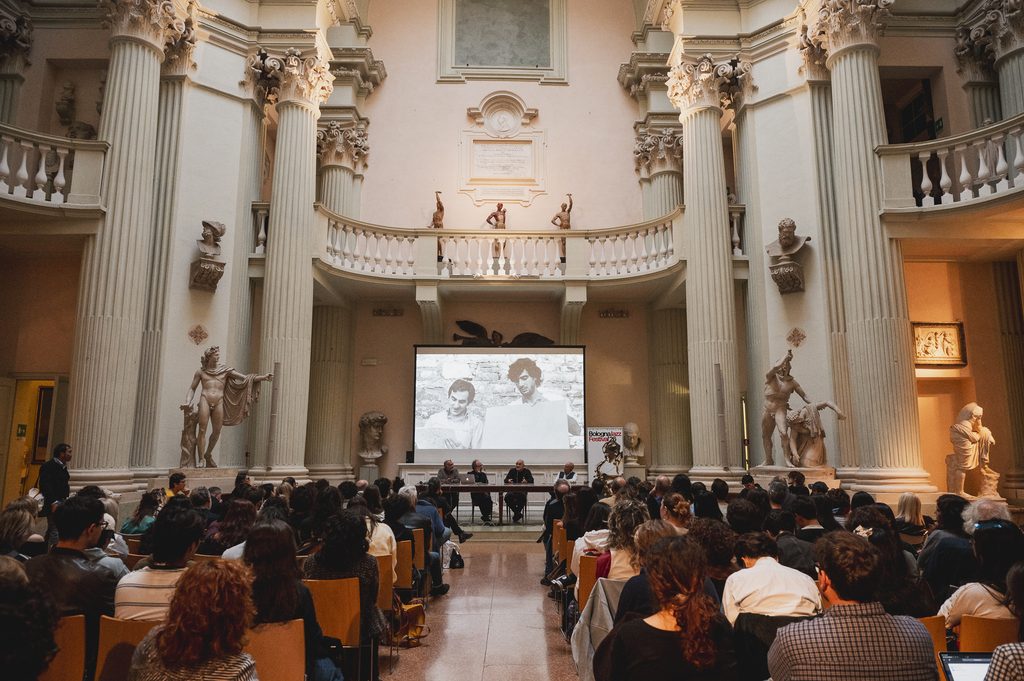
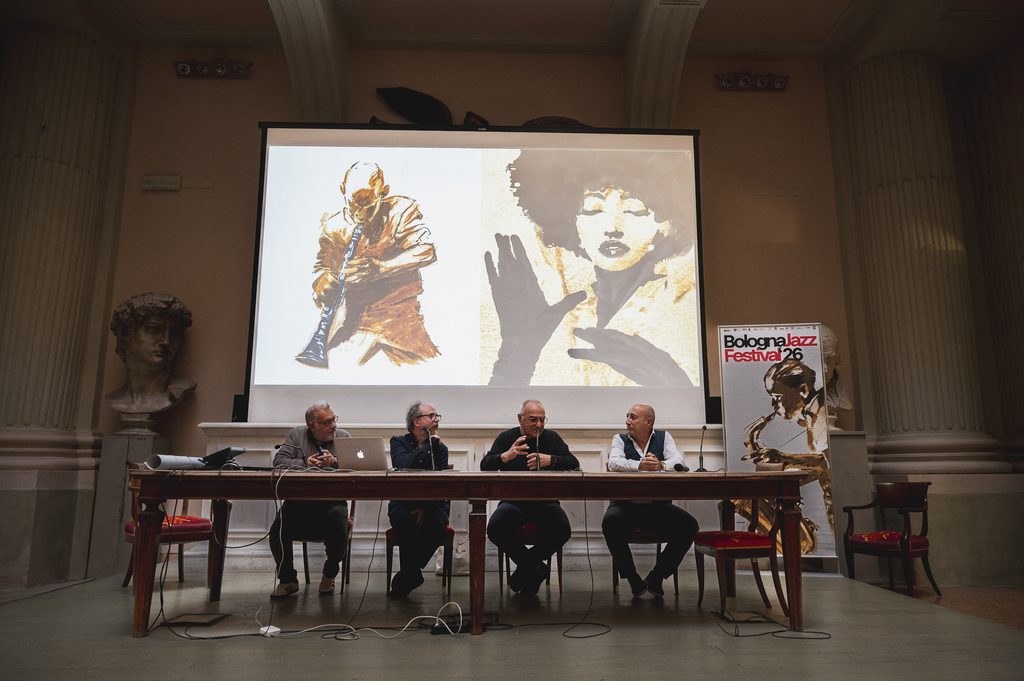
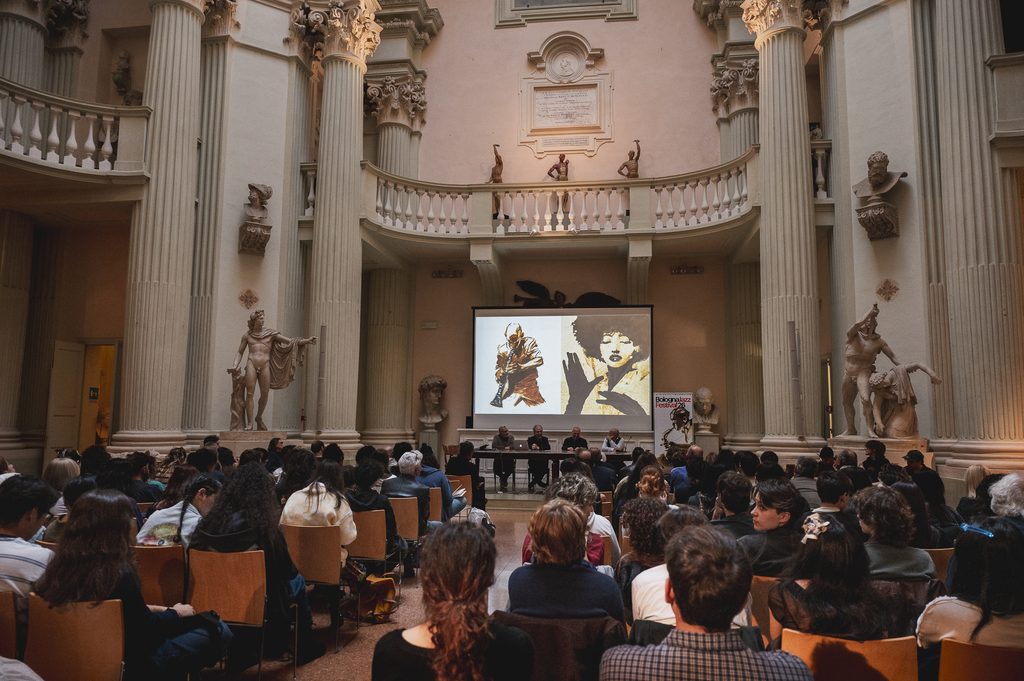
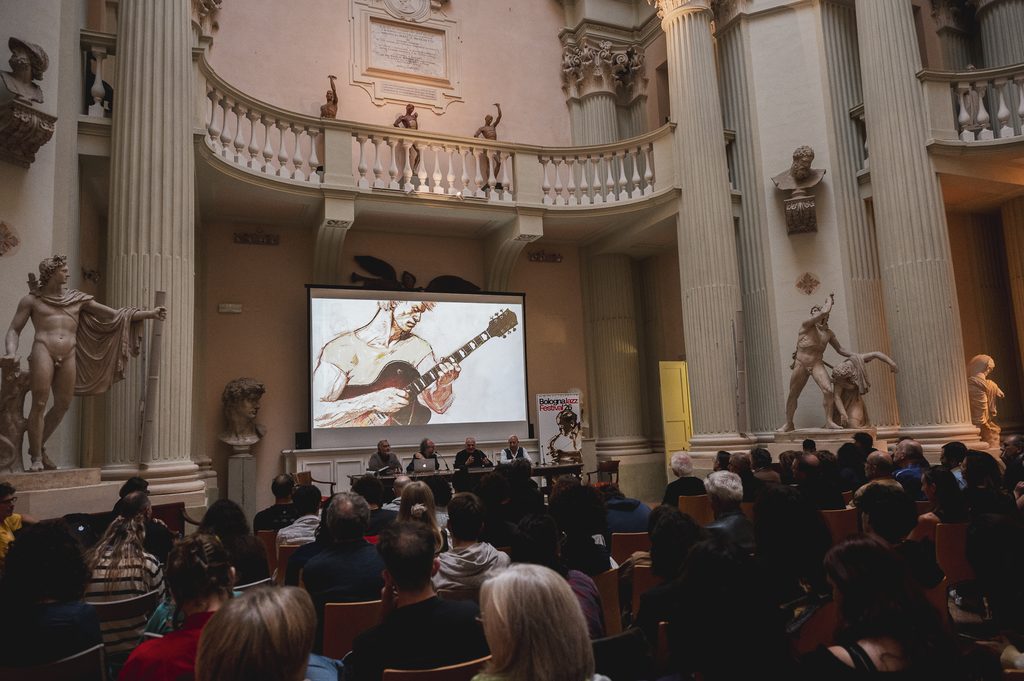
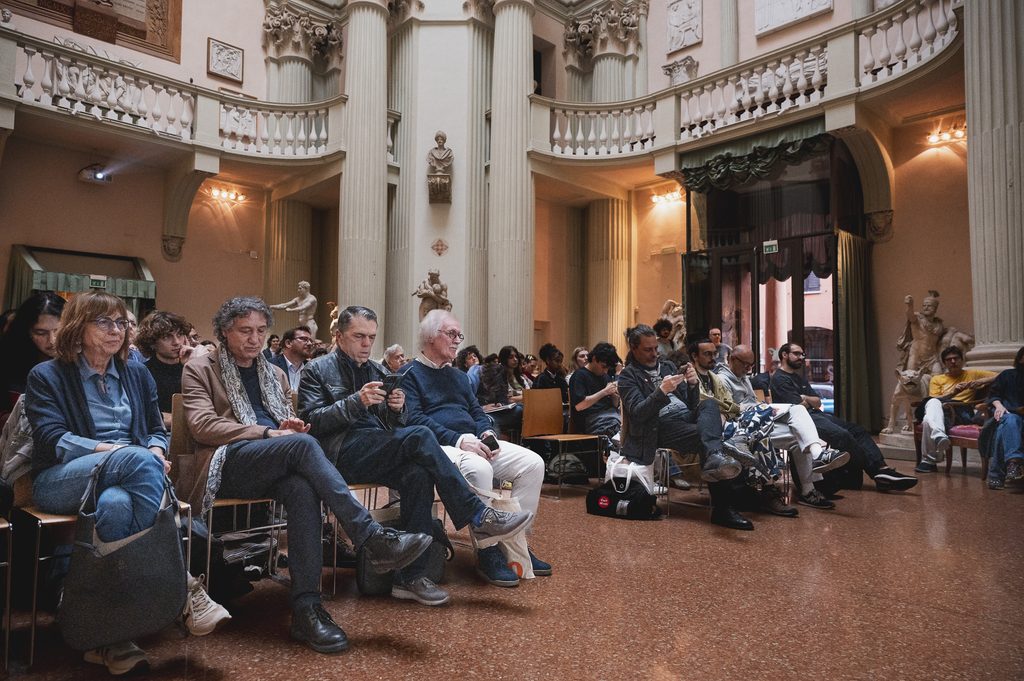
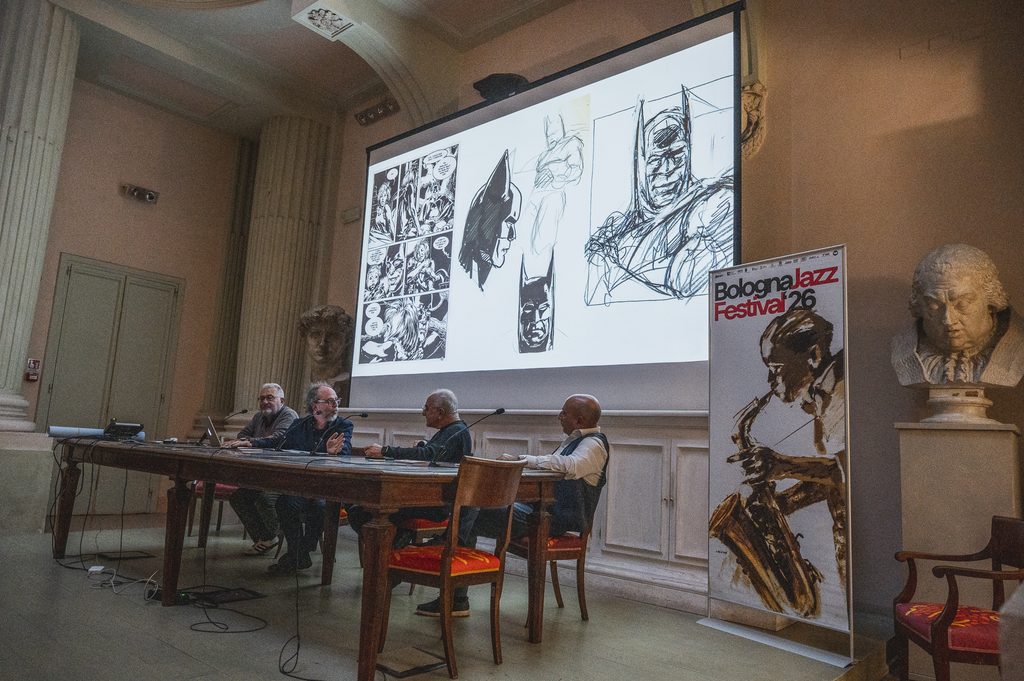
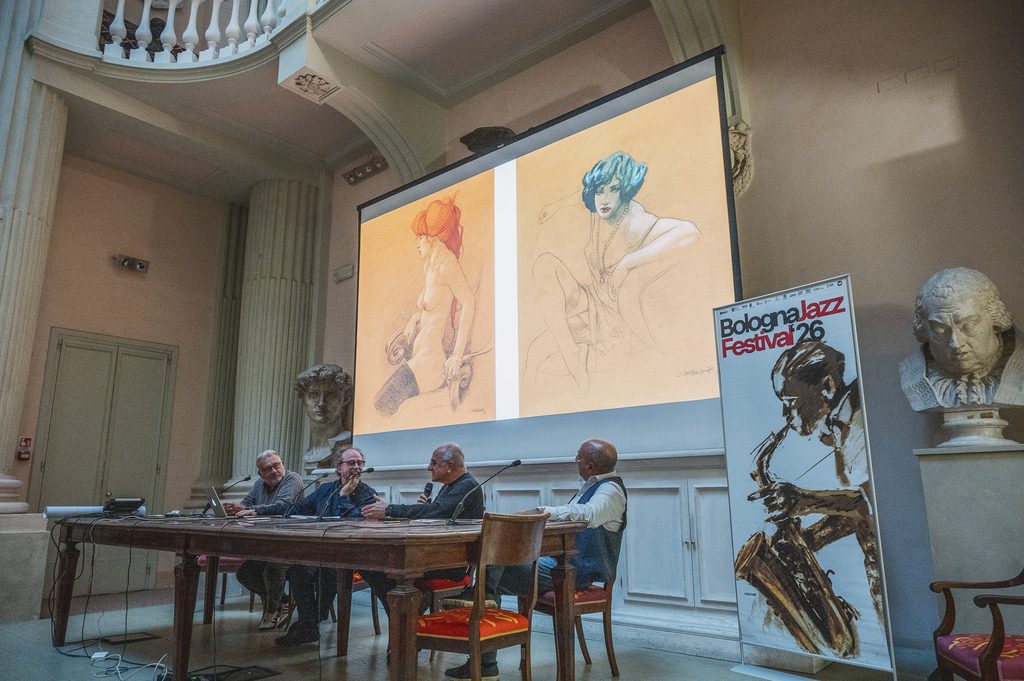
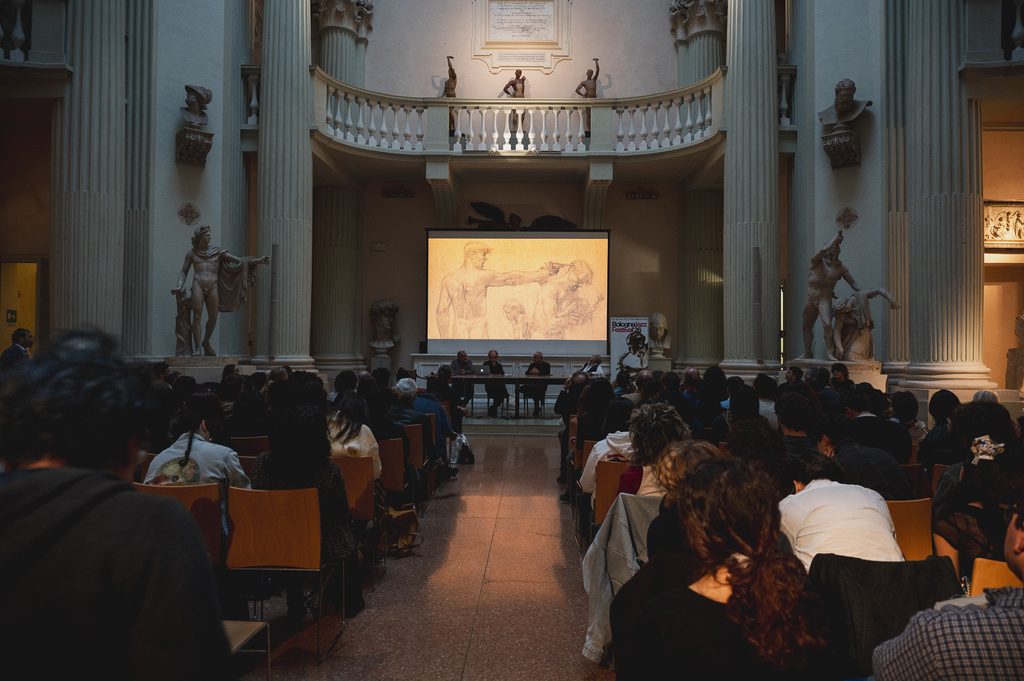
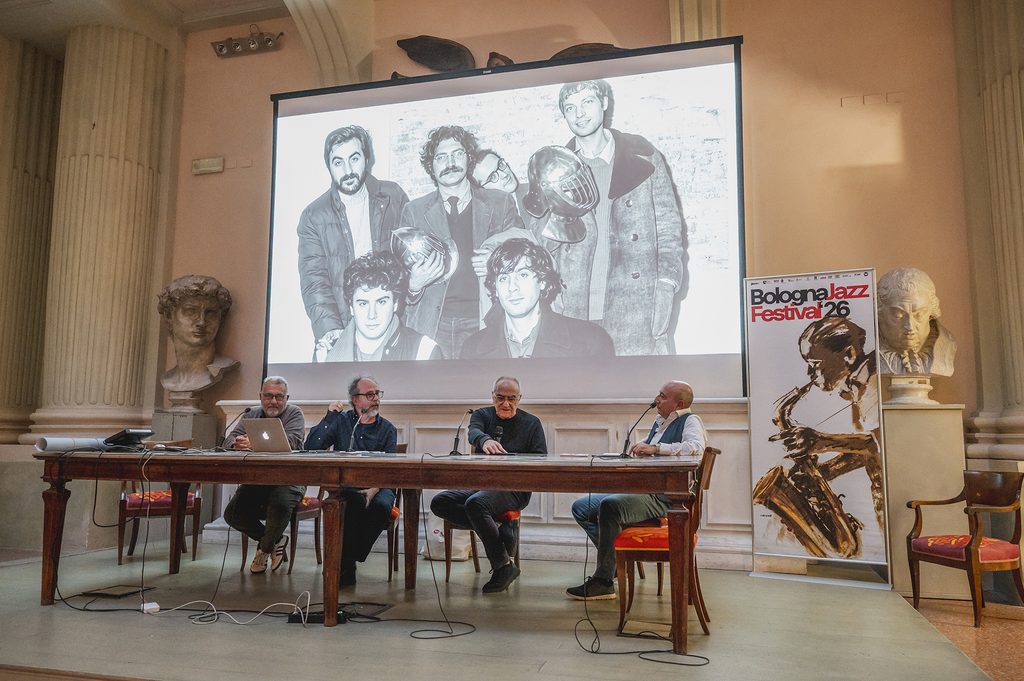
This interview is based on a public conversation with Tanino Liberatore, held on October 19, 2026, in the Great Hall of the Academy of Fine Arts of Bologna. Also in attendance were Enrico Fornaroli, director of the Academy, and Vanni Masala of the Bologna Jazz Festival.
The transcript has been edited for readability. Repetitions, hesitations, and a few unintelligible passages were removed while preserving the meaning of the conversation. ChannelDraw added editorial notes to provide historical and bibliographical context. Some autobiographical episodes are based on Liberatore’s personal recollections.
Photographs by Francesca Sara Cauli
Gianluca Costantini: Before we begin, I’d like to share something personal. When I was a kid, probably around twelve years old, I used to read Frigidaire secretly in my uncle’s room. I still remember that feeling very clearly. Those images were unlike almost anything I normally saw around me. They were powerful, sometimes violent, sexual, provocative. And among those images, of course, were yours.
I don’t think that, at twelve, I could fully understand what Frigidaire represented, what its political position was, or how closely it was connected to a particular moment in Italian history. But I understood something very simple: those images broke through something. They made me realize that drawing could be much more than a beautiful image. It could disturb, provoke, tell stories about society, and challenge the world around us.
Many years later, I found myself continually questioning that same relationship between drawing, reality, and politics. That’s why it’s particularly moving for me to be here with you today, at an Academy of Fine Arts, in front of students who are developing their own visual language.
I’d like to start long before Ranxerox, Cannibale, and Frigidaire. I’d like to understand where those images came from, but also to reconstruct the world in which they were created: Abruzzo, Pescara, Rome, 1977, Andrea Pazienza, Stefano Tamburini, politics, and the streets.
And then I’d like to understand how that young man became the artist we know today, how his way of working has changed, and, above all, what it means to keep drawing after more than fifty years.
So I’d like to begin right at the beginning.
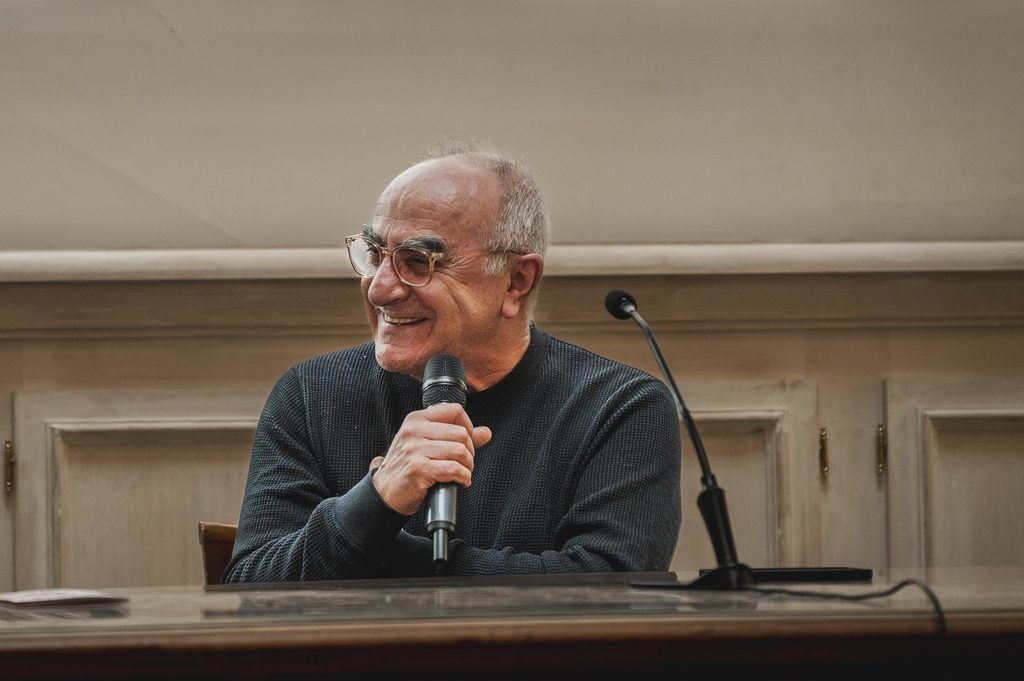
An Interview with Tanino Liberatore by Gianluca Costantini
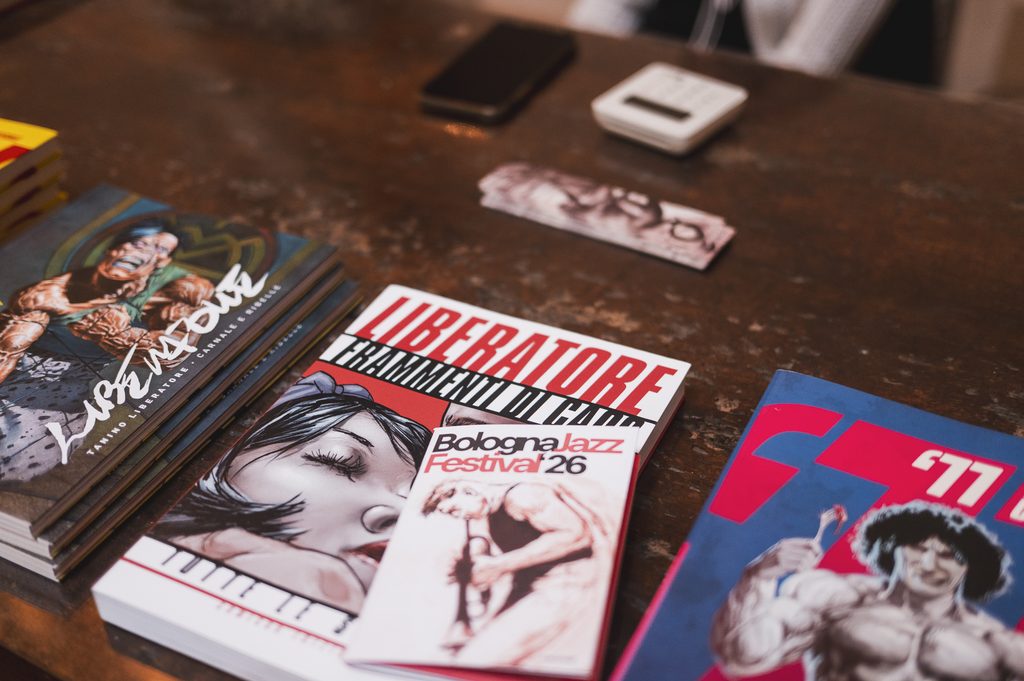
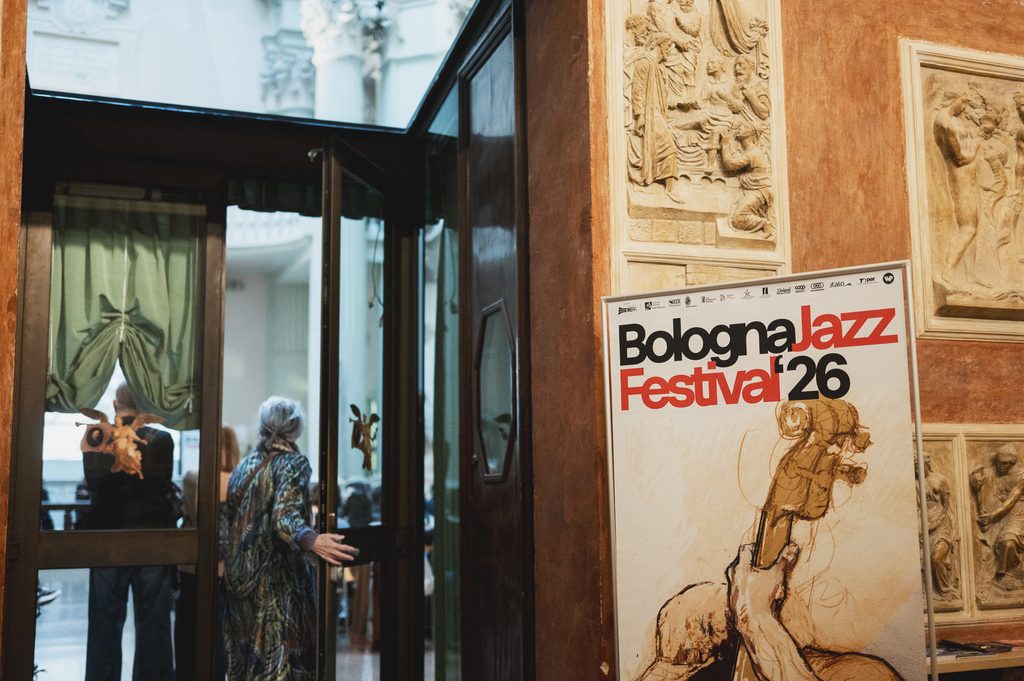
On October 19, 2026, I met Tanino Liberatore in the Great Hall of the Academy of Fine Arts of Bologna for a public conversation about his life and work. The event, organized as part of the Bologna Jazz Festival in collaboration with the Academy and Hamelin, offered an opportunity to revisit more than fifty years of drawing, comics, and artistic experimentation. Liberatore, who created the artwork for the 2026 Bologna Jazz Festival, spoke about his formative years in Pescara, his relationships with Andrea Pazienza and Stefano Tamburini, the birth of Cannibale and Frigidaire, the success of Ranxerox, and the experiences that took him from illustration to cinema, before eventually returning to painting and drawing on paper. The conversation also traces the political and cultural history of Italy from the 1970s to the present.
Childhood, Art School, and Andrea Pazienza
Tanino Liberatore: I remember starting to draw when I was five years old, one day when I had a fever. My parents moved me from the bedroom into the kitchen because it was warmer there. Back then, we didn’t have heating in every room. I remember that, over a couple of days, I filled a Cirio recipe book of more than three hundred pages with drawings. I drew cowboys and Indians, very crudely, practically using circles. But I filled every single page, and I’ve never stopped drawing since.
As for the subjects of my drawings, they’re very closely connected to the village where I grew up. Catholic upbringing in a small village was very strict. And that kind of upbringing turns all Catholics into sex maniacs! It happened to me too. That’s where it all started, and I’m serious, I’m not making it up. My father always tried to stop me from drawing. I drew in secret because he didn’t want me to. He would say, “This won’t get you anywhere. You have to concentrate on the important things in life.” And for him, the important things were becoming a lawyer or a doctor.
Luckily, when I was attending middle school and was supposed to leave the village to study elsewhere, I broke my foot and had to stay. So I went to middle school in the village, and in a way that saved me, because I kept drawing. There were teachers who knew my father and told him I was good at drawing. They were the ones who encouraged me to attend art school. My father didn’t agree, but he also didn’t want me to reproach him one day for having made my decisions for me. So he told me to go ahead and try it. He was a very strict man, but in the end he let me go.
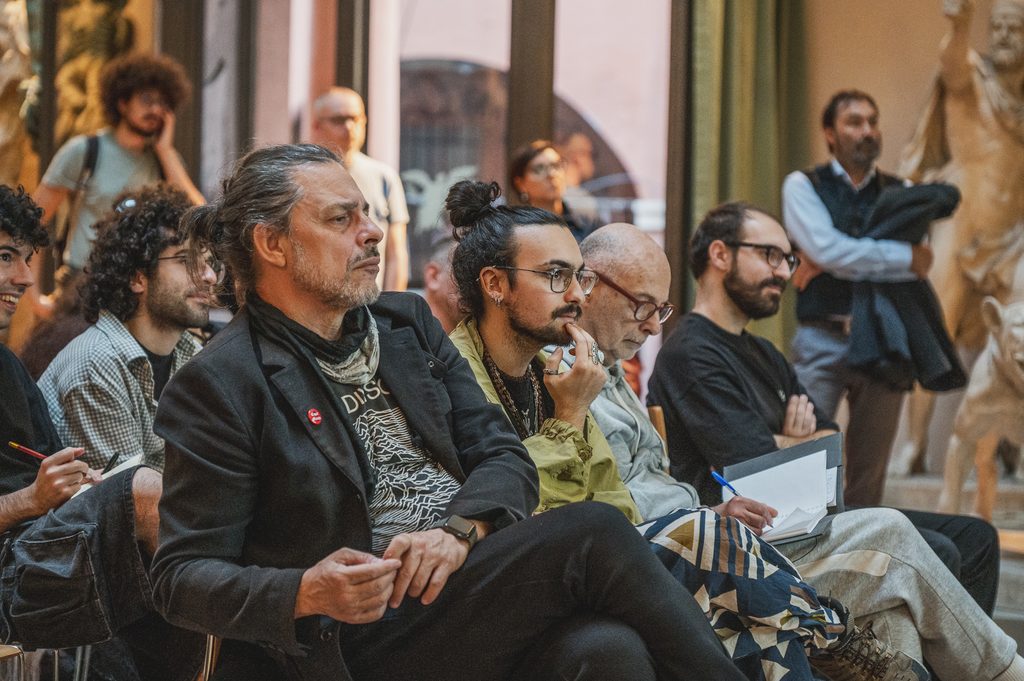
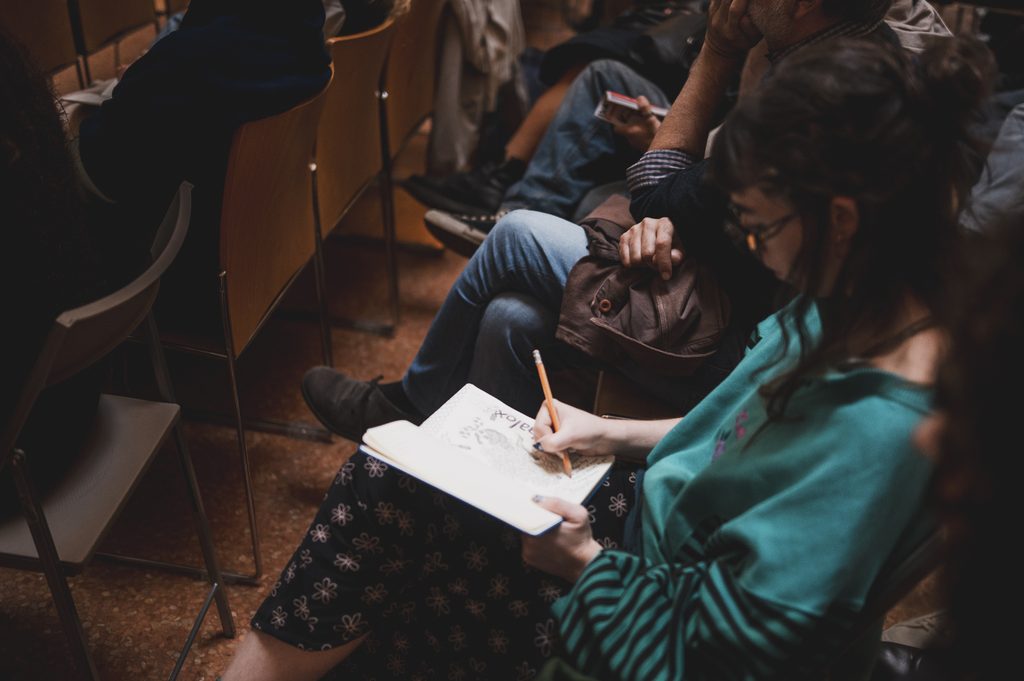
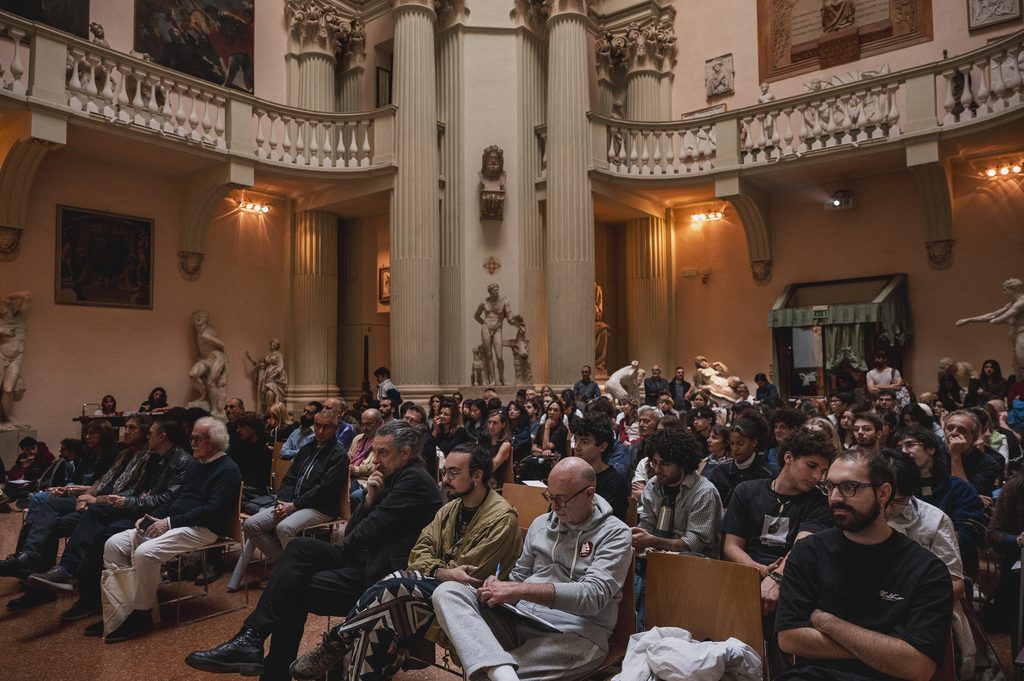
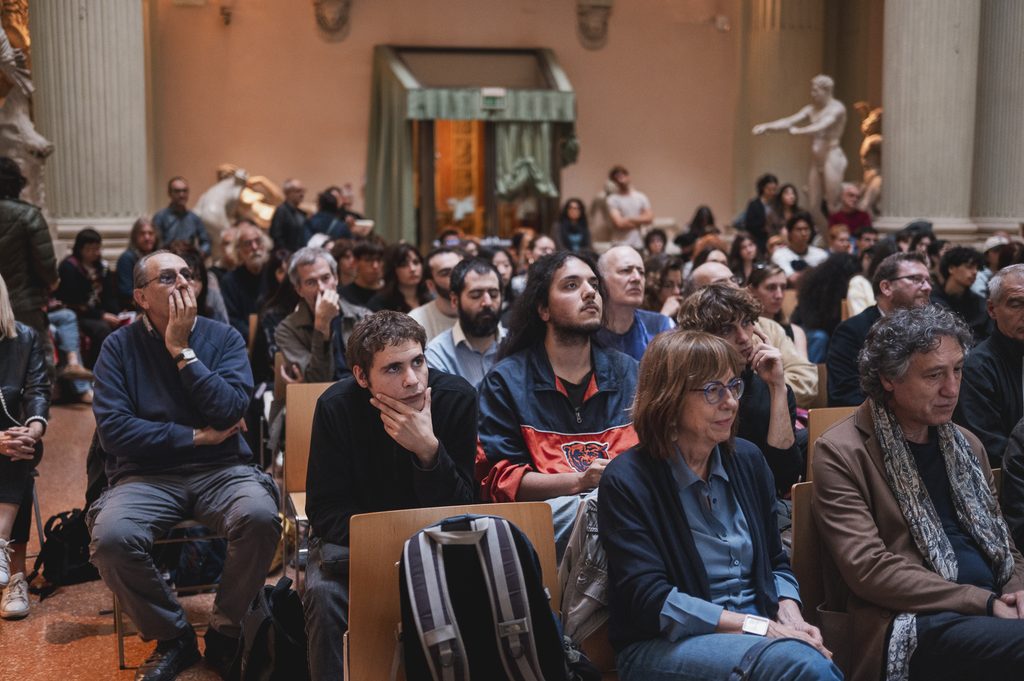
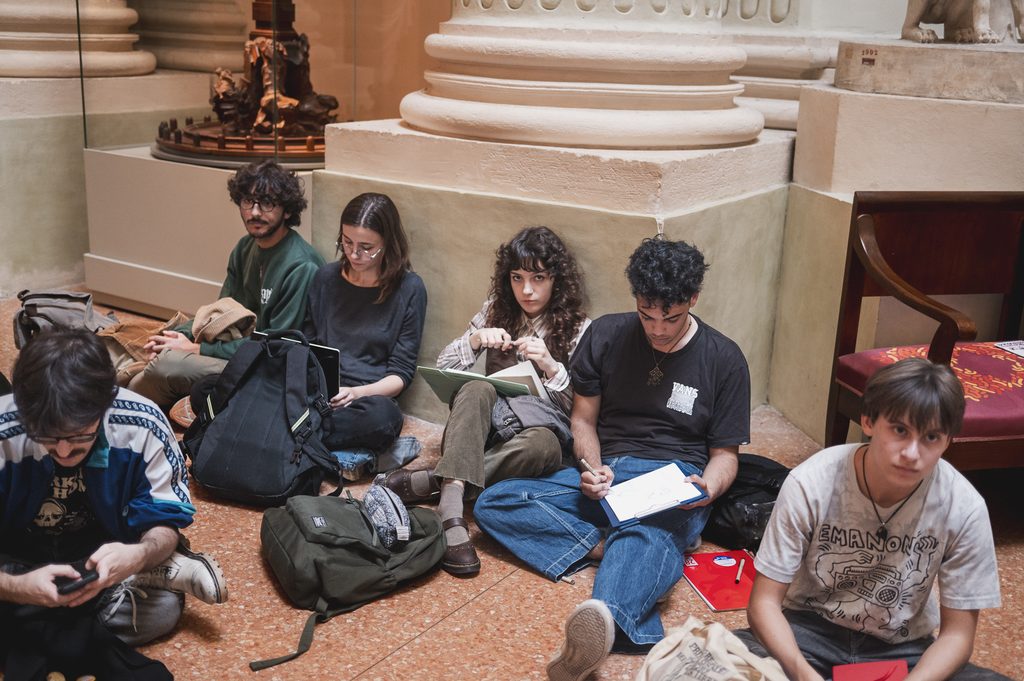
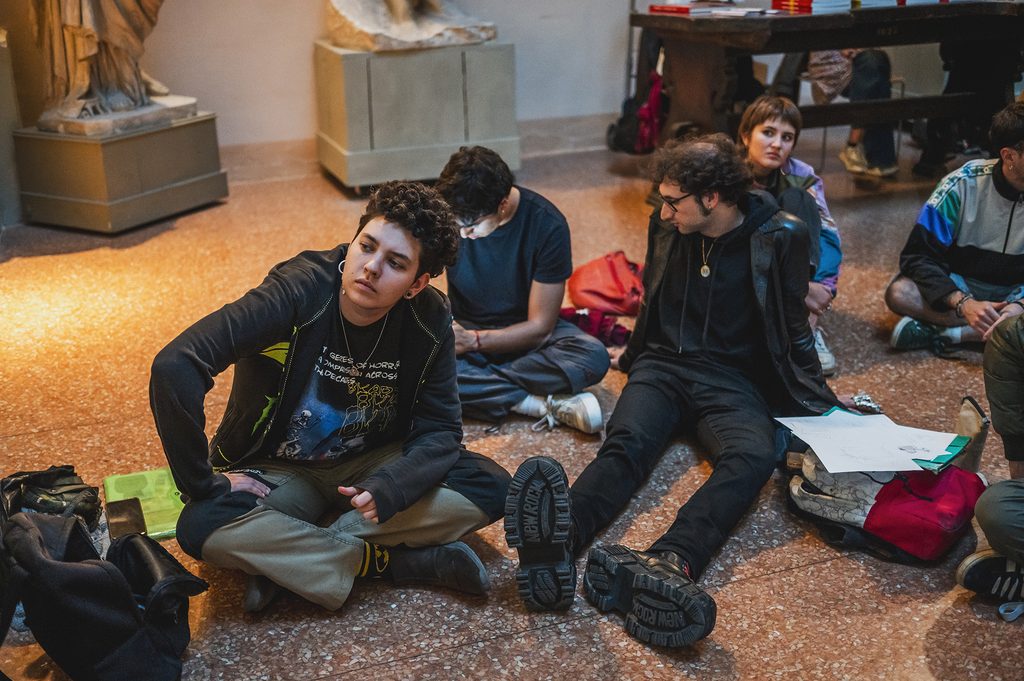
Audience members and students during the talk with Tanino Liberatore. Photo by Francesca Sara Cauli, 2026.
The art school had been founded by a man called Giuseppe Misticoni, who had practically built it from nothing. It started out as a private school, then became municipal, later provincial, until eventually a building was constructed specifically for art education.[1] It was a fantastic school, with huge windows, excellent easels, including some very expensive ones, and, above all, an extraordinary approach to teaching. When I arrived, I immediately felt at home. I felt comfortable because things started coming naturally. I wasn’t drawing just cowboys and Indians anymore. That experience was fundamental. The teachers I met didn’t so much teach me how to draw as how to look. They taught me to recognize what was essential, to understand how to observe reality.
It was just as important for Andrea Pazienza, although he was already making comics at the time. He could draw plaster casts of Greek sculptures beautifully, but his work always had that distinctive quality, that ability to tell a story. For Andrea, comics were always his natural language. He was also a brilliant illustrator, but whatever he did, he was telling a story. I’m more like a photographer. That’s why I always say I don’t really consider myself a comic artist, but rather an illustrator, among other things.
Andrea was the one who introduced me to Pantone markers.[2] He used them one way, and I would later use them in a completely different way. The result depended a lot on the paper. Andrea used Fabriano paper, which produced fairly flat areas of color, but with his extraordinary skill he managed to create exceptional things. When I started working on Ranxerox, I had practically never made a color comic. In general, I didn’t work much with color at all. I mainly worked in black and white. So I had to find a new technique to make this damned Ranxerox, something that would work for Frigidaire.
Ranxerox had already appeared in Cannibale, which was something like a semi-fanzine. There, Stefano’s artwork, inked over drawings by Andrea and me, worked perfectly well. Then Stefano, who was a genius in that situation too, came up with the idea of creating Frigidaire. It was his idea. He wanted a much more glamorous, much more colorful magazine. He realized that his own drawing style wasn’t really suited to a magazine like that, so he asked Andrea and me to take over.
Andrea initially agreed, but then Stefano decided he was less flexible and asked me if I wanted to do it. At that point, I had to invent a technique that would allow me to work quickly. We had to produce eight color pages every month, and it was tough. Comics are really hard to draw. It’s not as simple as people think. For one thing, you have to know how to draw absolutely everything.
Gianluca Costantini: Have you ever thought about how extraordinary it was that you and Andrea Pazienza ended up at the same art school? The two of you, in exactly the same place, almost by chance?
Tanino Liberatore: No, no. Neither of us was anybody back then. When I met Andrea, he was just a kid. He was twelve or thirteen, perhaps even younger. I think he was twelve. He had incredible energy, incredible curiosity. And of course, you can see what he went on to achieve. He was also an unbelievable pain in the ass at the time! He could be suffocating, but in that insistent way that comes from wanting to search, to discover things. As for the fact that we met, you have to remember that many years later he was the one who introduced me to the people behind Frigidaire. I don’t know whether it was fate.
Gianluca Costantini: Do you remember the first time he showed you his drawings? How did that happen?
Tanino Liberatore: Actually, he never showed me his drawings back then. We only knew each other by sight, because I was in my third year and he was in his first. The following year he was no longer staying with the Jesuits, while I was, and after that we each went our separate ways. I came across his work again through the publication of Pentothal,[3] although it didn’t particularly impress me at the time. Then one day he published a short color story called Armi,[4] drawn on graph paper. It was a fantastic story, both in terms of the drawings and the concept. It dealt with weapons in a very technical way, while telling the story of a sniper who had to take a shot. It was beautifully drawn and I liked it enormously.
At that point, I decided to get back in touch with him. I still had his family’s telephone number and thought, “Who knows? Maybe it still works.” His mother answered and said, “Yes, yes, Andrea is coming here to the Gargano this summer.” I didn’t live very far from the Gargano, so that summer I went to visit him at his home. I remember something extraordinary. In his room there was a large sheet of paper on which he had drawn, in different places, a foot, a gun, and a head. While he was talking to me, he picked up a marker and, without any preliminary pencil drawing, began connecting all those elements without the slightest hesitation. Watching Andrea draw was a spectacle.
During that visit, he told me, “I’m in touch with some guys in Rome, and we’re thinking of starting a magazine or something like that.” That magazine would become Cannibale. He said he’d call me when he came to Rome, and he did. And once again, thanks to music, I ended up working on Cannibale.
When I went to Mattioli’s apartment, where Stefano Tamburini and Andrea were waiting, I brought a portfolio containing some comic experiments I’d never published, along with a series of portraits of musicians. Stefano looked at the comics, which were fairly conventional, with some Spanish influences. But then he saw the portraits: Frank Zappa, Robert Wyatt, David Crosby, Brian Eno, all those rather strange musicians. At the time, I really looked like an Abruzzese shepherd: a huge beard, hardly saying a word, very withdrawn. Stefano, who was incredibly intelligent, just like Andrea, must have thought, “Someone who looks like that and listens to such strange music must have something strange going on inside him too.” And that’s how he invited me to work for Cannibale. But it was thanks to the musicians!
Rome in the 1970s and the Birth of Cannibale
Gianluca Costantini: So you went through a sort of progression of cities: from Quadri to Pescara, and then Rome.
Tanino Liberatore: That was my journey. When I was little, Pescara wasn’t even part of the picture in my head. There was Quadri, Rome, Venice or Florence, then Paris and New York, and finally Scotland or Ireland, where I imagined I would die. And I did eventually make it to Paris.
Gianluca Costantini: You arrived in Rome in the 1970s, in a very particular city, shaken by political movements, protests, clashes, and tremendous violence. Those were the years we all know about. I like to imagine this Abruzzese shepherd, before he even met Stefano Tamburini, crossing Rome on his way to study architecture. What do you remember about that city?
Tanino Liberatore: When I first arrived, Rome wasn’t quite like that yet. I lived through the whole transformation, and in some ways it was a fairly traumatic experience because the city became genuinely dangerous. I remember that from 1976 onwards, by six in the evening there was practically nobody left on the streets. Rome became almost a ghost town. Every day there were confrontations, conflicts, deaths. It was an extremely violent situation.
I simply found myself in the middle of it. I experienced it the way Romans did. It’s not that I was fascinated by the violence, but you followed what was happening and experienced it firsthand. Sometimes you found yourself close to an incident and reached the scene almost immediately. The violence was right there in front of you. You could practically touch it.
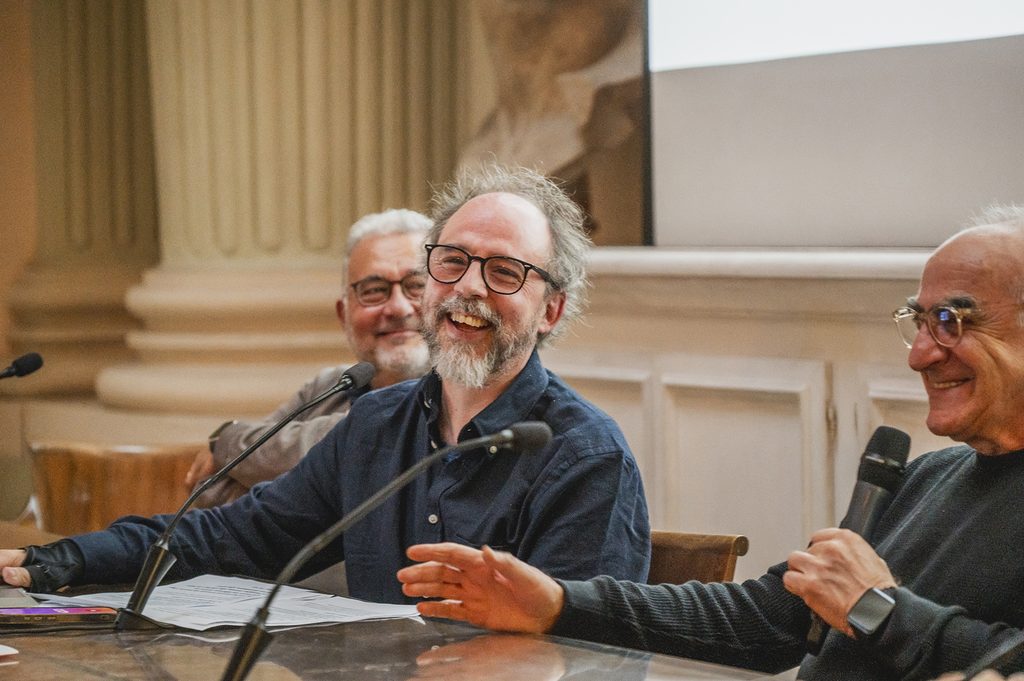
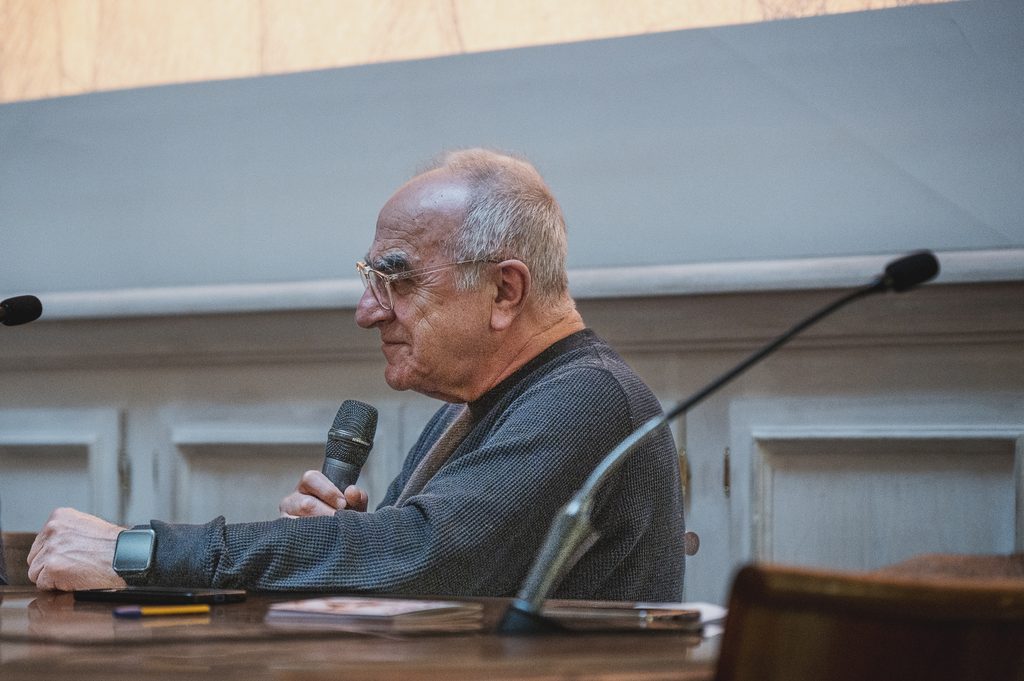
Gianluca Costantini and Tanino Liberatore. Photo by Francesca Sara Cauli, 2026.
Gianluca Costantini: And inevitably all of that found its way into your work, didn’t it?
Tanino Liberatore: Yes. I have to say that meeting the people from Cannibale didn’t change the way I drew so much as what I drew. They allowed me to bring out the worst part of myself, and that’s exactly what I’d been waiting for. I felt completely at home. When I made that cover for Cannibale, it was a total liberation. That was the moment when I truly became Liberatore.
Before that, I’d been keeping certain things inside, perhaps without even realizing it. With Cannibale, I felt free to represent absolutely anything. Of course, looking back at my work today, I realize I was still fairly restrained. I never really went that far. But at the time, it was an extraordinary feeling of freedom, something fundamental.
Meeting Stefano Tamburini was decisive. We then spent practically two or three years together all the time. We lived together in the sense that we only went back to our own homes to sleep. The rest of the day, we were always together. Stefano was already talking to me about Ranxerox in 1976. He already had the character in his head and was constantly telling me about it.
You have to remember that there was no Internet back then, and one of the most extraordinary inventions around was the photocopier. It was a relatively new technology, especially color photocopying. For Stefano, it became an absolutely fundamental tool, something he could use to do almost anything. And that’s where the idea for Ranxerox came from: a character assembled from the discarded parts of a photocopier. It wasn’t simply a way of making comics. It was the very idea of transforming the waste of a machine into a character.
Snake Agent[5] was another stroke of genius. Stefano had tremendous fun with photocopies. Since he was working with Il Male, they paid for them, and photocopying was very expensive at the time. He would go there and make hundreds of copies every day, until Vincino came along and told him off. But with those photocopies, he created the visual identity of Frigidaire. He developed his ideas, made Ranxerox, Snake Agent, and all the graphic design of Frigidaire. That was entirely his work, nobody else’s.
When we first met, I’d given Stefano one of my drawings, a portrait of Robert Wyatt. It was a really beautiful illustration, with a whole series of hyperrealistic insects crawling over Wyatt’s flat head. I’d given it to him as a present. Then one day I noticed that he’d used the drawing in the layout of a page. I said, “But how did you do that? Those don’t look like photocopies.” And he replied, “No, I cut up the original because I needed it.” Back then, people didn’t attach the same importance to original artwork, you understand? Today I’d have killed him!
Gianluca Costantini: So you found yourself among some extraordinary characters: Andrea Pazienza, Stefano Tamburini, Massimo Mattioli, the whole group that would go on to produce so much over the years. At a certain point, you decided to make Cannibale. But who actually made that decision? How did the magazine come about?
Tanino Liberatore: Cannibale was always Stefano’s idea. He started from Francis Picabia, who had published two issues of a magazine called Cannibale. So Stefano began with issue number three. The first Cannibale he produced was truly underground, printed by Stampa Alternativa. There was him and another guy called Alessandro, whose surname I can never remember. And that was it. Then Mattioli joined, and later Andrea and Filippo Scòzzari came along. Eventually we started producing a magazine that was distributed through newsstands. But the idea was always Stefano’s.[6]
Gianluca Costantini: Were you completely independent?
Tanino Liberatore: Let’s say we were lucky enough to have the people from Il Male[7] as our patrons. The magazine was doing incredibly well at the time. They financed us and, for a while, they even paid us a salary.
Gianluca Costantini: Were they the ones who got you into the newsstands?
Tanino Liberatore: Yes, yes. They even gave us a salary. They paid us. Of course, we all did work for Il Male too. But we were genuinely fortunate because, thanks to them, we could work without anyone stopping us from doing whatever we wanted. There was no censorship, no restrictions. We could represent absolutely anything.
We had that same freedom with Ranxerox when we started working on Frigidaire. If we’d taken a story like that to Linus, they probably would have said, “Fantastic, but it’s too violent. People aren’t ready for it yet.” That’s what publishers used to say. But the public has always been much further ahead than publishers imagine. Ranxerox had already been successful in Stefano’s black-and-white version, but when the color version appeared, it made an even greater impact, particularly in France.
To be honest, when I drew the first color pages during the summer, I was really worried. I remember returning to Rome in September to hand them in, thinking, “These guys are going to take the piss out of me.” Instead, nobody reacted with any particular enthusiasm. There was nothing extraordinary about their response. They simply said, “Okay, good job. Thank God you’ve finished.” They were mainly relieved because they needed those eight pages for the printer. Otherwise they’d have been left with eight blank pages!
In France, on the other hand, they bought Ranxerox immediately after the first installment was published. They didn’t even wait for the story to be completed or for the whole album to come out. They bought it straight away and signed the contract immediately. It was an extraordinary success.
Frigidaire: The Indispensable Superfluous
Gianluca Costantini: And then you made the leap: you decided to create a magazine called Frigidaire. Even today, I think a magazine like Frigidaire would be difficult to pitch. It brought together comics, journalism, writing, and graphic experimentation. It was a truly audacious project, wasn’t it? With Cannibale, you were still very much part of the counterculture and underground scene, whereas Frigidaire became something much broader, a magazine that could reach all kinds of readers.
Tanino Liberatore: Yes, but the idea was always Stefano’s. He had gone to America for his summer holidays and came back completely fired up. I don’t know exactly what he’d seen over there, because Stefano had this ability: he’d see something and then amplify it, transform it into something entirely new. He came back with the idea of making a magazine that would include comics, but not just comics. It was supposed to be a cross between Actuel and Métal Hurlant.[8] He arrived saying that we had to create a magazine unlike anything else. The slogan was “The Indispensable Superfluous,” which expressed exactly what we wanted to do. Something that might seem superfluous but was actually indispensable.
You also have to remember that Frigidaire was one of the first magazines to talk about AIDS, at a time when almost nobody was discussing it.[9] And not just AIDS. We published articles about Ebola and other diseases that later proved extremely dangerous. I clearly remember an article about research being conducted in Atlanta on viruses, diseases whose origins were still poorly understood, and the risks they posed.
Frigidaire wasn’t important only because of its comics, but also because of its articles, its stories, and the subjects it addressed. We covered things nobody else was talking about. And not because they were nonsense or provocations for their own sake, but because they were important issues that other publications simply ignored.
Gianluca Costantini: Of course, and Stefano’s trip to New York probably played an important role. Already in the 1970s, New York had many magazines that combined graphic design, drawing, comics, illustration, and politics. They published articles about activism, social movements, and what was happening in the city, but they were still very closely tied to underground culture. With Frigidaire, on the other hand, something changed, partly through that overwhelming use of color.
Tanino Liberatore: Yes, that was the main thing. Stefano came back with this idea of glamour, of a glossy magazine. Enough with fanzines, enough with photocopies. We had to make a magazine printed on glossy paper, something completely different. I still remember the first editorial, Viaggiare tra le merci (Traveling Among Commodities).[10] That was exactly the idea: to take everything that came out of the underground and bring it into a magazine with a completely new level of graphic and editorial quality.
I think that, graphically speaking, Frigidaire still hasn’t been surpassed. And the same goes for its content. I’m very proud to have been part of that gang. We’re talking about Stefano, Andrea, Scòzzari, Mattioli, and they were all extraordinary people. Scòzzari was an exceptional writer as well as a very good artist. Mattioli, in his own way, was a genius from another planet. Andrea and Stefano were two incredible minds.
And there were only five of us, all completely different from one another. We came from different places, different social backgrounds, had different personalities and different ways of seeing things. Yet there was an extraordinary understanding between us, something that held us together and that we never really tried to understand, perhaps because we were afraid of ruining it by trying to explain it. It was what connected us and allowed us to keep going. It’s quite difficult to describe.
Ranxerox, the Human Body, and Stefano Tamburini
Gianluca Costantini: And when Stefano Tamburini asked you to bring Ranxerox back for Frigidaire, did he want something completely different? A color character with muscles, skin, reflections, something that also conveyed the madness of Rome in those years?
Tanino Liberatore: No, he didn’t put it quite like that. You have to remember that Stefano and I practically lived together for two or three years. We spent our days together, took the bus together, talked constantly. Many situations that eventually appeared in Ranxerox were things we’d encountered in everyday life, sometimes on the bus itself.
For example, there’s a scene where Ranxerox breaks a little girl’s hand. It was inspired by a girl we used to see every day, who came up to us trying to sell us a wilted flower. We’d give her some money. Naturally, we never hurt her! But in the world of Ranxerox, Stefano could transform an everyday situation into something entirely different.
When we started discussing the new version, what Stefano mainly wanted was for the artwork to suit Frigidaire. It was no longer a fanzine, but a magazine with a different printing quality. He wanted more sophisticated artwork than the black-and-white drawings of the early stories, something closer to my work or Andrea’s. But he didn’t give me precise instructions about how to achieve it. He more or less told me to make a different Ranxerox, no longer in black and white, and to find my own solution.
So I began experimenting with muscles, skin, reflections, and the airbrush. I’d never done anything like that before, and I think the result surprised Stefano too. It really was an experiment.
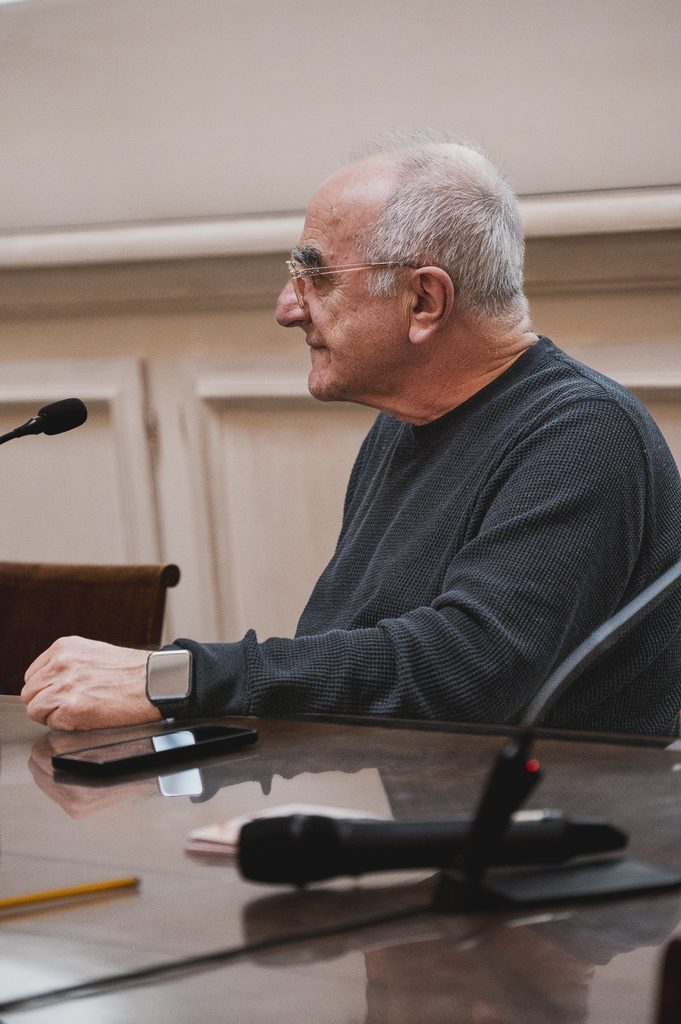
Tanino Liberatore. Photo by Francesca Sara Cauli, 2026.
Gianluca Costantini: At a certain point, though, Rank Xerox itself objected to the use of the name, didn’t it?
Tanino Liberatore: Actually, it was one of the company’s lawyers who took the initiative without even consulting the Italian management. He sent a cease-and-desist letter, and Stefano responded publicly in the pages of Il Male, making fun of him mercilessly. Later we heard that even the company’s executives had made fun of the lawyer. You have to remember that Il Male had become enormously well known by then and could get away with things like that. In any case, the company never intervened again.[11]
Gianluca Costantini: When people talk about your drawing, they often mention Michelangelo, Caravaggio, and the great artists of the Renaissance. But when I started learning more about comics, I also began to see other connections. For example, perhaps it’s just my impression, but I think of Richard Corben, especially in the way you represent the human body.
Tanino Liberatore: If anything, there’s more Mœbius than Richard Corben in my comics.[12] But I understand what you mean about the body. You also have to consider that we developed certain things at more or less the same time, without necessarily influencing one another.
I’ve always looked at a tremendous amount of other artists’ work. Perhaps a little less now, but in the past I looked at absolutely everything. Inevitably, some of it stays in your memory and resurfaces when you’re drawing. But I can assure you that when I sit down to draw, I don’t have any models in front of me, no photographs and no drawings by other artists. It’s very possible that certain images come back to me unconsciously, but it’s not something I deliberately try to do.
Corben is certainly an artist who left his mark, and I think he left his mark on me too. We had a fairly similar relationship with the human body, including the representation of women, but we worked in separate worlds. In fact, in some respects I think he was even better than me. We admired each other’s work, that’s true.
Gianluca Costantini: Then, sadly, Stefano Tamburini died. What happened to Ranxerox?
Tanino Liberatore: Stefano’s death, like Andrea’s, was terrible. Ranxerox was above all Stefano’s creation. I’ve always said that, at most, I could consider myself Ranxerox’s uncle, because Stefano was his father. That’s something I care about deeply. It bothered me, especially in France, when people talked about Ranxerox as though I were its creator. Sometimes it even made me angry, because I felt Stefano’s fundamental role was being forgotten.
I’d already started working on the third album with him and had completed about fifteen pages. There was also an idea for what came next, but I’d asked Stefano to change it because it seemed too similar to the earlier stories. I was also very slow at drawing and was working on other things in the meantime. So time went by, and while we were still trying to find a solution, Stefano died. At that point, I stopped. But those fifteen pages existed, and I wanted at least to complete the work somehow, to find a way to bring it to an end.
So I thought of asking Alain Chabat.[13] At the time, he was a journalist, and he’d conducted one of the most intelligent interviews I’d ever given. He was supposed to interview me about Ranxerox, but we ended up talking about everything except the comic itself: music, architecture, the world in which Ranxerox existed, and all kinds of other things.
It was an interview that made a real impression on me, and we stayed in touch. Alain later became a star in France. I asked him to help me develop a new version of the story, partly because I finally wanted to complete that work.
The original idea was still connected to Stefano. We’d already discussed certain possibilities, but I wasn’t satisfied with the direction they were taking. They seemed too close to things we’d already done, and I wanted to find something different. It wasn’t easy to continue Ranxerox without him.
A Single Image, Life in Paris, and Meeting Frank Zappa
Gianluca Costantini: I read something you said in an interview, and I’d like to ask whether you still identify with it. It’s similar to something Lorenzo Mattotti said in this very room about a year ago. You said that you’ve always liked comics, but that they’ve never really been your natural language. Your natural territory is illustration, or perhaps painting.
Tanino Liberatore: Yes, that’s true. I’ve always said that. Comics were a period in my life when I wanted to try doing something. I tried it, and I think I did it reasonably well. But if Andrea wanted to express something, he’d immediately invent a story, a comic strip, a comic. When I have something to say, I think of a drawing. I feel much closer to a photographer than to a film director.
When I make a single image, I get much more satisfaction from it than from drawing ten consecutive images. I’m interested in trying to say with one image what you could tell with ten. I don’t know whether I always manage to do it, of course, but that’s what I’m looking for. I want to find the image that’s enough on its own, that moment, that shot, that click which allows other people to understand everything you’re trying to communicate. That’s what gives me the greatest satisfaction.
Gianluca Costantini: We’ve traced your journey from Quadri to Pescara, then Rome. And in 1982, Paris. Why did you decide to move there? What were you looking for?
Tanino Liberatore: I’d always dreamed of Paris. It was part of the journey I’d imagined since I was a child, so for me it was an essential destination. When I finally went there and began to get to know the city, I liked it even more than I’d imagined. The same thing happened to me with New York.
Ranxerox had already started being published in France, and once I was invited to a comics event in Paris. While talking to my publisher, I told him how much I loved the city and that I’d move there immediately if I could find an apartment. He asked whether I was serious, and I said yes.
A few months later, he called and said, “Are you still willing to move to Paris? Because I’ve found the apartment.” At that point I had no excuses left, so I moved.
I didn’t move because I needed work. Initially, I did it simply because I wanted to live in Paris. But it turned out to be an excellent professional decision as well. I was welcomed incredibly warmly, not just because of Ranxerox, but also for my illustration work. When the French like you, they worship you. You immediately become French!
Gianluca Costantini: Let’s go back to Frank Zappa for a moment. Here we have a photograph of the two of you. Where were you?
Tanino Liberatore: We were in Rome, right here. It was the day we met him. Afterwards we went for a coffee, and he had Ranxerox with him. We were talking because the original idea was to make a comic about the misadventures of his Italian tour. Then, after he spoke to his manager, the project turned into an illustration for an album cover.
I remember that it was a day or two before the 1982 World Cup final between Italy and West Germany. During the match, someone in his entourage suggested going out for dinner because, with the whole of Italy watching television, there wouldn’t be anybody around. But Zappa found himself in the street just as Cabrini missed the penalty. Suddenly he heard all those swear words people were shouting.
And you have to know that Zappa was very familiar with Italian swear words. His father was Sicilian, and he used to say that when he got angry in the car, he’d start swearing in English and always end up in Sicilian.
Anyway, when he heard all that shouting, he decided not to go out for dinner. He went back to get his Walkman and started recording people’s voices, the sounds of the streets, the crowds marching along Via Veneto. Somehow, all that atmosphere eventually found its way into the album cover too.[14]
Batman, Cinema, and the Female Body
Gianluca Costantini: Now let’s make a fairly dramatic leap and move on to Batman. Looking at your work, someone might think you’d be the perfect artist for superheroes, with those bodies, those muscles, that ability to represent physicality. But for Batman, you chose a very different approach: almost classical, black and white, stark and rigorous.
Tanino Liberatore: I actually realized that working in black and white was much harder than I’d expected. I’d chosen a solution that distinguished between the dream, the black-and-white sections, and the parts rendered in gray tones, but then I realized I could have organized the whole thing differently and avoided a lot of problems. Still, it was a very interesting experience.
Batman is a character I enjoy drawing. And black and white fascinates me, even though I find it much more difficult than color. I really put a lot of myself into it. I also did another short story with an American writer, and I enjoyed that experience too.
American writers have a very precise way of writing scripts: they explain everything and define every stage of the story. You might think that would limit an artist’s freedom, but in both cases I actually felt very free.[15]
Gianluca Costantini: And what was it like working with Stefano Tamburini’s scripts? Were they just as detailed?
Tanino Liberatore: No, it was completely different. Stefano didn’t need to write everything in advance. He often added the dialogue after I’d already drawn the pages. That was a very natural way of working for me, because I wanted to be the one deciding on the framing, where the characters stood, and the movement of the camera, so to speak. You tell me the action, and I’ll decide where to put the camera. At that point, I become the director of the story.
Gianluca Costantini: And speaking of directing, let’s move on to another aspect of your career. You’ve also worked in cinema, for example on Ghostbusters and Asterix & Obelix: Mission Cleopatra. How did those experiences come about?
Tanino Liberatore: It all happened in a rather strange way. We had a mutual friend, Fershid Bharucha,[16] who worked extensively with the United States and was in contact with some of the most important American comic artists. He’d also produced a magazine in France called Special USA Magazine.
At some point he told me about a project for which they were looking for drawings of ghosts. He didn’t tell me much, except that they’d approached various artists and that each of us was supposed to submit our own ideas.
I made a few drawings and was paid for the work, but none of us would retain any rights to the images. I don’t even know whether they used anything from my designs. Perhaps some elements ended up in the film, but I certainly can’t say that I designed the ghosts in Ghostbusters.
For Asterix & Obelix: Mission Cleopatra, on the other hand, I really did work on the costumes. Not all of them, of course. I worked on some of Cleopatra’s costumes, as well as those of the pirates and the Romans. It was a very different experience from comics, because you had to think about something that would actually be made and worn by actors.[17]
Gianluca Costantini: I’d also like to focus on the role of the body in your work. I brought this book because it seems almost like a tribute to the human body, particularly the female body. The representation of women runs through practically your entire career, from the earliest illustrations to your most recent work.
Tanino Liberatore: I certainly can’t deny that. But I’d say there’s an important characteristic: the women I draw are often strong women, not submissive characters. That’s something that interests me a lot.
Gianluca Costantini: Has your idea of eroticism changed from the 1980s to today? Or does the way you represent women still come from the same imagination?
Tanino Liberatore: Women are still women! What’s changed is my eroticism, the way I look at them and represent them. I don’t think it depends so much on the subject you choose as on what’s going on in your head. It’s the details you put into the illustration, the body, the position, the gesture, that determine the erotic meaning of an image. It’s not so much about drawing a woman as how you draw her.
And of course people change, the world changes, and what you feel changes too. There are periods when eroticism can be slower, others when it’s more intense. It’s not something fixed, and it doesn’t necessarily depend on your age. It depends above all on the moment you’re living through.
Digital Drawing, Lucy, and the Return to Paper
Gianluca Costantini: Let’s turn to Lucy, which marks a return to long-form comics but also a major technical change. It’s a digitally produced work, with an almost obsessive attention to detail and to reconstructing a world from the distant past. What led you to choose that technique?
Tanino Liberatore: First, I need to explain something. Throughout my career, one of the most important things has always been the need to change. Ranxerox itself represented an enormous technical change. With Lucy, I wanted to take another step.[18]
I also chose digital drawing because I had someone I could constantly bother with questions, someone who could help whenever I didn’t understand how something worked. At the beginning, I wasn’t very experienced with computers. But I was convinced that digital technology would give me more possibilities to achieve a truly convincing result.
The story was set in an extremely distant past, with characters and environments that had to be reconstructed largely through imagination. That gave me tremendous freedom, but it also required a certain visual consistency. I thought the computer could help me achieve that.
So I began working digitally, and in a way I followed Lucy’s evolution myself. She was moving from walking on all fours to walking upright, while I, who was used to hunching over a drawing board, had to straighten up to look at the screen. It was almost a parallel evolution between me and the character!
At first, though, because I didn’t really understand the process, I made several mistakes. The pages were drawn in black and white and then colored in Photoshop. But the software required a very precise organization of layers: one for the drawing, one for the skin, one for the hair, and so on.
I’d started drawing as though I were working on paper. When I got to the coloring stage, I realized I needed to separate all those elements. So I practically had to redraw the first four pages to achieve a result consistent with the rest of the book.
Gianluca Costantini: Whenever I think of Tanino Liberatore, I imagine an artist who presses his pencil so hard against the paper that he almost tears through it. I’ve often wondered what you must have done to the graphics tablet you used all those years!
Tanino Liberatore: No, my line is strong, but not to the point of breaking my tools! Even when I draw with pencil or charcoal, which has now become one of my favorite materials, it’s not really about physical force. The mark can be violent, but the gesture itself isn’t necessarily violent.
Gianluca Costantini: Then, after this long digital experience, you returned to paper, drawing, and traditional techniques.
Tanino Liberatore: Yes, but it wasn’t easy. After so many years working digitally, returning to traditional techniques was genuinely difficult. At first, I stubbornly tried to use the methods I already knew, especially those I’d developed with Pantone markers. But I’d reached the limits of that technique. It no longer allowed me to move forward or discover anything new. At one point, to be honest, it was even making me lose the desire to draw.
So I decided to start studying again. I bought books about watercolor, oil painting, and charcoal. I went back to materials I’d known since art school but hadn’t used for many years. Oil painting in particular was something I’d hardly practiced at all.
I started with watercolor, even following the exercises in the books, and the first results gave me enormous satisfaction. I became passionate about drawing again.
Then came charcoal, and that was another total liberation. You have to remember that the original pages of Ranxerox were fairly small, just a little larger than A4. They were almost miniatures, considering how much detail they contained.
Now, on the other hand, I work on increasingly large formats. My drawing has become much more gestural. I’m more and more interested in the gesture itself rather than minute representation. It’s as though, by returning to techniques I knew as a young man, I’ve rediscovered a freedom I’d lost.
Gianluca Costantini: Now I’d like to ask you something that almost sounds like gossip: is it true that you turned down Alejandro Jodorowsky? I imagine there aren’t many artists in France who have refused one of his proposals!
Tanino Liberatore: Yes, I imagine there aren’t many either! But I said no because I know Jodorowsky. He proposes making one album, and by the time you know it, it’s turned into twenty! And for me, making comics has always been a sacrifice. I didn’t want to find myself committed to an endless series.
Of course, we remained friends. Jodorowsky is a very entertaining person, but he’s also extremely demanding. I told him quite clearly that I prefer working with people who know when to stop. He never stops!
“Drawing Can Stand Alongside People Who Take to the Streets”
Gianluca Costantini: I’d like to finish by going back to where we started, to the years of Cannibale and Frigidaire. In an interview, you said that back then you could be as cynical as you wanted, but there was still a sense in the air that you might be able to change the world.
When did that feeling end for you? And today, after so many years of work, looking at what’s happening in European cities, at the conflicts and wars surrounding us, do you think drawing can still have that kind of power? Can today’s artists rediscover the energy you had?
Tanino Liberatore: I think that, in some ways, some of the conditions we experienced back then are beginning to reappear. Perhaps this is exactly the right moment for another group like Frigidaire to emerge. There are important situations, sometimes dramatic ones, that inevitably influence artists’ work. What you do depends enormously on what you live through.
I really hope people start rebelling again, because up to now it seems to me that there’s been an overwhelming sense of apathy. Back then, we truly believed we could change the world. Then we became disillusioned fairly quickly. Today, I have to say, I don’t believe in it the way I did back then.
But when you’re very young, you have a particular kind of energy. You feel that what you’re doing can also be useful to other people, to those who take to the streets, who protest, who try to change things.
Rather than helping them, perhaps the right word is accompanying them. Drawing can accompany those people. It can stand alongside them. Because you can’t achieve anything on your own. There have to be many of you.
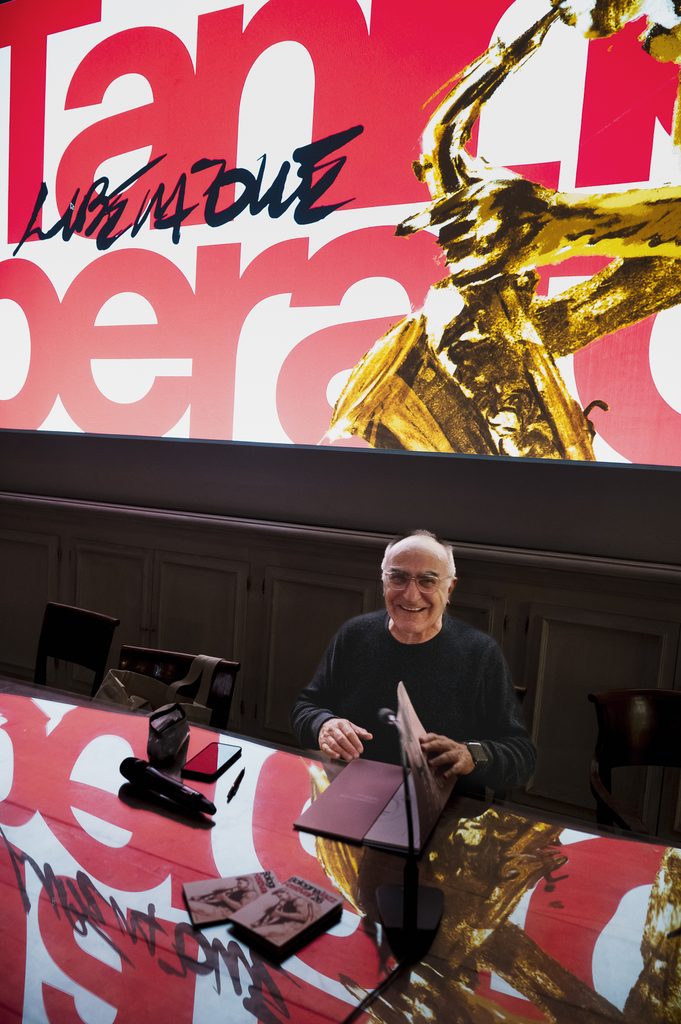
Tanino Liberatore. Photo by Francesca Sara Cauli, 2026.
Notes and References
[1] Pescara Art School. Founded in 1947 by Giuseppe Misticoni, initially as a private school, it became a municipal institution in 1950, provincial in 1960, and state-run in 1968. A building specifically designed for art education was inaugurated in 1962. Its students included Tanino Liberatore and Andrea Pazienza. Source: Unified Information System for Archival Superintendencies – Italian Ministry of Culture.
[2] Pantone. A professional system for identifying and reproducing colors. Among Italian illustrators in the 1970s and 1980s, the term was often used to refer to professional markers and coloring tools employed to produce comic pages and illustrations. Their appearance varied considerably depending on the paper used.
[3] Pentothal. The protagonist of Le straordinarie avventure di Pentothal (The Extraordinary Adventures of Pentothal), a comic by Andrea Pazienza first published in April 1977 in Alter Alter. The work combines autobiography, dreams, graphic experimentation, and references to the political and cultural movement of 1977.
[4] Armi. An eight-page color comic by Andrea Pazienza, published in June 1977 in Alter Alter, no. 6. Drawn on pink graph paper and colored with Pantone markers, it incorporates technical descriptions of firearms into the narrative. Source: Andrea Pazienza Archive – Alter Alter.
[5] Snake Agent. An experimental comic by Stefano Tamburini, published in Frigidaire beginning in December 1980. Tamburini used images taken from older spy comics, manipulating them through photocopying, enlargements, distortions, and montage. The photocopier thus became a creative instrument capable of generating movement and new narrative sequences.
[6] Cannibale. An underground comics magazine founded in Rome in May 1977 by Stefano Tamburini, Marco D’Alessandro, and Massimo Mattioli. Its first issue was numbered 3, as a tribute to the Dadaist magazine of the same name published by Francis Picabia in Paris in 1920, which had appeared in two issues. Filippo Scòzzari, Andrea Pazienza, and Tanino Liberatore joined the group in subsequent issues. The magazine’s numbering was deliberately irregular. Source: L’Arengario – Cannibale, First, Second and Third Series.
[7] Il Male. A historic Italian satirical magazine founded in Rome in 1978, considered one of the most important examples of satirical journalism and counter-information in Italy. Associated with figures such as Pino Zac and Vincino, it became famous for its fake editions of national newspapers, attacks on institutional politics, and graphic experimentation. It provided financial, editorial, and distribution support to the Cannibale group. Source: L’Arengario – Il Male, 1978.
[8] Actuel and Métal Hurlant. Two French magazines that played fundamental roles in the visual culture of the 1970s. Actuel, relaunched in 1970, combined counterculture, music, reportage, and editorial experimentation. Métal Hurlant, founded in 1975 by Jean Giraud/Mœbius, Philippe Druillet, Jean-Pierre Dionnet, and Bernard Farkas, transformed science-fiction comics and contemporary illustration.
[9] Frigidaire and AIDS. In February 1983, issue 27 of Frigidaire published Paolo Brogi’s article Cancer gay, beginning on page 84. It was among the earliest Italian journalistic accounts devoted to the AIDS epidemic. The title reflects terminology used by the press at the time, now abandoned because it is inaccurate and stigmatizing. Source: MoCu – Cancer Gay, the First Article Published in Italy About AIDS. Liberatore’s reference to articles about Ebola remains a personal recollection for which no precise bibliographical reference has been identified.
[10] Frigidaire and Viaggiare tra le merci. The first issue of Frigidaire appeared in November 1980. The magazine combined comics, journalism, photography, fiction, and visual experimentation. Its artistic editorial team included Andrea Pazienza, Stefano Tamburini, Tanino Liberatore, Filippo Scòzzari, and Massimo Mattioli. Vincenzo Sparagna was the editor-in-chief and wrote the editorial Viaggiare tra le merci (Traveling Among Commodities), published on page 5 of the first issue. Source: Frigidaire – Contents of the First Issue.
[11] Rank Xerox / Ranxerox. A character created by Stefano Tamburini and developed visually in the early stories with contributions from Andrea Pazienza and Tanino Liberatore. First appearing in 1978 in Cannibale, Ranxerox is an android assembled from photocopier components. The original name, Rank Xerox, was later changed to Ranxerox. With the move to Frigidaire, Liberatore created the color version that brought the character international recognition. Source: Feltrinelli – Tanino Liberatore.
[12] Richard Corben and Mœbius. Richard Corben (1940–2020) was an American comic artist and illustrator known for his anatomical depiction of bodies, experimental coloring, and work in fantasy and horror. Mœbius, the pseudonym of Jean Giraud (1938–2012), was one of the most influential French and international comic artists, a founder of Métal Hurlant and the creator of works such as Arzach and The Airtight Garage.
[13] Ranxerox 3: Amen! The third album in the series, published in France by Albin Michel in 1996. Following Stefano Tamburini’s death in 1986, the project was completed with contributions from Alain Chabat, a French actor, writer, comedian, and director. Chabat would later direct Asterix & Obelix: Mission Cleopatra. Source: Feltrinelli – Tanino Liberatore.
[14] Frank Zappa and The Man from Utopia. Frank Zappa (1940–1993), an American composer and musician, commissioned Tanino Liberatore to create the cover of his album The Man from Utopia, released in 1983. The illustration also refers to the difficulties and incidents that occurred during Zappa’s 1982 Italian tour, particularly the concert in Palermo on July 14. Source: Bologna Jazz Festival – Tanino Liberatore Illustrates BJF2026.
[15] Batman: Black and White – In Dreams. A short story published in August 1996 in the third issue of DC Comics’ Batman: Black and White series. Written by Andrew Helfer and illustrated by Tanino Liberatore, it represents a rare contribution by the Italian artist to American superhero comics. Source: Feltrinelli – Tanino Liberatore.
[16] Fershid Bharucha. A publisher and an important figure in the introduction of American comics to France, associated with publications such as L’Écho des savanes spécial USA and USA Magazine. His name has been reconstructed from references in the transcript; his precise role in connecting Liberatore with the production of Ghostbusters remains to be confirmed. Source: BDoubliées – Fershid Bharucha.
[17] Asterix & Obelix: Mission Cleopatra. A film directed by Alain Chabat, released in 2002. Tanino Liberatore worked on costume design alongside Philippe Guillotel and Florence Sadaune. The three received the César Award for Best Costume Design in 2003. Source: Académie des César – Astérix et Obélix: Mission Cléopâtre.
[18] Lucy – La speranza. A comic written by Patrick Norbert and illustrated by Tanino Liberatore, originally published in France in 2007 and released in Italy in 2017 by COMICON Edizioni. Set in prehistoric times, it follows a young Australopithecus afarensis and represents an important experiment in digital illustration in Liberatore’s career. Source: COMICON Edizioni – Lucy, La speranza.


