The editor-in-chief of the investigative outlet Al-Qatiba was detained as he was about to enter the studios of Express FM. He was scheduled to discuss Tunisia’s water crisis. His arrest comes amid growing pressure on journalists, lawyers, activists and political opponents in the country
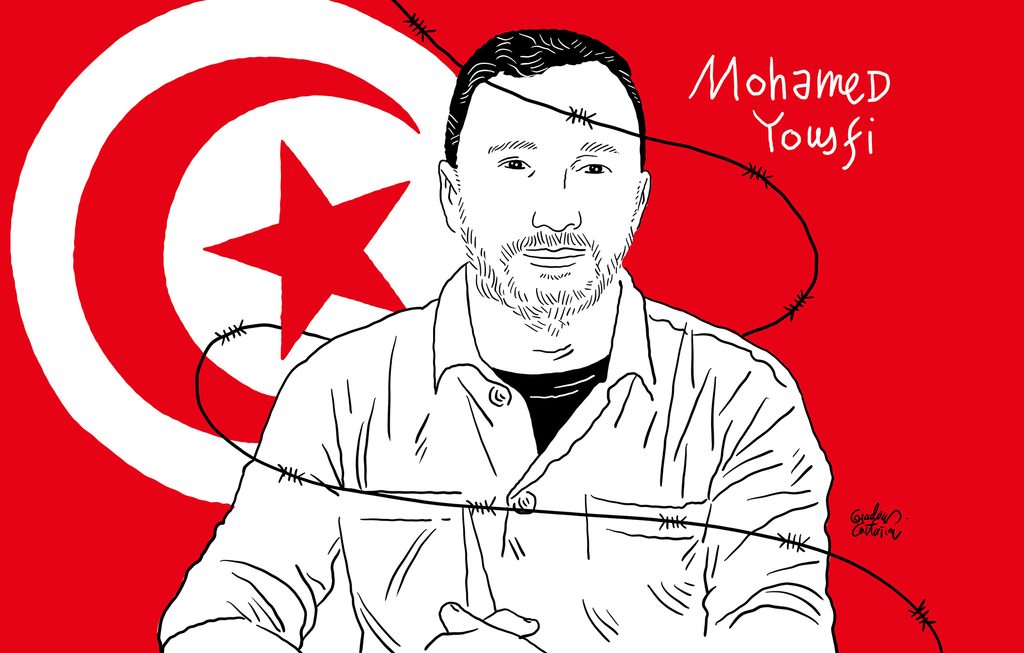
On September 4, 2026, Tunisian journalist Mohamed Yousfi was arrested as he was about to enter the studios of Express FM to take part in a radio program.
Yousfi is editor-in-chief of Al-Qatiba, an independent Tunisian media outlet known for its investigative journalism and reporting on political, economic, social and environmental issues.
According to Zied Dabbar, president of the National Syndicate of Tunisian Journalists (SNJT), police detained Yousfi just as he was preparing to enter the radio station.
Walid Ben Rhouma, the Express FM host who had invited him, said that officers told him the journalist was being taken away for questioning, without specifying the reason for his detention.
At the time of his arrest, Yousfi was due to appear on the program Le Mag Express to discuss water policies in Tunisia and a book published by Al-Qatiba on the issue.
It is a particularly sensitive subject. During the summer, numerous areas of Tunisia experienced disruptions to their water supply, while the country continues to face water scarcity, struggling infrastructure and the increasingly visible effects of the climate crisis.
It has not yet been publicly established whether Yousfi’s arrest is directly connected to his work on these issues.

The president of the Tunisian journalists’ union, however, said he believed the detention could be related to Yousfi’s journalistic work and his critical positions toward the authorities.
The case does not come at an ordinary moment.
In recent years, conditions for journalists and independent media in Tunisia have progressively deteriorated.
Following the 2011 revolution and the fall of Zine El Abidine Ben Ali, the country became a symbol of the possibility of a democratic transition emerging from the Arab uprisings. Freedom of expression and press freedom expanded in a way that appeared to mark a profound break with the country’s authoritarian past.
That experience has progressively entered into crisis.
In July 2021, President Kais Saied suspended parliament and subsequently assumed increasingly broad powers. Parliament was dissolved in 2022, and the president continued to govern through decrees and a new institutional framework that human rights organizations and international observers have repeatedly criticized for weakening democratic checks and balances.
One of the most controversial instruments is Decree-Law No. 54 of 2022, officially introduced to combat crimes related to information and communication systems.
The decree allows authorities to prosecute the dissemination of what it defines as “false information” through communication networks. Press freedom and human rights organizations have denounced its use against journalists, lawyers, activists and political opponents.
During 2026, several figures in the Tunisian media have been convicted or imprisoned.
Journalist Zied el-Heni was sentenced to one year in prison. Presenter Mourad Zeghidi and political commentator Borhen Bsaies were sentenced to three and a half years. Khaoula Boukrim, founder of the news website TUMEDIA, was sentenced in June to four years in prison in absentia after leaving the country.
The pressure does not affect journalism alone.
In recent years, leaders of major opposition parties, lawyers, human rights defenders, activists and businesspeople have been imprisoned, often in proceedings involving state security, corruption or money laundering.
On September 3, just one day before Yousfi’s arrest, Tunisia’s Court of Cassation upheld sentences in the major trial involving dozens of opposition figures, lawyers and human rights defenders accused of conspiring against the state.
Tunisian authorities reject accusations that they are establishing an authoritarian system. Kais Saied has repeatedly maintained that freedoms are guaranteed and that judicial proceedings concern the enforcement of the law rather than the repression of dissent.
But for those monitoring press freedom, the problem goes beyond any single judicial proceeding.
It concerns the effect that a succession of arrests, trials and convictions has on those who continue to ask questions, investigate and criticize those in power.
It is a dynamic that runs through many of the stories documented by ChannelDraw.


CHANNELDRAW STUDIO · INDEPENDENT PUBLISHING
Active Art Yearbook
A year of drawings, stories and civic engagement. Discover the Channeldraw annual volumes.
Explore the yearbooks →From the Italian case of Sigfrido Ranucci to journalists imprisoned around the world, and the journalists killed while documenting the war in Gaza, the issue is not only what happens to one individual.
The question is how much space remains for journalism when asking questions of those in power becomes increasingly dangerous.
In Mohamed Yousfi’s case, there is an image that makes this question particularly concrete.
A journalist is on his way to a radio station.
He is about to enter a studio and speak into a microphone about a matter of public interest: water.
He never makes it inside.
He is detained outside the entrance and taken away for questioning.
At the moment, we still do not know what charges, if any, will be brought against him or how the case will develop.
But we do know that Mohamed Yousfi is not the first Tunisian journalist to find himself in this situation.
And it is precisely this repetition that turns an individual arrest into a question of press freedom.
ChannelDraw tags: Human Rights · Tunisia
Sources
- Reuters — Tunisian police arrest prominent journalist Mohamed Yousfi, union says, September 4, 2026
- Express FM — Mohamed Yousfi detained outside the radio station, September 4, 2026
- Al Jazeera — Tunisia arrests journalist Mohamed Yousfi amid crackdown on critics, September 4, 2026
- Deutsche Welle — Tunisian journalist Mohamed Yousfi arrested, September 4, 2026
- National Syndicate of Tunisian Journalists — SNJT
ChannelDraw is independent and reader-supported. Your support helps us continue documenting artists, journalists and activists whose voices are threatened or censored.
Other ways to support ChannelDraw
You can also support our independent work by joining us on Patreon or Substack, or by purchasing a ChannelDraw Yearbook. Every contribution helps us keep ChannelDraw independent and continue documenting stories that need to be seen.


