From Roubaix to the leadership of the Union syndicale lycéenne: the nineteen-year-old who has become one of the leading voices of France’s high school protests.
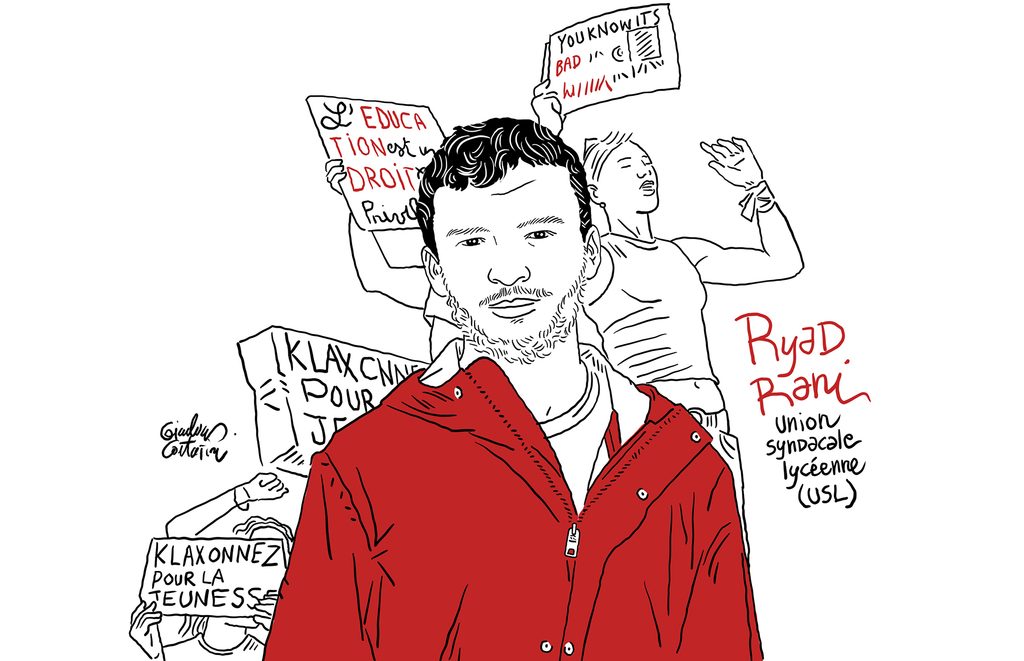
Ryad Rani is nineteen years old. Born in the working-class Pile neighbourhood of Roubaix, he grew up in Wattrelos, in northern France. Having recently completed his baccalauréat, he has become one of the most recognisable faces of the high school protests. His story begins far from government offices and television studios, in an area marked by deep social inequalities.
As media attention has grown, Rani has emphasised his role as a representative: gathering students’ demands, making them public and bringing them before those who make decisions. He resists being portrayed as an individual leader, describing himself instead as a union representative working on behalf of high school students. Wattrelos remains the city to which he feels most closely connected.
In spring 2026, he was elected to lead the Union syndicale lycéenne, an organisation founded in 2023. His work now involves turning problems students encounter every day into collective demands: lessons cancelled because teachers are unavailable, overcrowded classrooms, deteriorating buildings, exhausting timetables and shortages of school health and social support staff.


CHANNELDRAW STUDIO · INDEPENDENT PUBLISHING
Active Art Yearbook
A year of drawings, stories and civic engagement. Discover the Channeldraw annual volumes.
Explore the yearbooks →In his public statements, Rani often returns to a concrete example: preparing for the baccalauréat while spending months without a teacher in a subject students will be examined on. Added to this is the pressure of Parcoursup, France’s higher education admissions system, which the movement criticises for its role in selecting students. At the centre of his activism is the right to study in decent conditions, regardless of the neighbourhood in which someone grows up.
The USL has organised mobilisations alongside the Union étudiante, connecting high school students’ demands with those of university students. Their protests concern education funding, the physical conditions of schools and universities, and opportunities to continue studying.
On 2 October, Rani met Education Minister Édouard Geffray alongside other representatives of youth organisations. Afterwards, he distanced himself from violence and called for the mobilisation to continue until concrete measures were adopted to improve learning conditions. Dialogue with the French Ministry of Education and public protest have become two aspects of his union work.
His growing public visibility has also made him a target of racist abuse and death threats. The education union FNEC FP-FO has condemned these attacks and expressed solidarity with him and the USL.
ChannelDraw is independent and reader-supported. Your support helps us continue documenting artists, journalists and activists whose voices are threatened or censored.
Other ways to support ChannelDraw
You can also support our independent work by joining us on Patreon or Substack, or by purchasing a ChannelDraw Yearbook. Every contribution helps us keep ChannelDraw independent and continue documenting stories that need to be seen.


