Portraits, Drawings and the Memory of St. Paul’s Within the Walls
An Exhibition by Gianluca Costantini
Celebrating the 150th Anniversary of St. Paul’s Within the Walls · Rome, 1876–2026

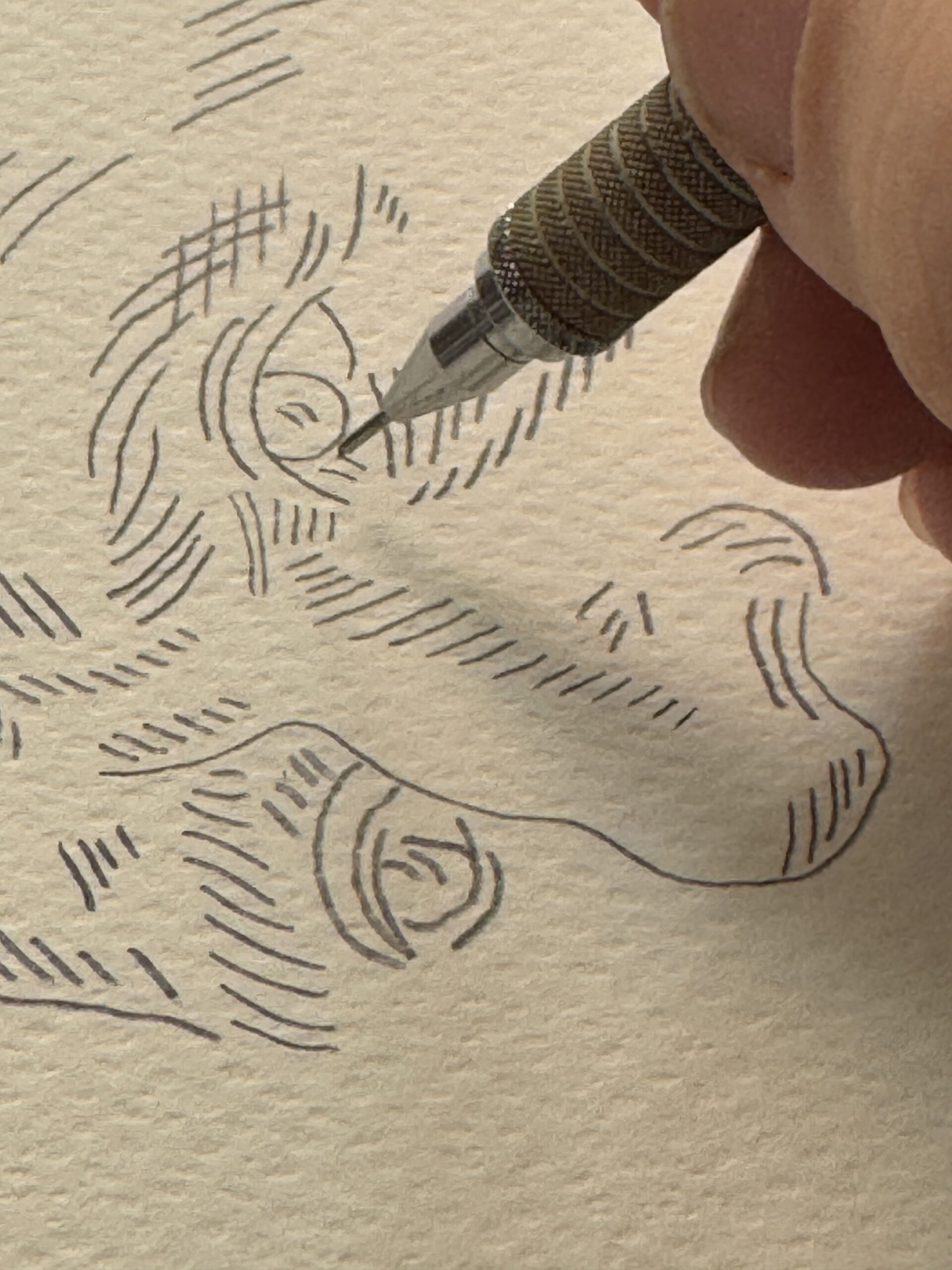
There are places where images do not belong solely to the past, but continue to tell the stories of the people who imagined, drew and created them. Places where an artist’s work survives through the hands of others, crossing generations, techniques and different geographical boundaries.
St. Paul’s Within the Walls, the American Episcopal Church in Rome, is one of these places. Built in the second half of the nineteenth century on Via Nazionale, it houses an extraordinary artistic heritage in which Italian medieval architecture, the English Pre-Raphaelite movement and the Byzantine mosaic tradition come together in a project that involved artists, architects, craftspeople and workshops from several European countries.
Created to mark the 150th anniversary of the consecration of St. Paul’s Within the Walls (1876–2026), Gianluca Costantini’s exhibition retraces the artistic history of the church through portraits of the people who contributed to its construction and decoration. Through drawing, different printmaking techniques and a contemporary mosaic, the project brings the memory of this place into dialogue with the present, giving visibility not only to the great artists but also to the craftspeople and collaborators who made its creation possible.
Gianluca Costantini is an artist who has long used drawing as a means of bearing witness, denouncing injustice and defending human rights. His work explores wars, repression, migration and the stories of people persecuted for their beliefs. Through portraiture, he depicts journalists, activists, dissidents and men and women fighting for freedom.
This attention to individuals and their personal stories also forms the starting point of his research into St. Paul’s Within the Walls. The project seeks not only to reconstruct the artistic history of a building, but also to bring to light the lives of those who made it possible, recognising drawing as a medium capable of crossing time and preserving memory.
Through letters, archival documents, preparatory drawings and historical accounts, the research gradually expanded, reconstructing an artistic geography stretching from London and Birmingham to Venice, Ravenna and Rome.
Among these cities, Ravenna occupies a special place. Not only because Edward Burne-Jones visited it in 1873 and retained a memory deeply connected to its Byzantine mosaic tradition, but also because it is Gianluca Costantini’s hometown and the place where he received his artistic education.
Originally from Ravenna, Costantini studied at the Gino Severini Art Institute, now part of the Nervi-Severini Art High School, and subsequently in the Mosaic Decoration programme at the Academy of Fine Arts in Ravenna. Long before becoming the subject of this research, mosaic was therefore part of his artistic education, his knowledge of materials and the visual heritage that accompanied his formative years.
The exhibition emerges from this encounter: a nineteenth-century story reconsidered through drawing, printmaking and the creation of a new contemporary mosaic, presented for the duration of the exhibition in dialogue with the church’s historic decoration.
A Church in a Changing Rome
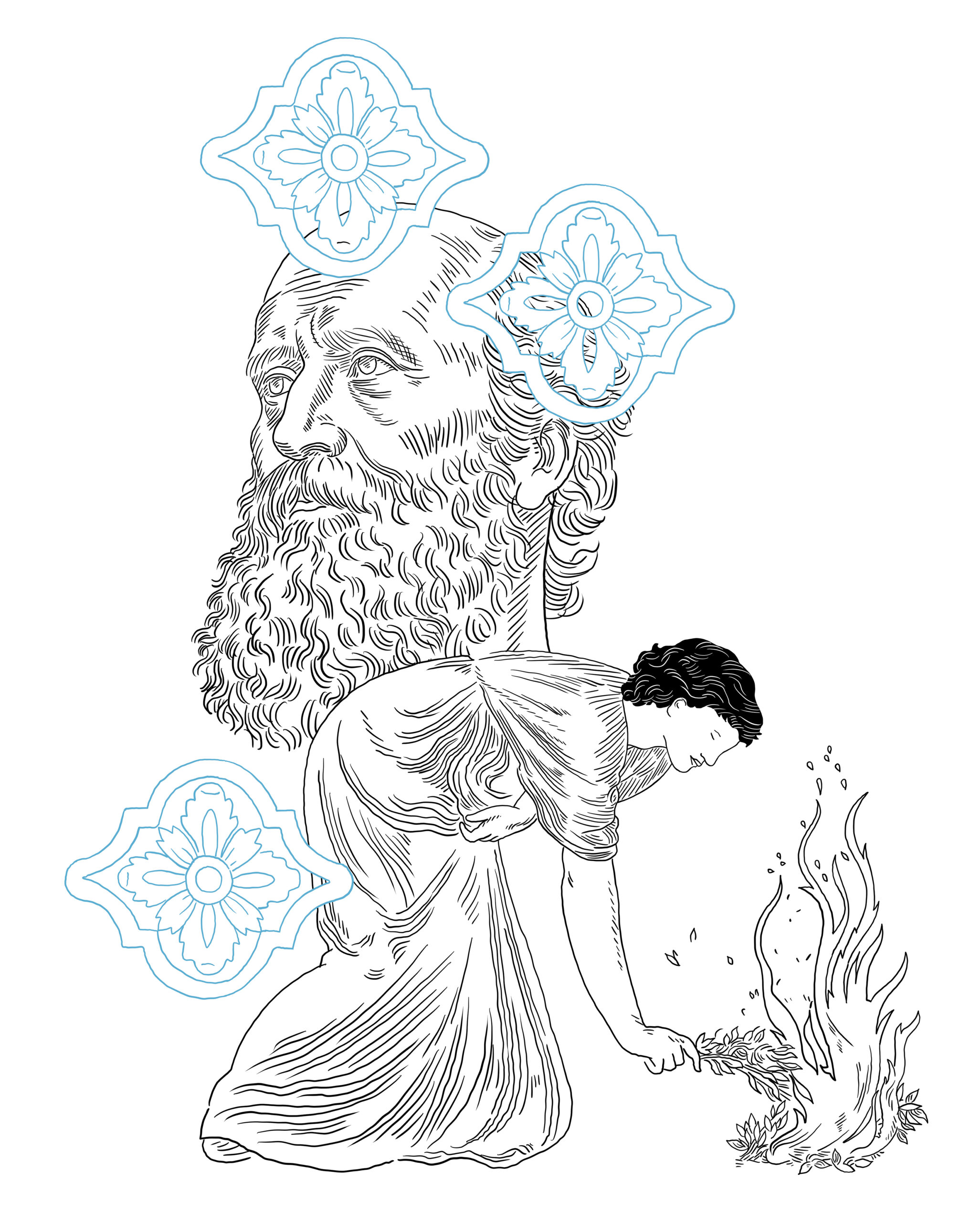
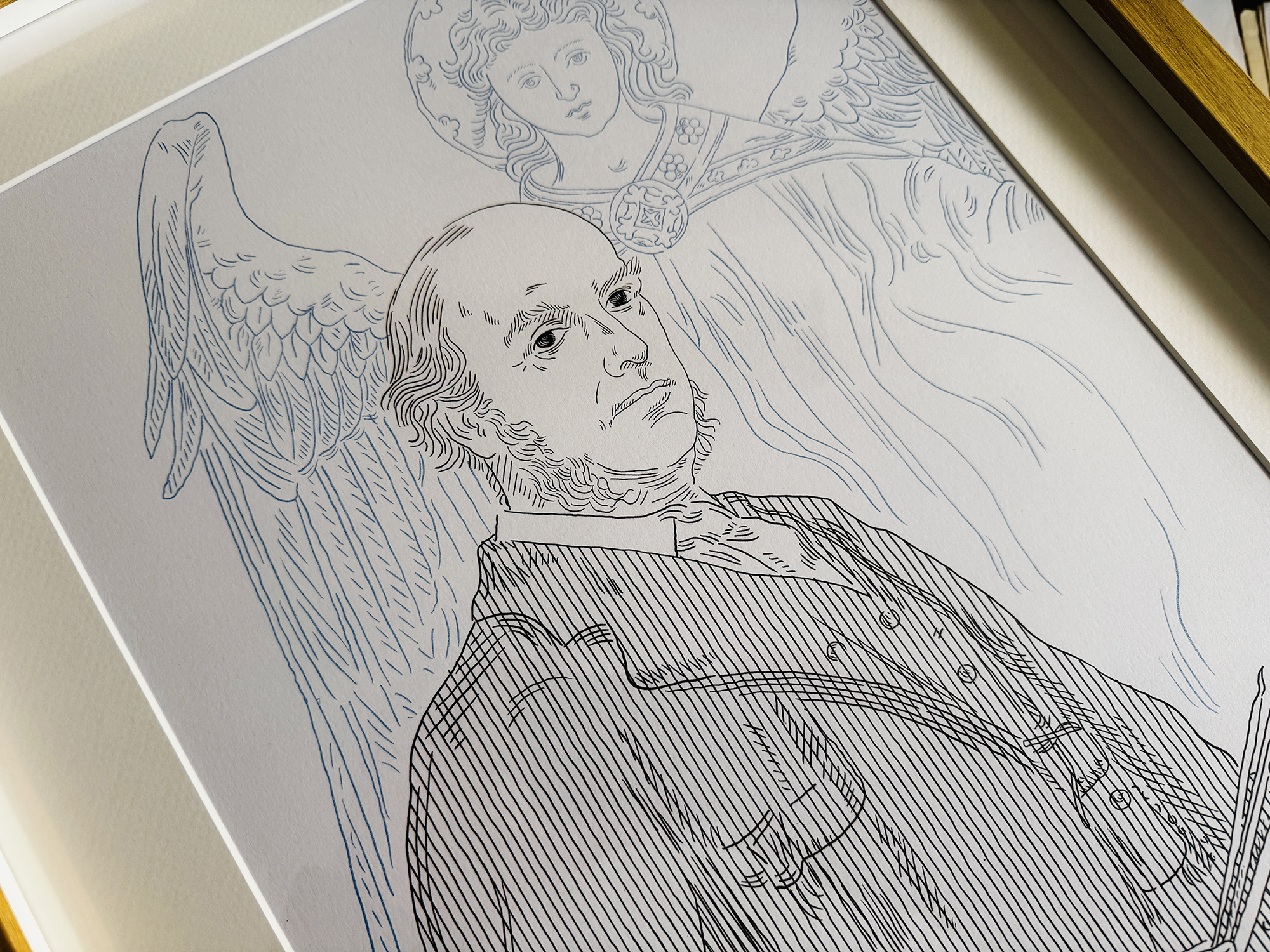
Technical pen drawing executed using a vintage pen plotter by Pen Plot Studio in Hummelo, the Netherlands, unique edition, 2026
The history of St. Paul’s Within the Walls begins at a moment of profound political and cultural transformation.
In 1870, with the capture of Rome by Italian troops and the end of the temporal power of the popes, the city became part of the Kingdom of Italy. The following year, it became the capital of the new state. New streets were opened, neighbourhoods emerged, buildings were constructed, and the architecture of the new administration began to stand alongside that of ancient and papal Rome.
It was in this context that the American Reverend Robert Jenkins Nevin (1839–1906) promoted the construction of a church for the American Episcopal community.
Nevin was not only a clergyman but also a man deeply interested in art, architecture and European culture. His project carried a significance that extended beyond the construction of a place of worship: to establish a Protestant church within the historic walls of Rome, in a city where the possibility of building non-Catholic places of worship had long been severely restricted.
Today, St. Paul’s belongs to the Convocation of Episcopal Churches in Europe, which forms part of the Episcopal Church and the wider Anglican Communion.
The architectural project was entrusted to George Edmund Street (1824–1881), one of the leading figures of the British Gothic Revival.
Street had an extensive knowledge of Italian medieval architecture. He had travelled throughout the peninsula, studying its churches, structures, decoration and use of materials. In 1855, he published Brick and Marble in the Middle Ages: Notes of Tours in the North of Italy, an important study of medieval architecture in northern Italy.
For the Roman church, he chose an architectural language combining Romanesque and Gothic elements. Red brick alternates with pale travertine, creating a chromatic rhythm that continues inside the building. The proportions, arches, columns and decorated surfaces form a space in which architecture cannot be separated from the arts that complete it.
An important resource for studying Street’s work is the Paul Joyce Archive at the Paul Mellon Centre, which includes research documentation, architectural drawings and material relating to his buildings.
The foundation stone was laid on 25 January 1873, the Feast of the Conversion of St. Paul. The church was consecrated in 1876, while work on its decorative programme continued in the following decades.
One hundred and fifty years after its consecration, the exhibition offers an opportunity to revisit this history through a contemporary perspective. It is not simply a celebration of an anniversary, but an invitation to explore the artistic heritage of the church, rediscover the people who created it and understand how images continue to establish connections between different periods, cultures and generations.
The building was therefore conceived at a time when Rome was redefining its identity. Its very existence bears witness to the complexity of an era in which different religious traditions began to share an urban space that had previously been deeply shaped by papal authority.
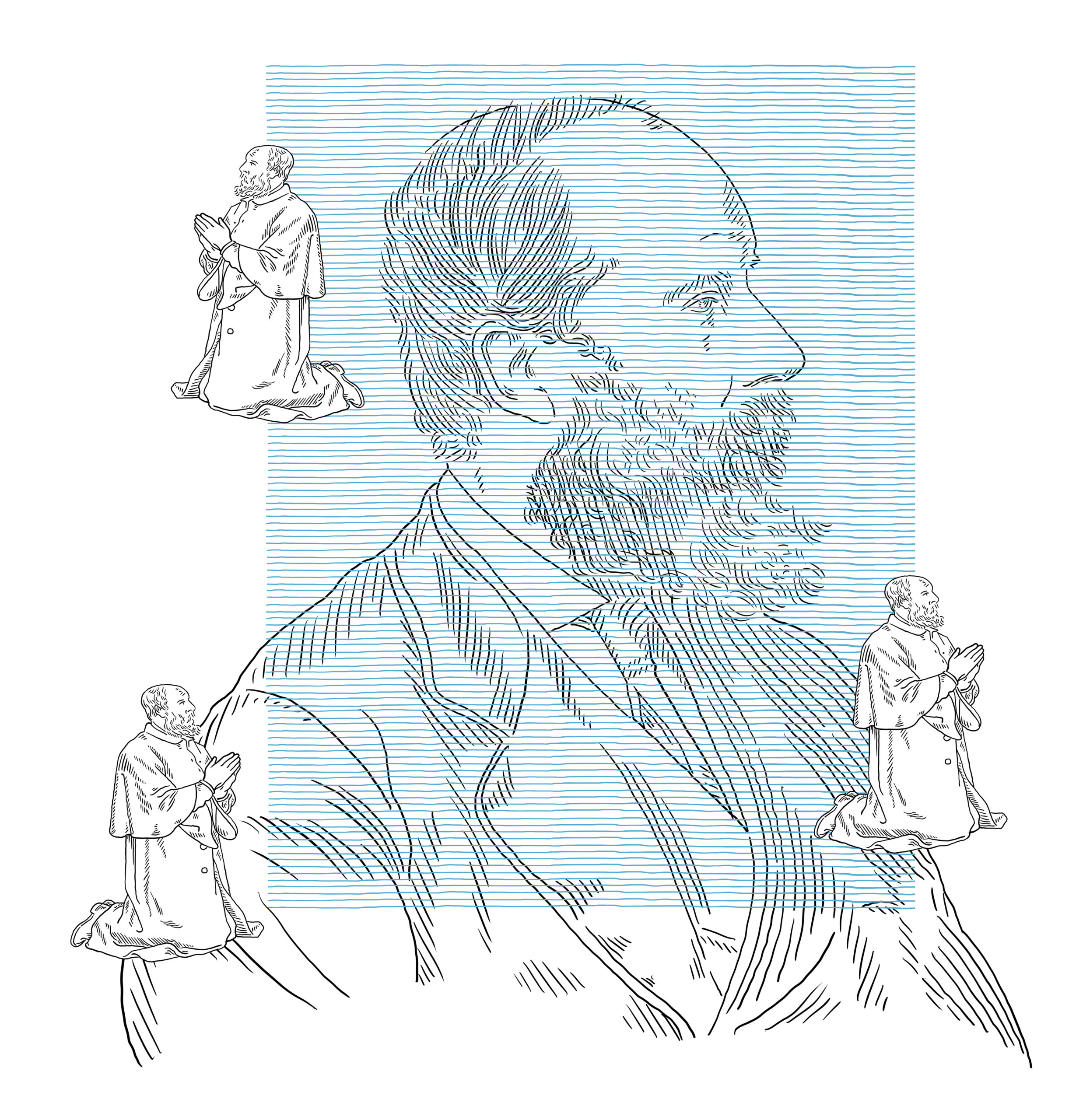
Technical pen drawing executed using a vintage pen plotter by Pen Plot Studio in Hummelo, the Netherlands, unique edition, 2026
Glass, Ceramics and the Hands of Craftspeople
and now every colour remembers it
Risograph print produced by Tiratura in Ravenna, in an edition of 6 copies, 2026
Upon entering the church, the first impression is that of a space constructed through colour.
The stained-glass windows filter natural light and depict episodes from the life of St. Paul. They were created by the renowned English firm Clayton & Bell, founded by John Richard Clayton and Alfred Bell.
John Richard Clayton (1827–1913) came from the world of drawing and illustration, while Alfred Bell (1832–1895) had developed his artistic training in the fields of decorative arts and architecture.
Together, they established one of Britain’s most important stained-glass workshops, contributing to the decoration of churches and major public buildings.
Their work can also be explored through the collections and documentation of The Stained Glass Museum in Ely and through the windows they designed for Westminster Abbey.
At St. Paul’s, light passes through their stained-glass windows, continually transforming the perception of the space. Coloured glass is not merely a decorative surface: it is a material that transforms light and becomes an integral part of the architecture.
The research also brought to light a lesser-known figure, Frederick Garrard, a ceramicist and manufacturer of decorative tiles active in London and connected to George Edmund Street’s professional circle.
The church’s ceramic decoration has traditionally been associated with William Morris, a central figure of the Arts and Crafts movement. However, specialist studies have identified Garrard’s role in its production, revealing a lesser-known history of craftsmanship and decorative experimentation.
The William Morris Gallery in London is dedicated to Morris’s life and work and also preserves works by artists associated with his circle, including Edward Burne-Jones.
This detail tells us something essential: the history of a building does not belong only to its most celebrated artists. It is also the history of materials produced in workshops, of technical skills and of crafts that rarely become the focus of historical narratives.
Recovering these figures means recognising the collective nature of artistic creation and the fundamental role of those whose work makes the realisation of a project possible.
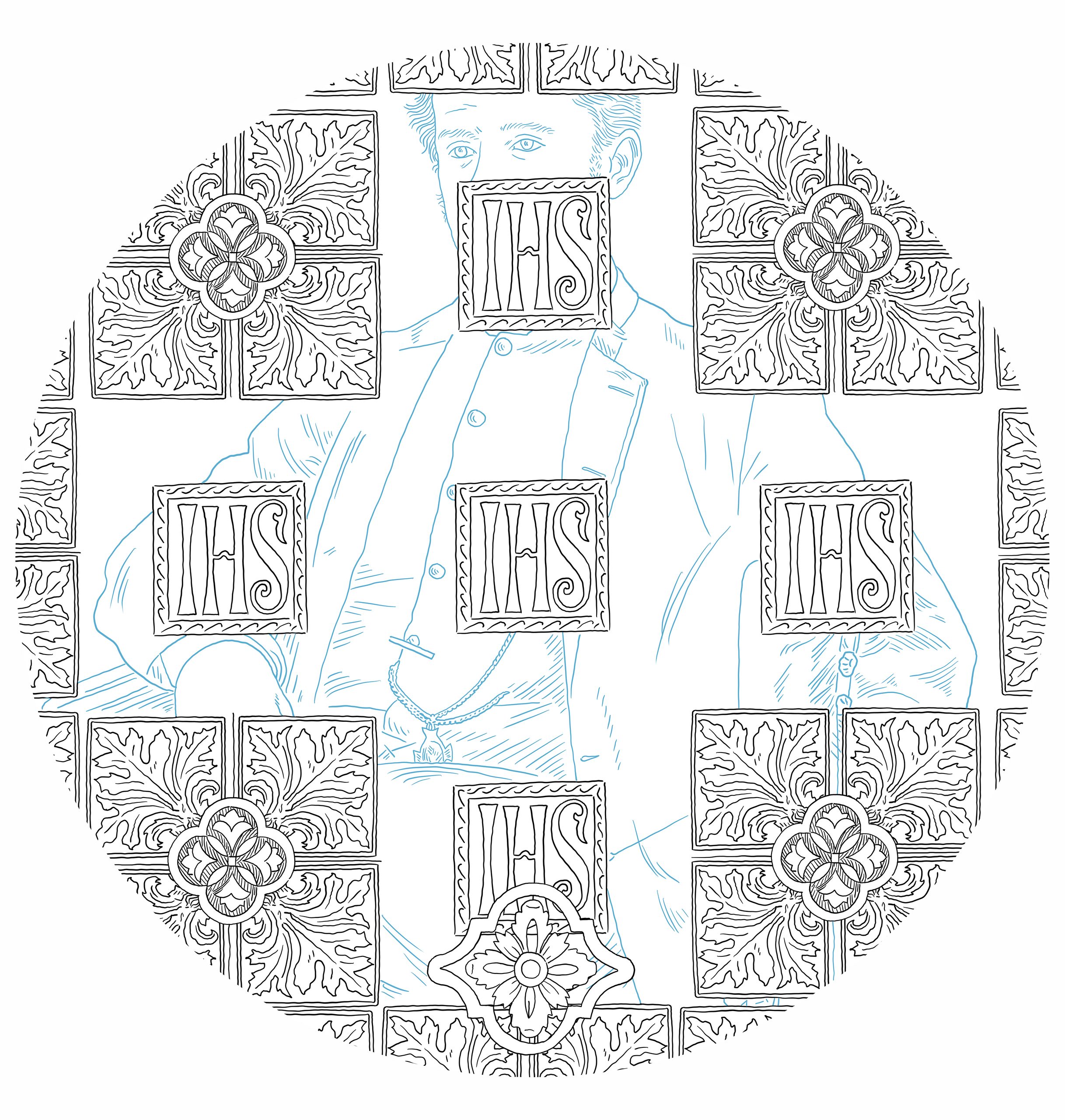
Fine art giclée print produced by ArtOk in Palmanova, unique edition, 2026
Edward Burne-Jones and the Journey to Ravenna
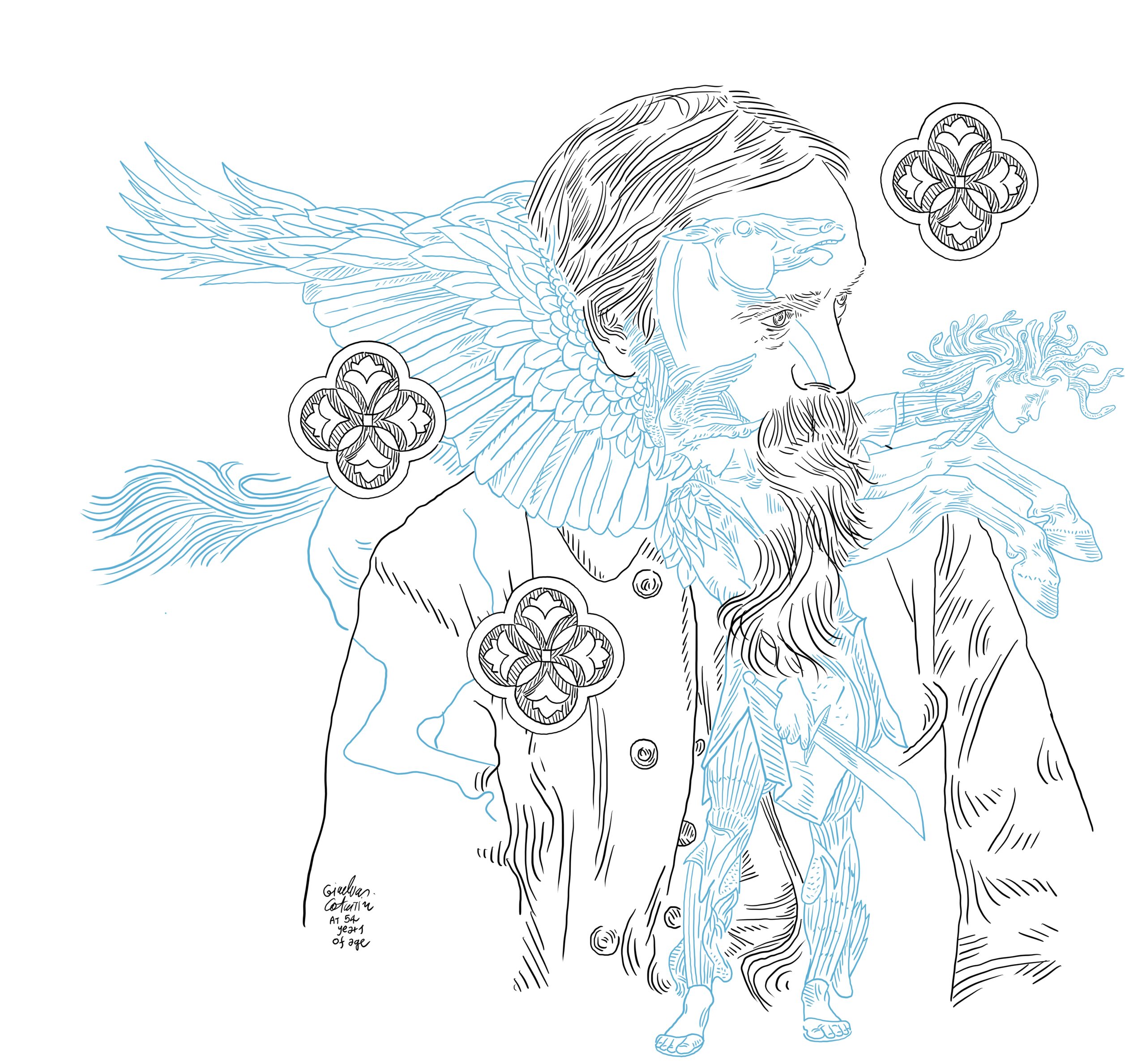
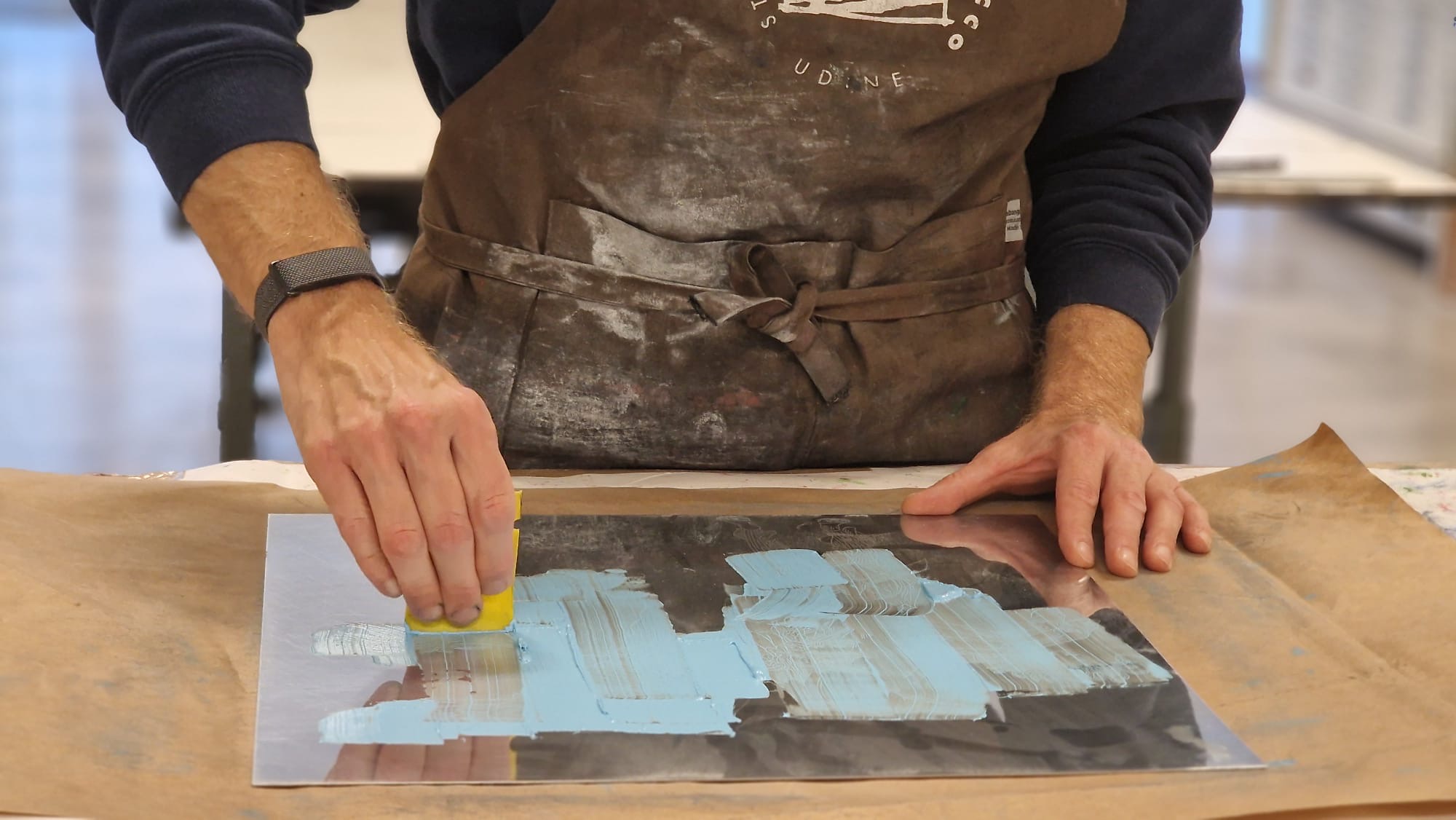
Etching from two plates, printed by Stamperia d’Arte Albicocco in Udine, in an edition of 10 copies, 2026
The most celebrated artist associated with the decoration of St. Paul’s is Edward Burne-Jones (1833–1898), an English painter closely associated with the second generation of Pre-Raphaelites and a friend of William Morris.
In his works, the medieval world becomes a suspended space, inhabited by silent figures, angels, knights, gardens and characters who seem to exist outside time. In ancient images, Burne-Jones sought not only aesthetic models but also a different relationship between art, spirituality and imagination.
A major collection of his work is preserved at Birmingham Museum & Art Gallery, an important centre for the study of Pre-Raphaelite art. The Burne-Jones Catalogue Raisonné Foundation is also dedicated to systematically documenting the artist’s works, including those created by his studio and collaborators.
To understand his relationship with the Roman mosaics, it is necessary to return to 1873, the year of his final journey to Italy.
During this trip, he visited several cities, including Ravenna. His journey is documented in letters collected by his wife, Georgiana Burne-Jones (1840–1920), in Memorials of Edward Burne-Jones, published in 1904.
In one letter, the artist writes that he is on his way to Ravenna; in another, he confirms that he arrived there, adding that he fell ill almost immediately. A fever, which subsequently forced him to remain in Bologna for several days, brought his Italian journey to an end.
Nevertheless, the memory of Ravenna remained vivid. In a later letter, Burne-Jones advised travellers visiting Italy to take quinine before entering the city’s churches, which he described as “heavenly churches”.
These buildings and their mosaics belonged to an artistic world that deeply fascinated him: frontal figures, golden backgrounds, intense colours, solemn gestures and the ability of images to transform an architectural space into a vision.
It is not yet possible to establish with certainty, from the letters alone, which basilicas he actually visited during his brief stay in Ravenna. What is documented, however, is the profound relationship the artist developed with the city’s artistic tradition.
When, some years later, he was designing the mosaics for the American church in Rome, he wrote that he was undertaking the work for the love of Venice, Ravenna and the seven impenetrable centuries between them.
“For love of Venice and Ravenna and the seven impenetrable centuries between them.”
This is an extraordinary testimony, as it allows us to recognise, in the artist’s own words, the connection between his Roman work and the Byzantine mosaic tradition.
The research into his 1873 journey also led to the Fitzwilliam Museum in Cambridge, which preserves a sketchbook used by the artist during his Italian travels. The document offers an insight into how he observed and studied art, although it has not yet been possible to identify with certainty drawings executed in Ravenna.
The relationship between Burne-Jones and Ravenna forms one of the central threads of the exhibition: an encounter between the memory of Byzantine art and the imagination of an English artist who looked to images of the past as a means of creating new visions.
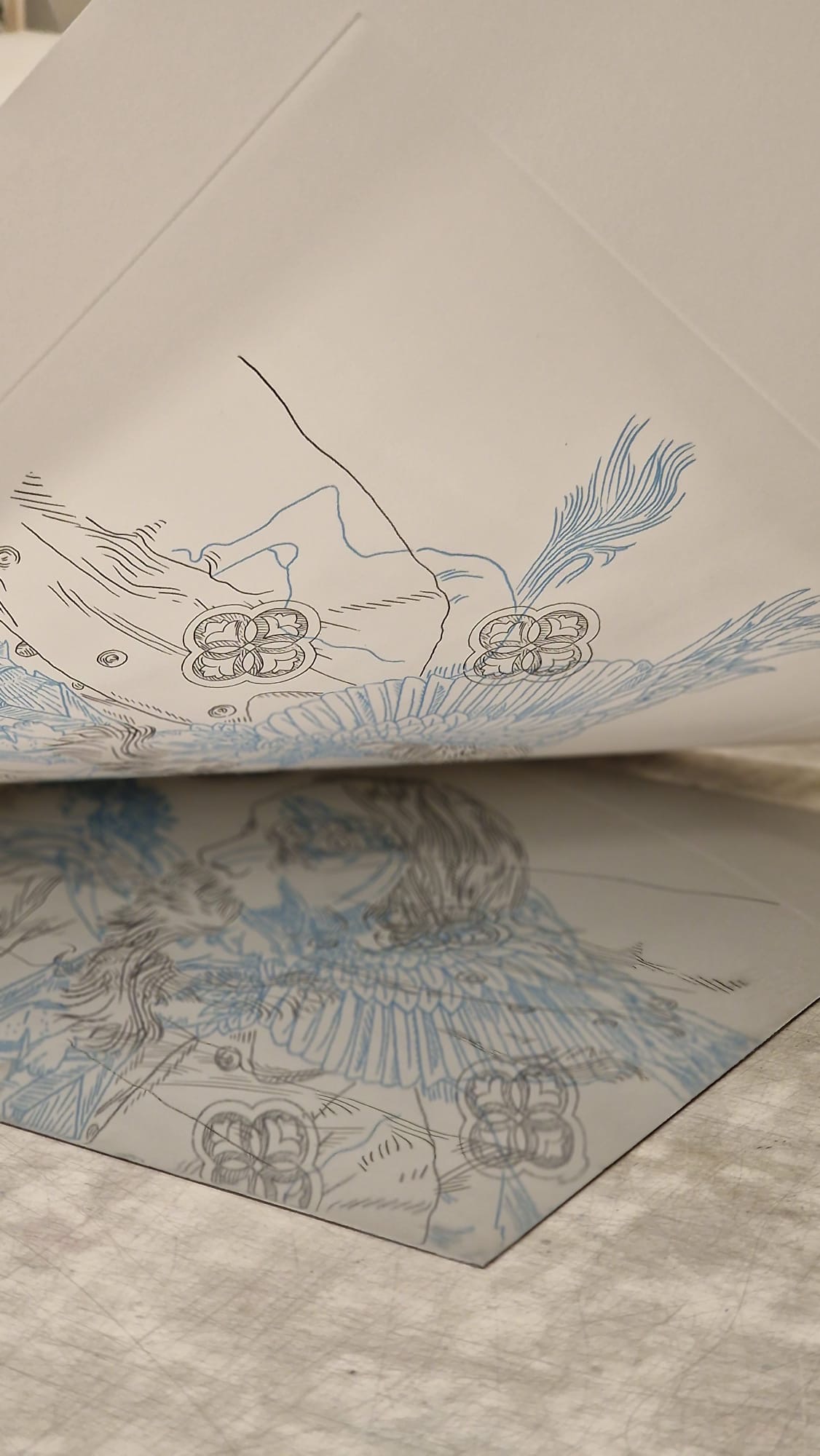
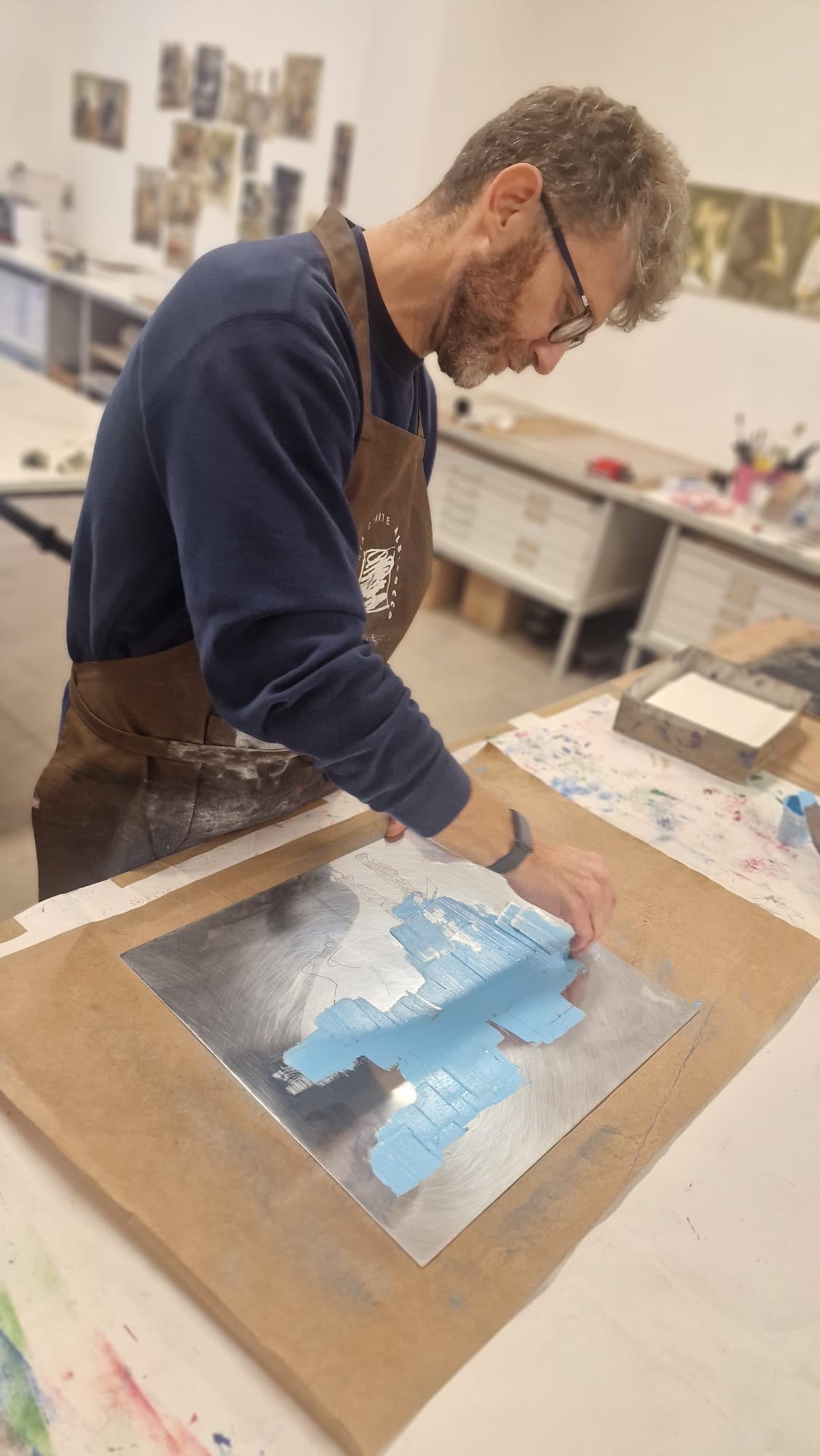
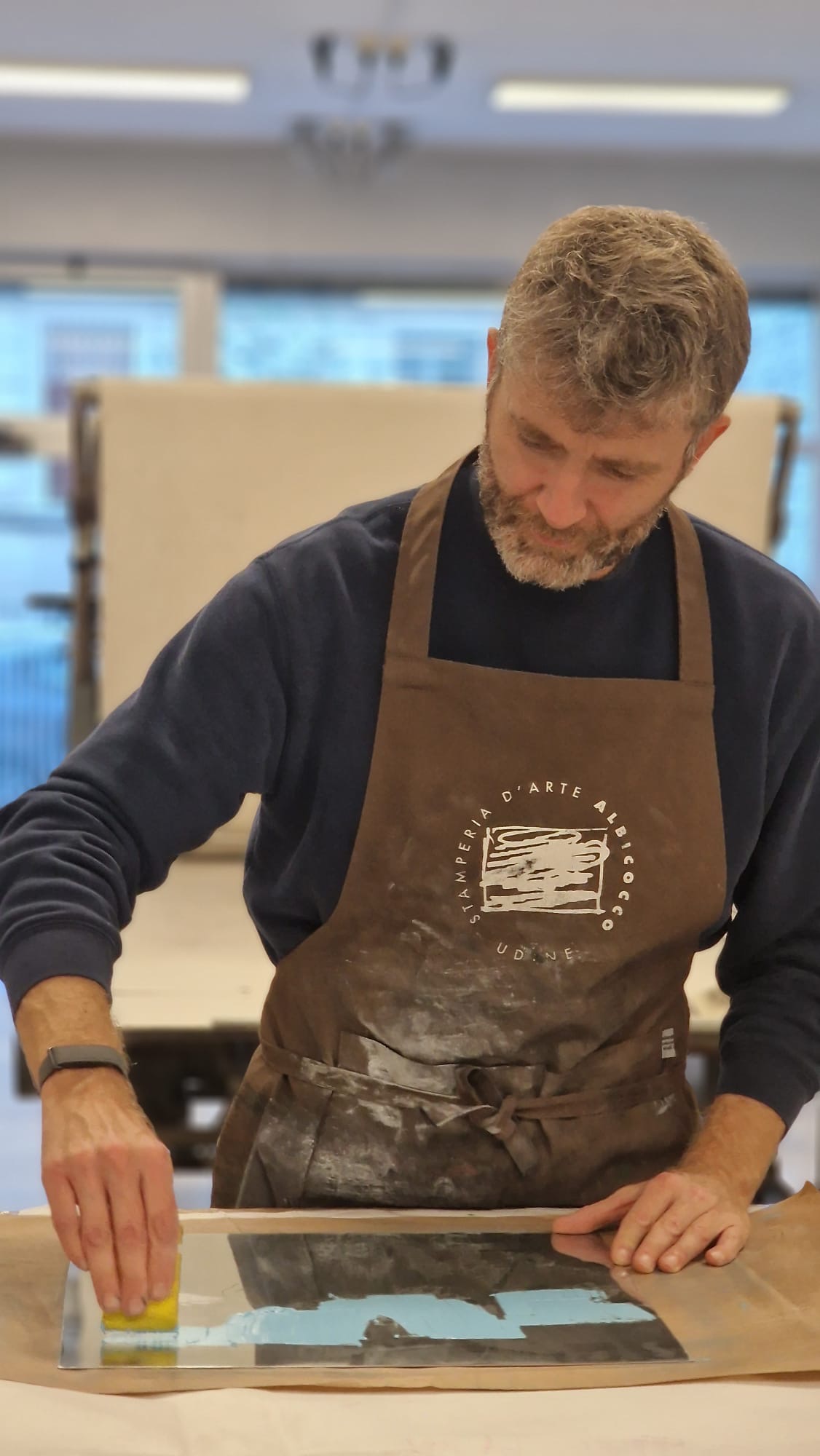
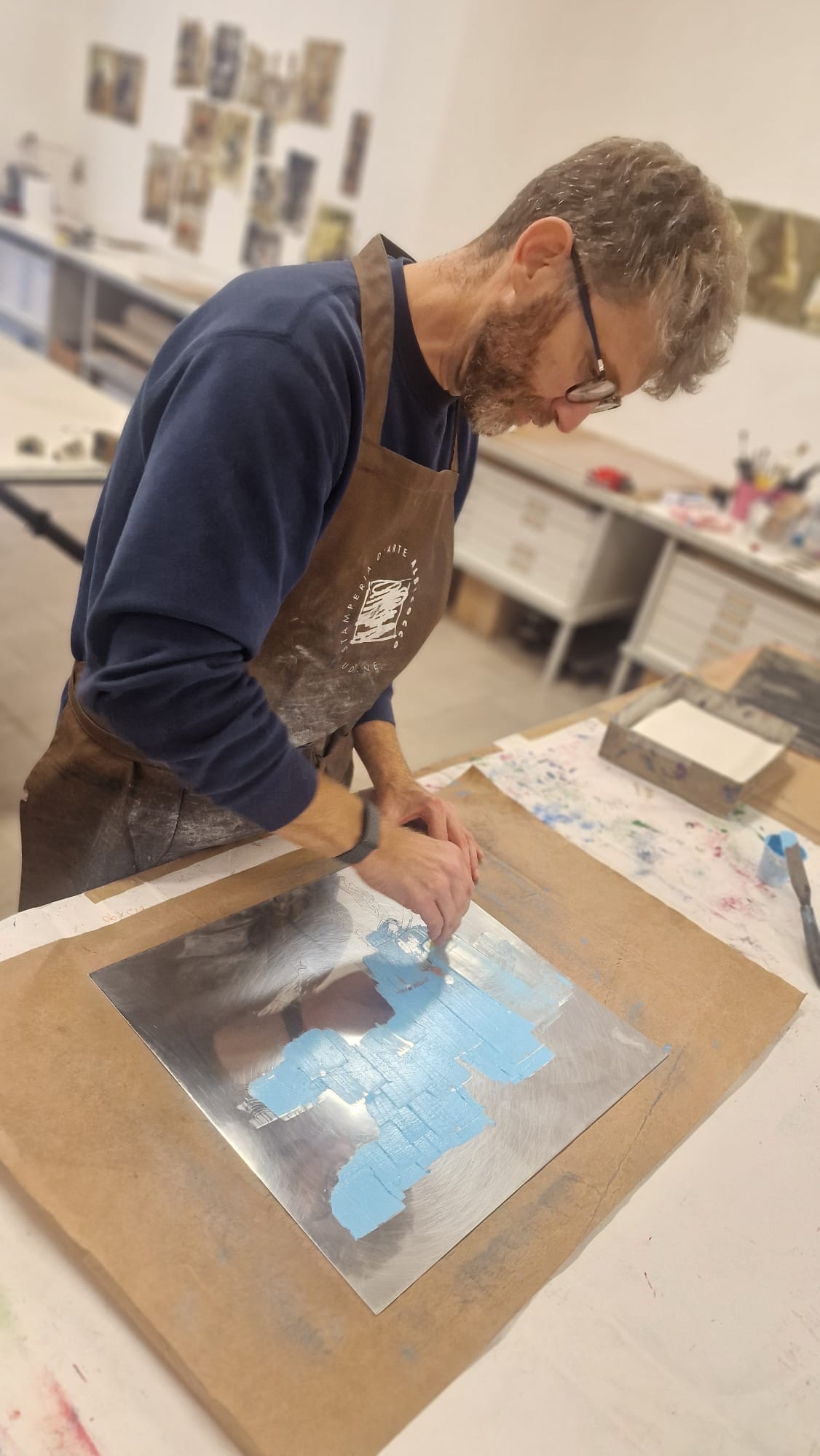
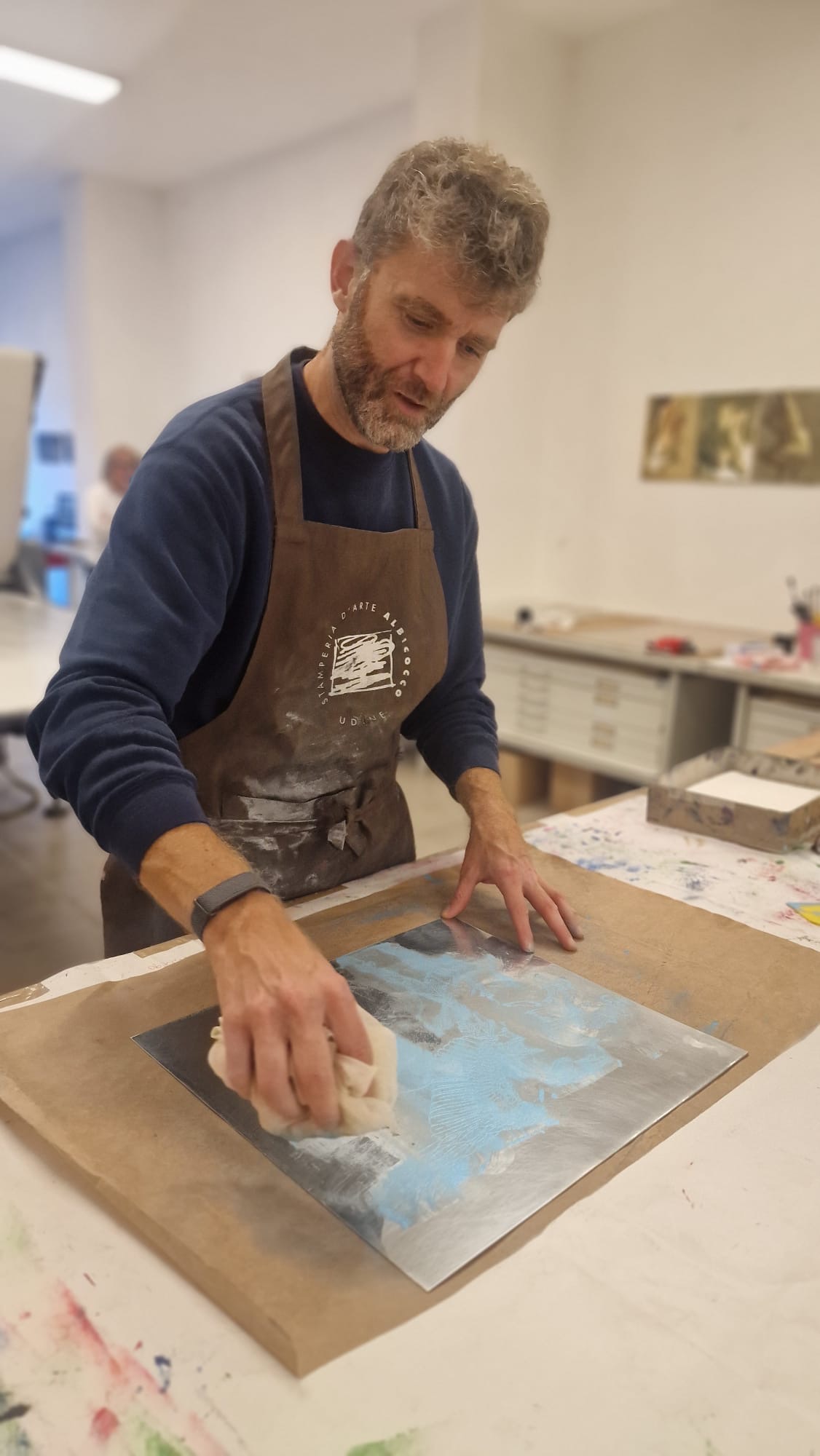
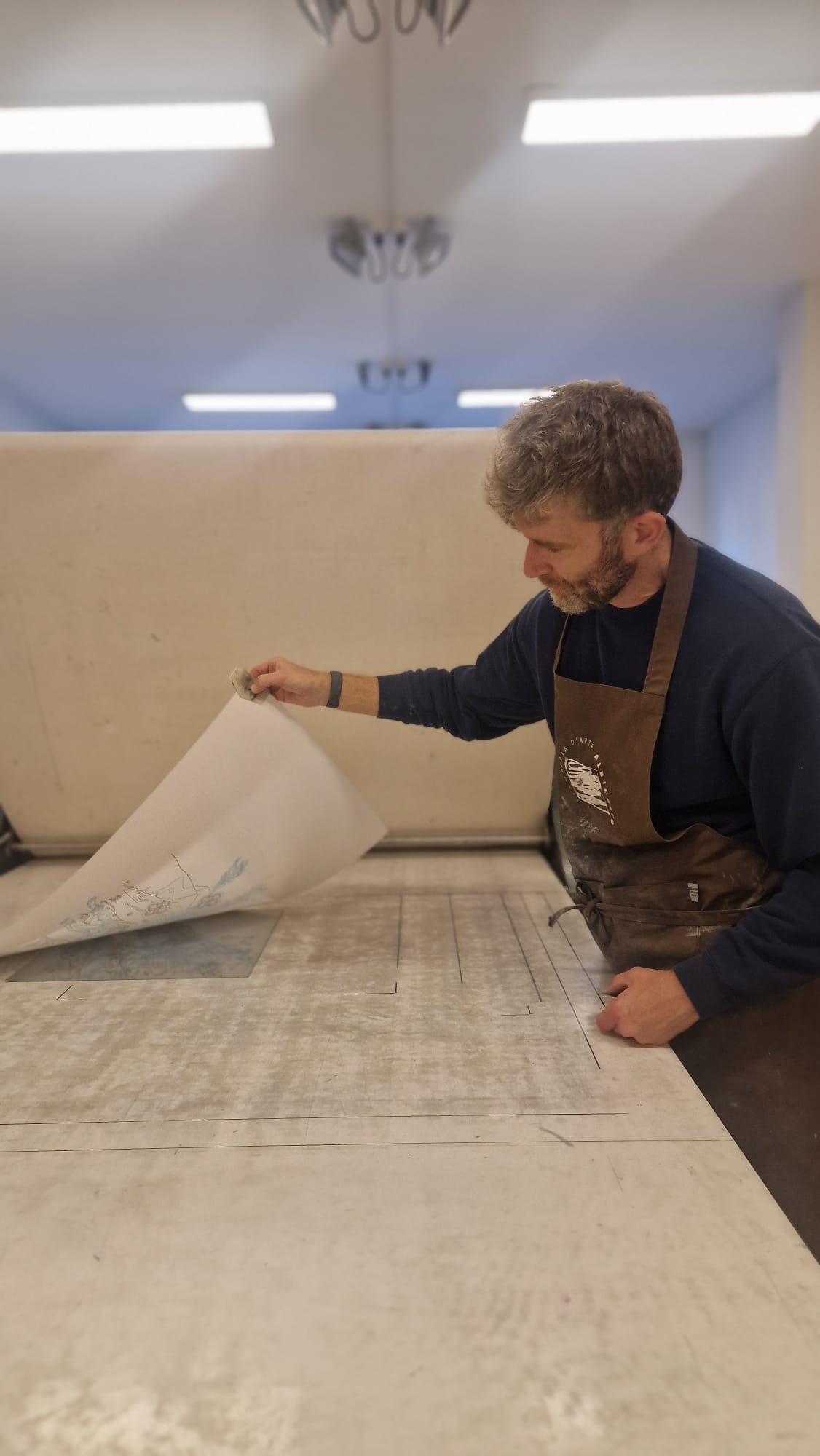
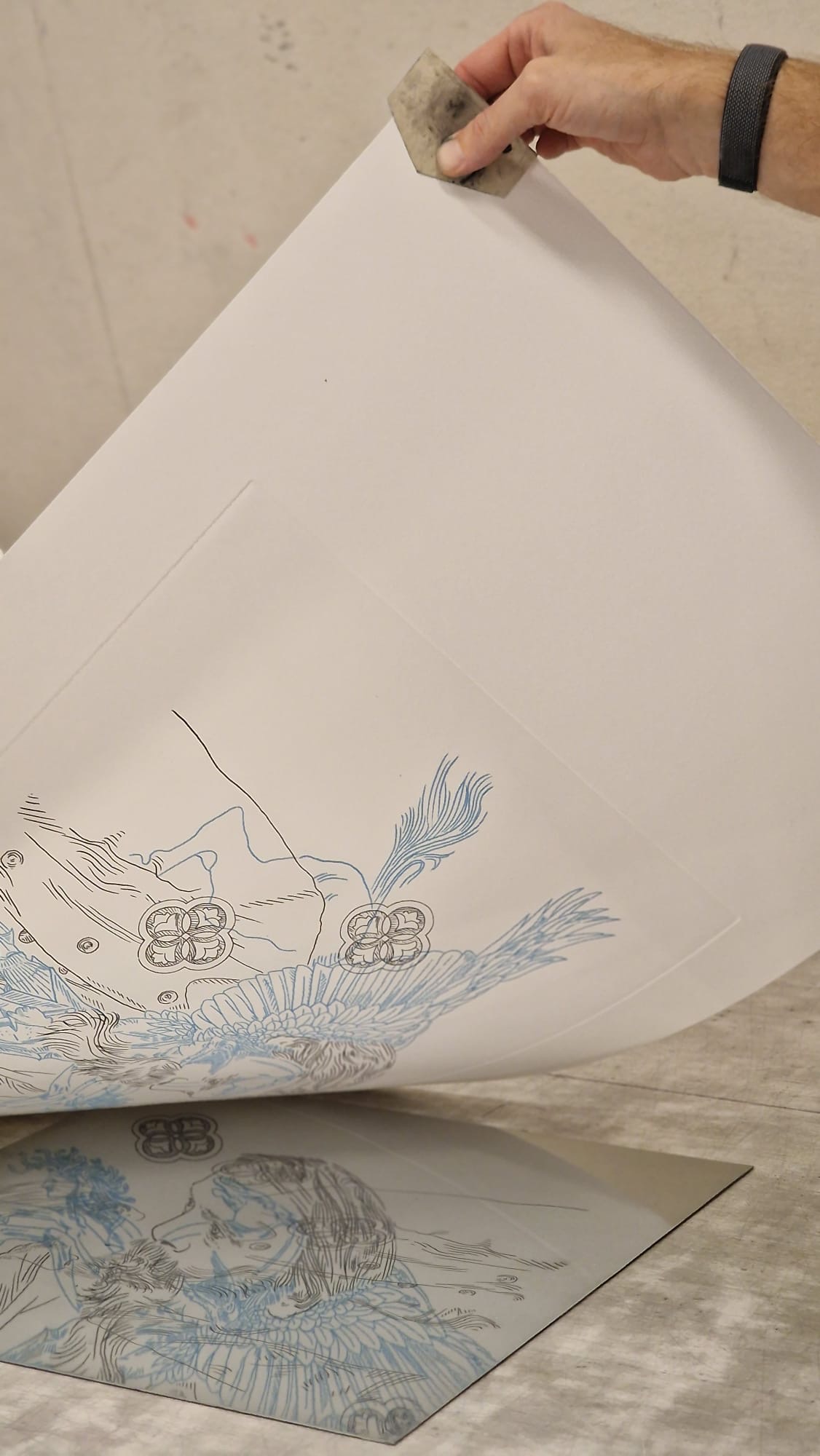
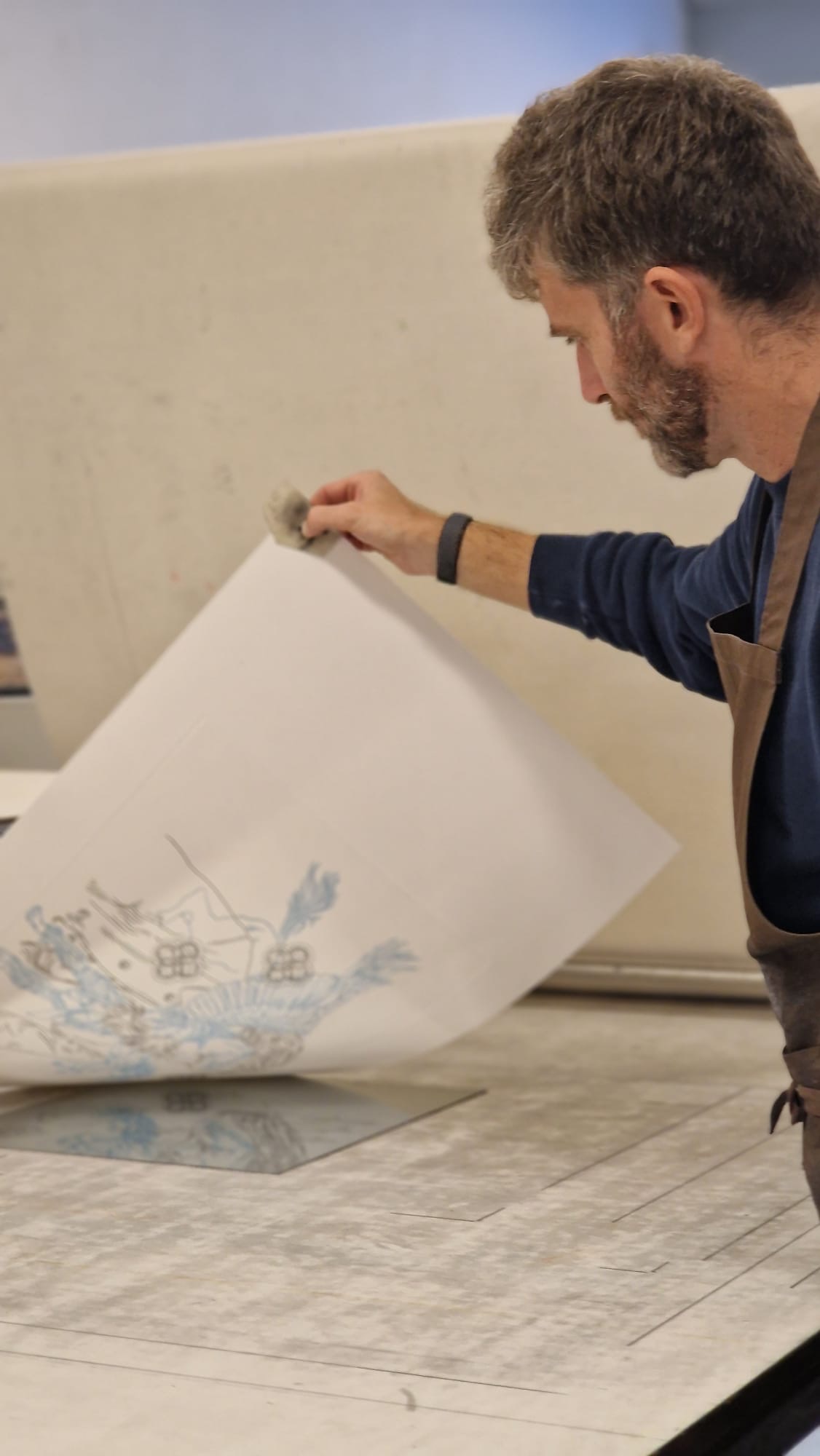
Gianluca Albicocco of Stamperia d’Arte Albicocco in Udine prints the Edward Burne-Jones etching, 2026.
A Vision Constructed from Thousands of Fragments
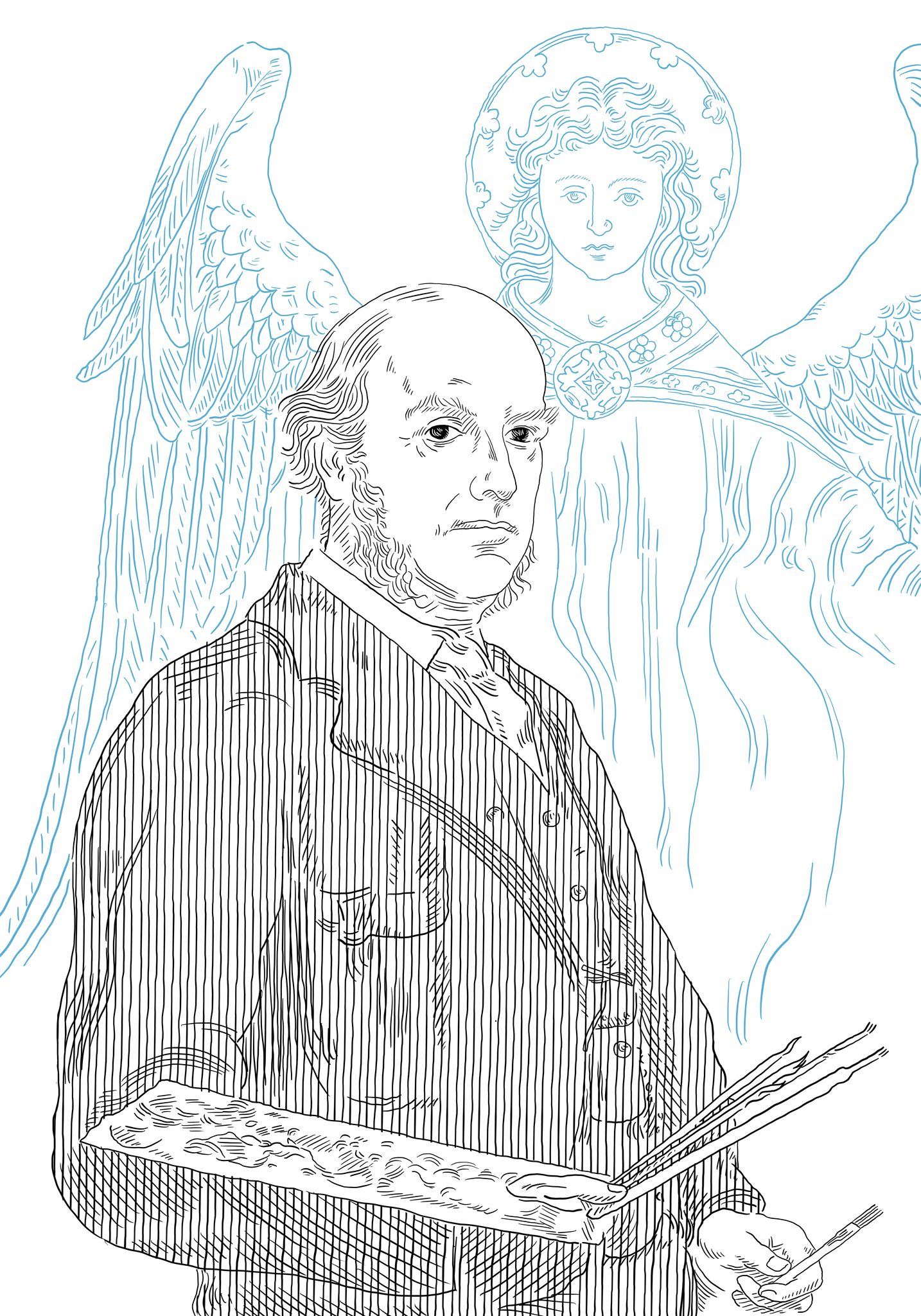
Risograph print produced by Tiratura in Ravenna, in an edition of 6 copies, 2026
The commission for the mosaics of St. Paul’s took shape in 1881. Burne-Jones developed an elaborate decorative programme that transformed the apse and chancel into a monumental visual narrative.
In the Heavenly Jerusalem, located in the apse and completed in 1885, Christ appears enthroned, surrounded by angelic figures. The composition recalls the Byzantine tradition, while reinterpreting it through the artist’s visionary sensibility.
This was followed by the Annunciation, completed in 1893 and set within an austere, almost deserted landscape, and the Tree of Life, completed in 1894, in which the body of Christ is superimposed upon a flourishing tree, transforming the image of the Crucifixion into a vision of life and redemption.
The decorative programme developed over many years and involved numerous people.
Burne-Jones did not personally execute the mosaics. His work consisted of conceiving the compositions and preparing drawings and cartoons, which were subsequently translated into glass tesserae by a Venetian workshop.
Several preparatory drawings for the Roman mosaics are preserved in the collection of the Delaware Art Museum in Wilmington, including studies for the figure of Christ in the Heavenly Jerusalem. These drawings provide a particularly important opportunity to examine the relationship between Burne-Jones’s original designs and the finished mosaic.
The process recalls the great tradition of ancient and medieval mosaics, yet belongs fully to the modern productive world of the nineteenth century: an artwork could be designed in England, created in a Venetian workshop and installed in Rome.
Within this context stands Antonio Salviati (1816–1890), the lawyer from Vicenza who played a decisive role in the revival of Venetian mosaic and artistic glassmaking.
Fascinated by the mosaics of St. Mark’s Basilica, Salviati founded a business in 1859 dedicated to reviving and developing mosaic and glassmaking techniques. Through collaborations with Venetian craftspeople and British investors, he helped transform this production into an international enterprise.
The history of Venetian artistic glass and its nineteenth-century revival is documented by the Murano Glass Museum, whose collections provide an important historical context for Salviati’s work.
The history of the companies associated with his name is complex, and it is important to distinguish his contribution to the revival of Venetian mosaic from the specific execution of the Roman works.
Mosaic thus becomes the result of a collaboration crossing places, languages and different areas of expertise. An image originates in an artist’s imagination but acquires its final form through the work of many other hands.
It is precisely this relationship between conception and execution, between drawing and material, that forms one of the fundamental elements of the contemporary research developed for the exhibition.
Thomas Rooke and a Work That Survives Its Creator
A key figure in this history is Thomas Matthew Rooke (1842–1942), a painter and assistant to Burne-Jones.
Rooke worked closely with the artist for many years and was also involved in the Roman mosaic project, helping to translate his designs into monumental works.
His work and career are documented in the Delaware Art Museum’s artist records, which provide a resource for understanding his artistic activity beyond his collaboration with Burne-Jones.
When Burne-Jones died in 1898, the decoration of the church was not yet complete.
Between 1906 and 1907, Rooke completed the large lower section of the apse, generally known as The Church Militant and Triumphant, working from his master’s drawings.
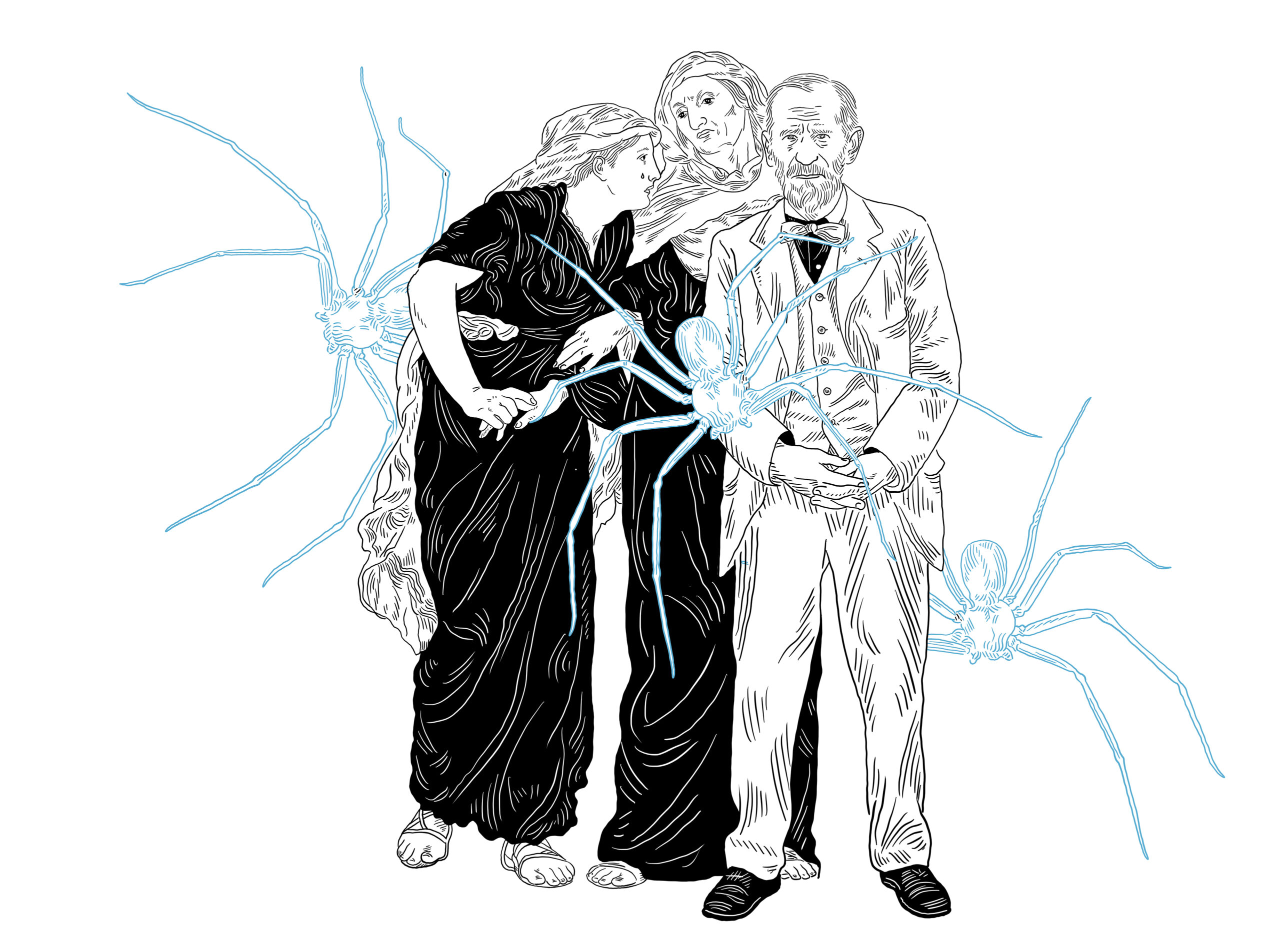
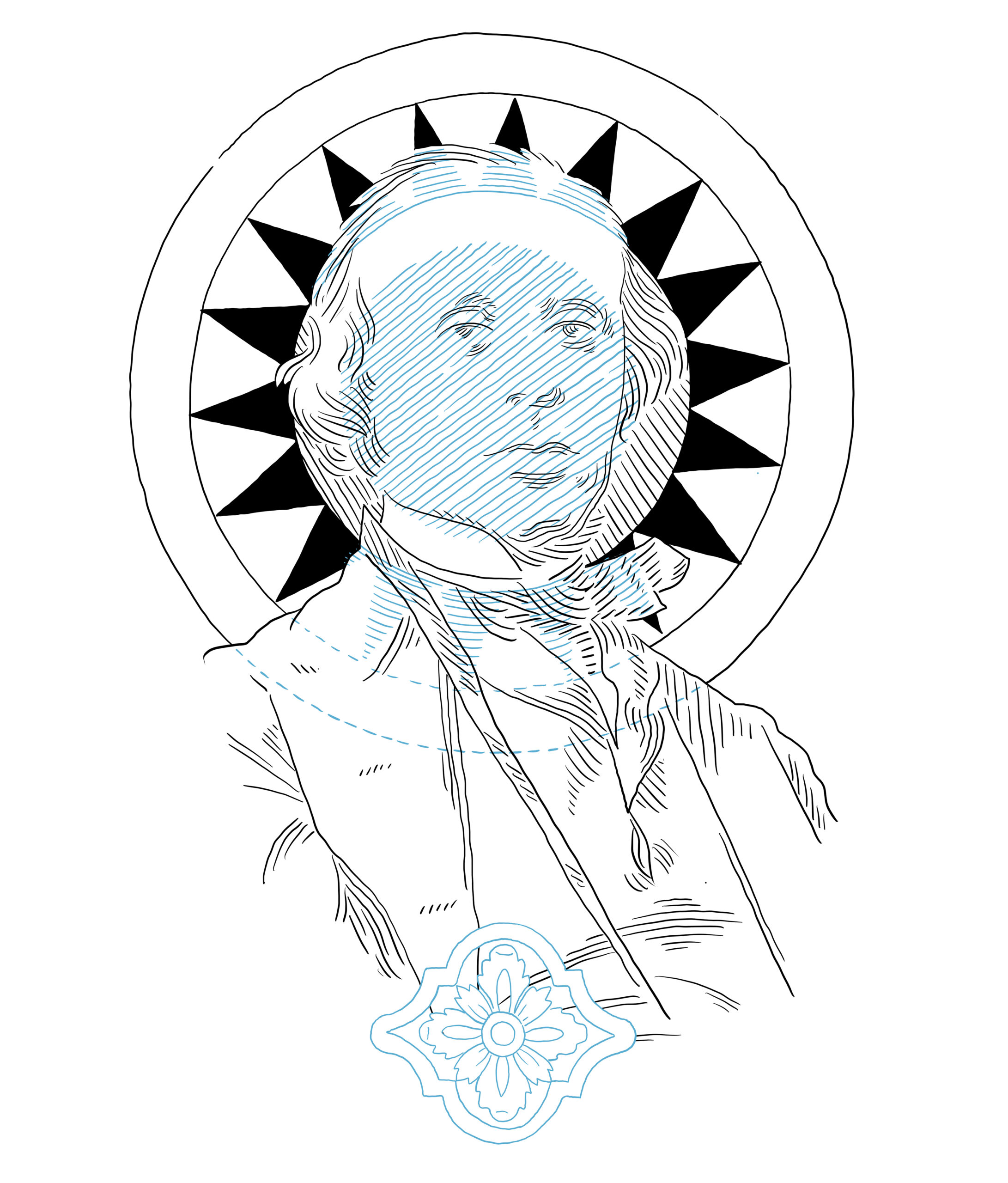
Technical pen drawing executed using a vintage pen plotter by Pen Plot Studio in Hummelo, the Netherlands, unique edition, 2026
The mosaic depicts a vast community of religious figures: saints, martyrs, ascetics, mothers, Fathers of the Church and Christian warriors. It is a collective image in which people belonging to different periods and traditions come together within the same space.
Some of the faces were modelled on real historical figures, including Abraham Lincoln, Giuseppe Garibaldi and Ulysses S. Grant.
The creators of the project also enter the image symbolically: Burne-Jones is identified with St. John Chrysostom, while Rooke appears as St. Longinus.
This is one of the most remarkable aspects of the entire decorative programme. A religious mosaic also becomes an archive of faces, a collective memory in which political history, personal biography and sacred imagery overlap.
The work thus continues to live beyond the death of its creator. Drawing becomes a form of transmission: an unfinished idea can be inherited, interpreted and completed by another person.
George Breck and the American Continuation of the Project
The artistic history of the church does not end with Rooke.
George William Breck (1863–1920), an American painter and decorator, continued the mosaic programme in the early twentieth century, contributing to the decoration of the façade and interior spaces.
Breck had studied in Rome and developed particular expertise in mural painting and architectural decoration.
Documentation relating to his work and his involvement with the American Academy in Rome can be found in the Smithsonian Institution’s Archives of American Art, including records associated with his position in Rome.
Among his contributions are the mosaics depicting the symbols of the four Evangelists, completed in 1909, and the Adoration of the Magi, inaugurated at Christmas in 1913.
Here, too, the work involved Venetian workshops, with which Breck collaborated while overseeing the production and installation of the mosaics.
Through Breck’s contribution, the church continued to evolve, adding new artistic languages and images to the original project. Its decoration is therefore not the result of a single creative moment, but of a process spanning several decades and successive generations of artists.
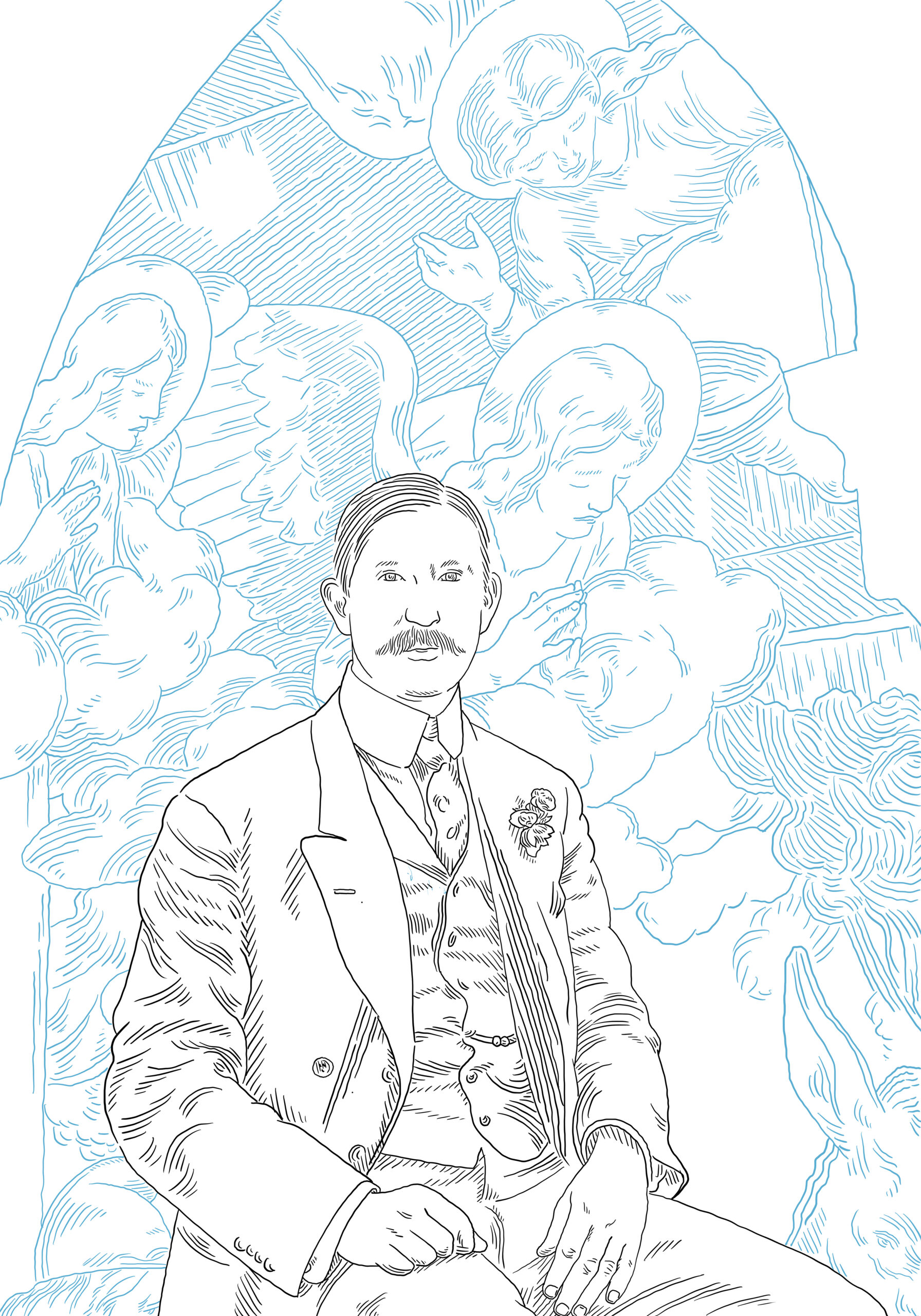
Risograph print produced by Tiratura in Ravenna, in an edition of 6 copies, 2026
Ravenna: A Personal Story Within a European History
Within the exhibition, the relationship between Burne-Jones and Ravenna acquires a significance that extends beyond historical reconstruction.
For Gianluca Costantini, Ravenna is his hometown, the place of his artistic education and his first encounter with the techniques of mosaic.
His studies at the Gino Severini Art Institute, subsequently incorporated into the Nervi-Severini Art High School, and in the Mosaic Decoration programme at the Academy of Fine Arts in Ravenna allowed him to engage with a tradition in which drawing cannot be separated from material.
Mosaic requires a particular understanding of the image: not only the composition of figures, but also the relationship between colour, light, surface and the movement of the viewer’s gaze.
The Ravenna tradition teaches that material is not simply a support for an image. The tesserae, their inclination and their different capacities to reflect light actively participate in the construction of meaning.
Discovering that Burne-Jones had visited Ravenna in 1873 and that, many years later, he had explicitly expressed his love for the city and its mosaics created an unexpected connection between the English artist’s history and Costantini’s own education.
The research thus also became a return to his artistic origins.
The intention is not to reproduce the style of ancient mosaics, but to explore what that tradition can still offer to the creation of contemporary images.
Giuseppina Bakhita: A New Image Created in Mosaic
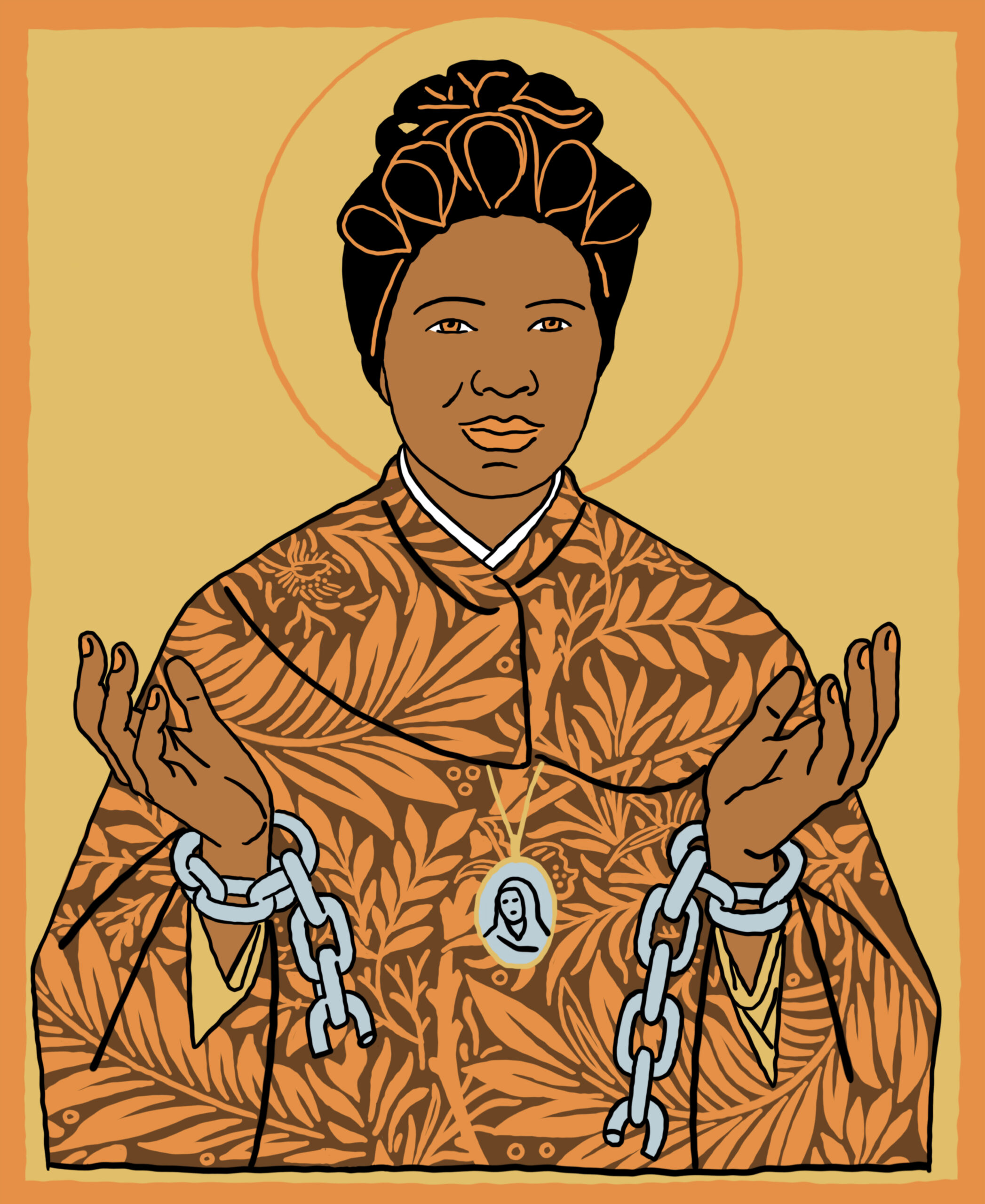
The Day Giuseppina Bakhita Taught the Angels the Name of Freedom
Digital drawing made on an iPad, 2026
This connection finds its most tangible expression in the contemporary mosaic dedicated to Giuseppina Bakhita (1869–1947), created specifically for the exhibition.
Born in the Darfur region of present-day Sudan, Bakhita was abducted as a child and enslaved. Sold several times, she endured violence, deprivation and displacement before reaching Italy.
In Venice, in 1889, she was legally recognised as free. She subsequently joined the Canossian Daughters of Charity and spent much of her religious life in Schio, in the Veneto region. She was canonised in 2000.
Her life and memory are preserved in Schio, where the Museum of St. Giuseppina Bakhita and the Sanctuary of St. Bakhita offer opportunities to explore her history.
Her story belongs to the same historical period in which the mosaics of the American church in Rome were taking shape, but reveals a reality profoundly different from that of the European artists and architects.
It is a story that encompasses slavery, freedom and faith. Bakhita’s presence in the exhibition introduces a reflection on human dignity and the capacity of images to preserve the memory of people whose lives have been marked by violence and injustice.
The decision to portray Giuseppina Bakhita grows out of Gianluca Costantini’s longstanding commitment to human rights. Through drawing, he tells the stories of people who have been persecuted, deprived of their freedom or forced into exile, using portraiture to keep their lives in view. Bakhita’s experience of enslavement and her struggle for freedom bring that contemporary practice into contact with the life of a nineteenth-century woman whose story continues to raise questions about how images can bear witness to violence and affirm human dignity.
Mosaic artist Samuela Cottignoli translated Costantini’s original portrait into mosaic, working in the Byzantine tradition of Ravenna. She used marble and Venetian smalti, including gold, choosing the material, cut, colour and angle of each tessera in relation to the pieces around it. Those decisions give the portrait a physical presence of its own. Marble, coloured glass and gold catch the light differently, so the balance of colour and brightness changes as the viewer moves. This passage from drawing to mosaic places the collaboration between Costantini and Cottignoli at the heart of the exhibition. It also recalls, across more than a century and through different techniques, the work of the Venetian mosaicists who translated Burne-Jones’s designs into glass.
During the exhibition, the mosaic of Giuseppina Bakhita will be displayed inside St. Paul’s Within the Walls, alongside the church’s historic mosaic cycles. Some of the saints in Burne-Jones’s compositions bear the likenesses of prominent nineteenth-century men. The new mosaic brings into the same space the face of an African woman who lived in their century and whose experience of violence, emancipation and faith opens a different perspective on religious portraiture. Seen together, these works invite us to ask whose lives are given a place in sacred images and what those images can carry forward.
That question has a particular resonance at St. Paul’s today. The church is home to the Joel Nafuma Refugee Center, which has welcomed and supported refugees and asylum seekers since 1982. Bakhita’s portrait enters a place where people forced to leave their homes are still received. Through Cottignoli’s work, the mosaic tradition of Ravenna becomes a way to tell Bakhita’s story within the present life of the church.
The Figures Return Through Drawing
The portraits in the exhibition grew out of research into the people who built and decorated St. Paul’s Within the Walls. Their work survives in architectural drawings, stained glass, ceramic tiles and mosaics. In the portraits, I took details from those materials and gave them another life in the titles.
Alfred Bell’s face appears as the red of a stained-glass window reaches an angel’s eyes. In John Richard Clayton’s glass, night seems to have lodged inside the colours. The two titles follow the same light through a window, from the darkness the glass holds to the colour it casts on a figure.
Edward Burne-Jones is accompanied by the sound lilies make when no one is watching. The sound is imagined, but it begins with the stillness of his figures. In Frederick Garrard’s portrait, time cools beneath a skin of enamel, like a tile taken from the kiln. George Breck crosses the sky with earth still on his hands, carrying something of the workshop into the image above him.
Thomas Rooke stands before a paradise left open after the death of the man who dreamed it. The title comes from his part in completing the mosaics Burne-Jones left unfinished. In George Edmund Street’s portrait, a line rises from the page and begins to ring the bells. Robert Jenkins Nevin leaves a room empty so that light can lose its way. The architect’s line and the rector’s empty room take us back to the church while its interior was still taking shape.
The lilies, angels and gardens recall the world of the Pre-Raphaelites. The glass, enamel and earth bring us back to the people who worked with those materials, and to the choices they made before a drawing could become part of a building.
From Mosaic to Contemporary Printmaking
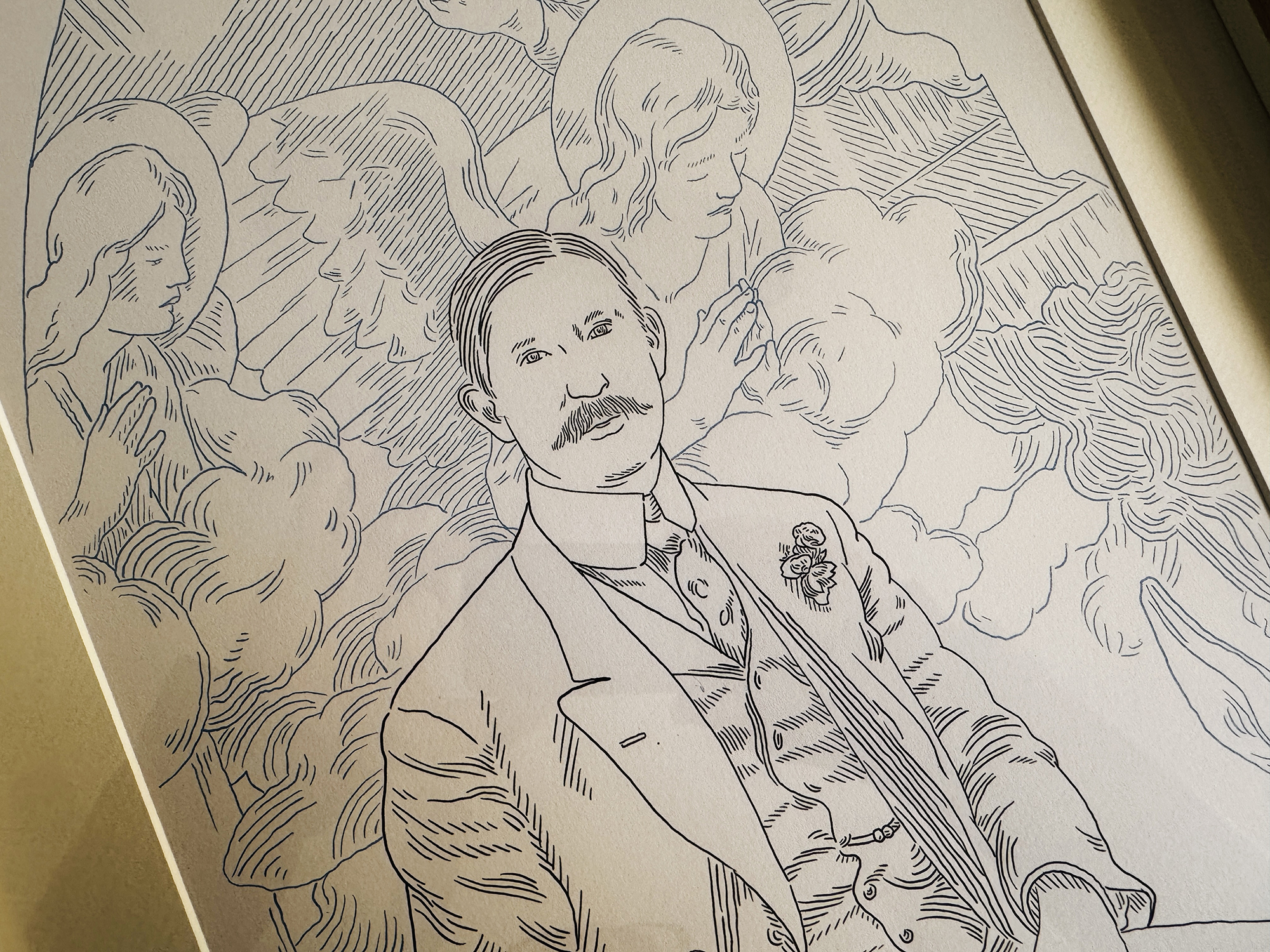
The historical research behind the exhibition led to a question about how images take shape and pass from one set of hands to another. In a mosaic, each tessera has its own colour, texture and way of catching the light, yet its effect depends on the pieces around it. That relationship between the individual mark and the whole image guided the choice of printing techniques for the portraits, each of which builds an image through a different combination of materials, tools and workshop practices.
The Risograph portraits of Alfred Bell, John Richard Clayton and George Breck were produced by Tiratura in Ravenna, each in an edition of six. Risograph printing uses a separate master for each colour, building the image as successive layers of ink are laid down on paper. Where the colours overlap or fall slightly out of register, the layers remain visible. In portraits connected with stained glass and mosaic, those variations suggest how separate areas of colour can come together without losing their individual character.
For Edward Burne-Jones, Stamperia d’Arte Albicocco in Udine printed a two-plate etching in an edition of ten. The image takes shape first in the lines etched into the metal and then on paper, where the press transfers the ink from the plates. The finished print holds the results of each stage, from preparing and inking the plates to bringing the two colours into register. Frederick Garrard’s portrait, by comparison, is a unique fine art giclée print produced by ArtOk in Palmanova. Its fine gradations of colour evoke the glazed ceramic surfaces associated with Garrard’s work.
The portraits of Thomas Rooke, Robert Jenkins Nevin and George Edmund Street were each produced as unique works by Pen Plot Studio in Hummelo, the Netherlands, using a vintage technical pen plotter. The plotter follows paths defined in a digital file, moving a pen across the paper to draw one line at a time. The precision of those paths is visible in the finished work, alongside the physical trace left by the ink as the pen moves over the sheet.
Across the exhibition, these processes give the workshops a part in shaping the finished images, through choices about ink, paper, pressure and the order in which the marks are made. In the mosaic of Giuseppina Bakhita, that collaboration takes a form rooted in Ravenna’s mosaic tradition. Samuela Cottignoli translates the drawing into marble and glass, and the image takes shape through the placement of individual tesserae and the light that falls across them.
Images Need Other Hands
The church we see today took shape through work passed from one person to another. George Edmund Street designed a building that others constructed, while the windows drawn by Clayton and Bell depended on the skill of glassmakers. Venetian mosaicists worked from Burne-Jones’s designs, Thomas Rooke completed the part of the apse his master had left unfinished, and George Breck carried the decoration into a new century. Each time an image moved between people, cities or materials, it took on something of the place and the hands that received it.
The exhibition follows a similar route. Gianluca Costantini’s research and drawings became prints through collaborations with workshops in Ravenna, Udine, Palmanova and Hummelo, a route that recalls the exchanges between England, Venice and Rome that shaped the church. The mosaic of Giuseppina Bakhita brings that connection into view. Just as Burne-Jones relied on Venetian mosaicists to interpret his designs, Costantini worked with Samuela Cottignoli, whose choices of material, colour and placement gave the portrait its form in mosaic. Inside St. Paul’s, the new work lets us see how a technique used in the historic mosaics can take on a different subject in the hands of an artist working today.
The Memory of Light
The exhibition began with a close look at the mosaics of St. Paul’s Within the Walls and a search for the people who made them. Their faces return in prints made with techniques from another era, and the documentary research gives each portrait a starting point for invention. Costantini’s work on human rights has long used the portrait to bear witness to injustice and bring individual lives into view. Here, that same practice recovers lives from the history of art and asks what their stories can tell us about the images we still see.
When Edward Burne-Jones visited Ravenna in 1873, he encountered a mosaic tradition that stayed with him as he designed the decoration of the American church in Rome. More than a century later, Costantini returned to those mosaics and recognised a connection with his own artistic education in Ravenna. The two journeys meet in the portrait of Giuseppina Bakhita, which Samuela Cottignoli translated into mosaic using techniques still practised in Ravenna.
During the exhibition, Bakhita’s face will take its place among the figures that have inhabited the church for more than a century. The portrait brings the story of an African woman who survived enslavement and fought for her freedom into a building that now welcomes people forced to leave their countries. In that setting, the historic mosaics and the new works show how an image can carry a life into the memory of people who never knew it. The prints and the mosaic will eventually leave the church. What may stay with a visitor is the way ink or a piece of glass caught the light and made a face worth remembering.