Why remembering the journalists killed in Gaza is not propaganda
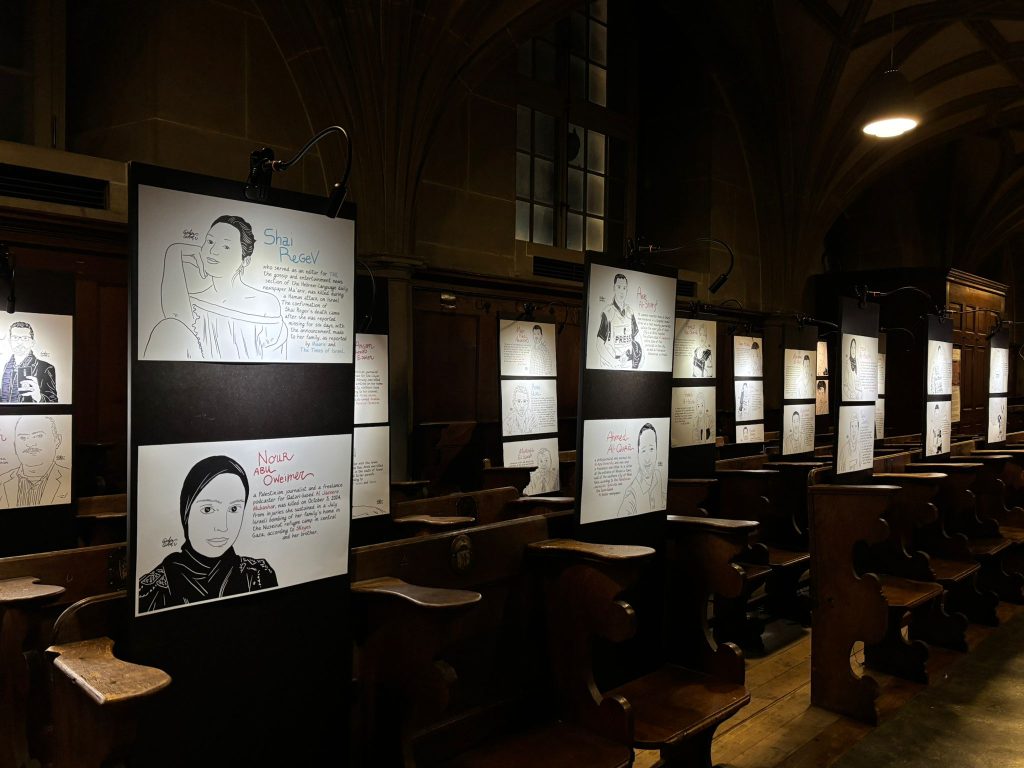
I am the author of the portraits exhibited in the Heiliggeistkirche in Bern, curated by offene kirche bern and Pecore Ribelli. I would like to respond to some of the criticism that has circulated in recent days by the Swiss historian and journalist Hannah Einhaus, which you can find here: Der Bund
My drawings are not political slogans, but faces. They are portraits of journalists killed in Gaza. They do not show flags, they do not praise any party, they do not call for the destruction of anyone. They ask for one thing only: that these people are not forgotten.
I understand and respect the sensitivity of the Jewish community, especially at a historical moment marked by a disturbing increase in antisemitism in Europe. Precisely for this reason, however, it is important not to confuse the denunciation of violence against Palestinian civilians – including journalists who were trying to report on a war – with hatred towards Jews or towards Israel as such. Criticizing the violence of a state or an army does not mean denying the right of that people to exist, just as denouncing the crimes of Hamas does not mean being anti-Palestinian.
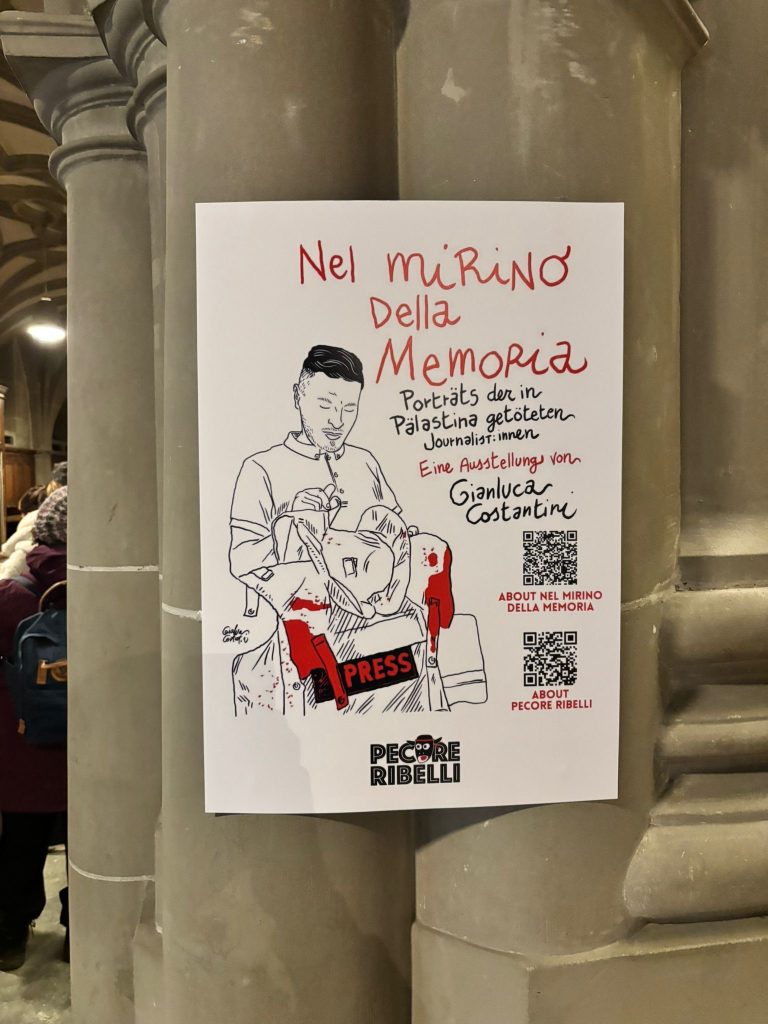
My artistic practice has been linked for years to documenting human rights violations: I have drawn Turkish activists, Russian dissidents, Syrian, Kurdish, Iranian, Ukrainian, Israeli and Palestinian victims. It is not a “campaign against someone”, but an archive of faces that the news tends to reduce to numbers. In this sense, the portraits of journalists killed in Gaza are in continuity with all my previous work.
Displaying these drawings in a church open to the city is not an act of provocation, but of civic responsibility: it is an invitation to look into the eyes of people who lost their lives while exercising the right–duty to inform. If today, out of fear of being misunderstood or accused, we give up showing the human consequences of a war, we are accepting the idea that some lives are less visible, less tellable, less worthy of mourning.


I firmly reject any antisemitic interpretation of my work. Antisemitism, like any form of racism, is profoundly alien to me. But I also reject the idea that the memory of Palestinian victims – in this case, journalists – should be censored so as not to unsettle someone. Grief is not a zero-sum game: remembering the dead in Gaza does not erase the trauma of October 7, just as remembering Israeli victims does not erase Palestinian suffering.
Anyone who really wants to engage with these drawings is invited to look at them closely, to read the names, to search for the stories of these people. It is in that moment, not in polemical headlines, that the meaning of the work becomes clear: not propaganda, but responsibility. Not hatred, but memory.


