Tracing a career deeply embedded in local media institutions and the vulnerabilities that come with reporting in a religious‑political hub
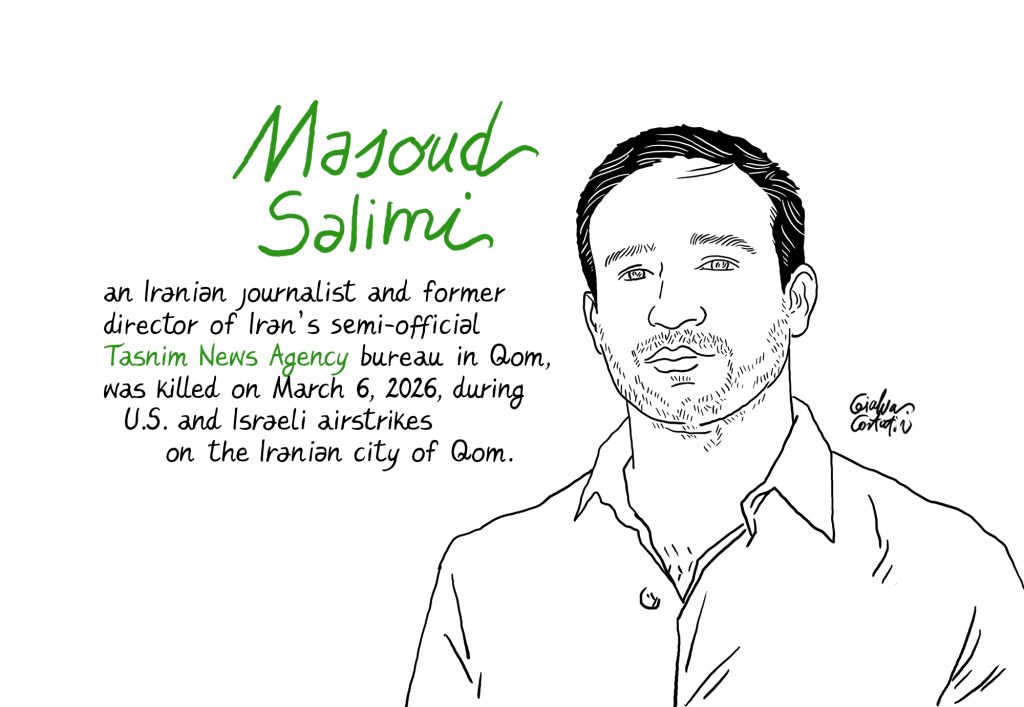
Masoud Salimi was an Iranian journalist who had long been active in the media landscape of the city of Qom, where he built his career within the local press system and eventually became head of the Tasnim News Agency’s office. In addition to his editorial work, he contributed to local publications in the province and was a member of the Qom Press House, reflecting his deep integration into the professional and institutional fabric of the region.
His death occurred in the early days of the military escalation that struck Iran in March 2026. According to available information, Salimi was killed on March 6, when a missile hit a Basij base in Qom during U.S. and Israeli military operations.
Reports indicate that he was not necessarily on assignment at the time of the attack, but rather in an area that had become a military target. This reflects a recurring dynamic in contemporary conflicts: journalists are not only at risk while reporting, but also because they live and work in spaces that become targets.
His professional profile—linked to an agency close to institutional circles and to a city like Qom, a major religious and political center—placed him in a particularly exposed position. In times of conflict, such locations become strategic nodes, and those who operate within them, even without a direct role in military activities, find themselves caught within the geography of risk.
Salimi’s death also highlights another level of vulnerability: a systemic one. In the days surrounding the attacks, increasing restrictions on information and growing dangers for journalists in the region were reported. In this context, the distinction between civilian, media worker, and potential target becomes increasingly blurred.
His case thus reflects a form of local journalism deeply embedded in its territory and, for that very reason, directly exposed to the consequences of global conflict. Not an external observer, but a presence within the field—where reporting and survival become ever more difficult to separate.