The Ugandan human rights defender, lawyer and anti-corruption activist has been sent back to Luzira Prison after a controversial arrest. Her story connects a new generation of civic resistance with the growing pressure on freedom of expression and political dissent in Uganda.
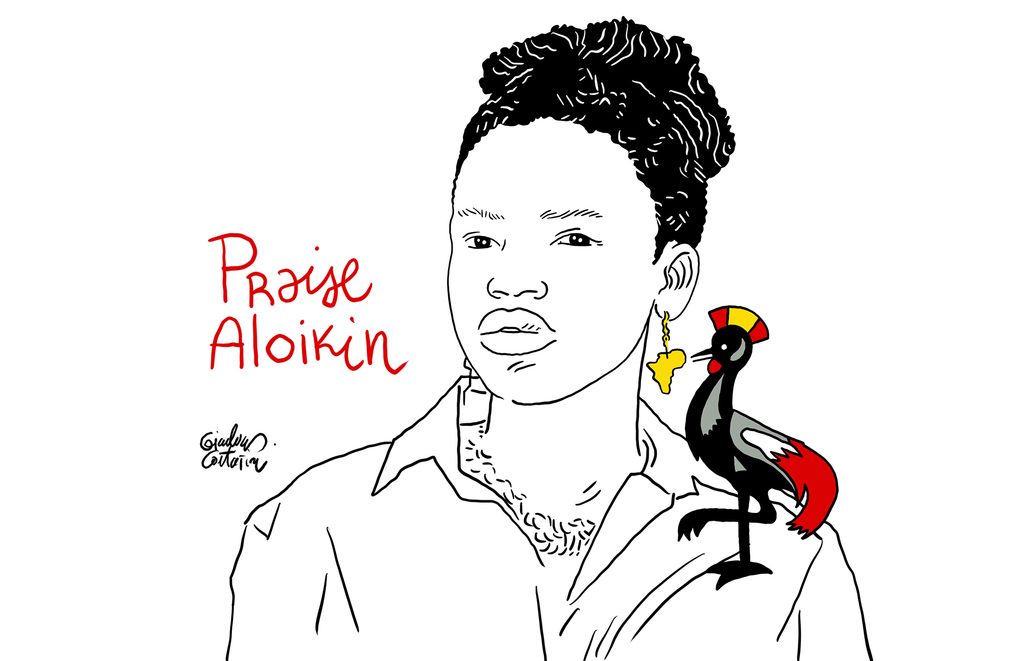
Praise Aloikin Opoloje is 27 years old. She is a lawyer, human rights defender, feminist, anti-corruption activist and mother. On September 28, 2026, she appeared before the Buganda Road Chief Magistrate’s Court in Kampala and was remanded to Luzira Prison until October 14.
The formal charge against her is unusually specific: prosecutors allege that during September she used a SIM card registered in another person’s name — identified in Ugandan media as her mother — “for the purpose of executing illegal activity.” The charge was brought under Regulation 29 of Uganda’s Regulation of Interception of Communications Regulations, 2024. Aloikin pleaded not guilty.
But the story of her arrest began before she entered the courtroom, and it raises questions that go far beyond a SIM card.
On Saturday, September 26, Aloikin went voluntarily to Namungoona Police Station in Kampala after being summoned over what appeared to be an ordinary dispute concerning the ownership of a carpet. According to an account given by her friend Raus Ninsima to Ugandan media, they brought the carpet with them, expecting to resolve the matter at the station.
What happened next remains disputed.
Ninsima says that once inside the police station, Aloikin encountered men who appeared to be security operatives and was told that she had been under surveillance. According to her account, Aloikin began photographing one of the men when she realized that the carpet dispute might not have been the real reason she had been summoned. A confrontation followed. Ninsima says armed men eventually forced Aloikin into a vehicle and drove her away.
For hours, her location was unknown.
Lawyers, activists and civil society organizations demanded that the authorities disclose where she was being held and under what legal authority. The Uganda Law Society was among those raising concerns about her whereabouts. The episode was initially described by activists and some Ugandan media as an abduction; police later rejected that characterization and confirmed that Aloikin was in state custody.
The timing immediately attracted attention.
Shortly before her detention, Aloikin had published a video sharply criticizing General Muhoozi Kainerugaba, Uganda’s Chief of Defence Forces and the son of President Yoweri Museveni, as well as the conduct of the Patriotic League of Uganda. When police eventually confirmed that she was being held, spokesperson Kituuma Rusoke initially spoke publicly about allegations involving the misuse of her digital or social-media account. Another police statement reported by local media referred to “broadcasting without a license.”


CHANNELDRAW STUDIO · INDEPENDENT PUBLISHING
Active Art Yearbook
A year of drawings, stories and civic engagement. Discover the Channeldraw annual volumes.
Explore the yearbooks →Neither allegation, however, was the charge ultimately presented in court.
When Aloikin appeared before the magistrate on September 28, the prosecution charged her instead with using another person’s SIM card. The charge sheet did not establish a connection between the video criticizing Kainerugaba and the alleged SIM-card offence. That distinction matters. In a case surrounded by competing accounts and rapidly changing explanations, it is important to separate what authorities have formally alleged from what activists, witnesses and observers believe may have motivated her detention.
To understand why the arrest has caused such concern, it is necessary to look beyond these few days.
Praise Aloikin Opoloje was born in 1999 in Uganda’s Paliisa District. Before becoming internationally known, she described herself simply as a social justice advocate passionate about human rights. She studied law at Makerere University, trained with the human rights organization Chapter Four Uganda, worked with Open Parly UG, a youth-led parliamentary monitoring initiative, and volunteered on projects addressing period poverty and misinformation.
Uganda: from the archive




She is also a mother.
Her activism developed around a conviction that political participation cannot remain confined to institutions and elected representatives. In a 2024 interview with the National NGO Forum, she spoke about the distance she saw between the protections contained in Uganda’s Constitution and the reality experienced by people who challenge those in power.
That conviction moved from words to the streets.
On July 23, 2024, Aloikin was among the young Ugandans involved in the March to Parliament, a youth-led protest against corruption, public spending and the lack of political accountability. Security forces arrested scores of demonstrators as they attempted to march toward Parliament.
Aloikin was among those arrested.
The experience did not stop her.
A few weeks later, on September 2, 2024, she returned to the streets with Norah Kobusingye and Kemitooma Nyina’kyenzibo. The three women staged one of the most striking protests of Uganda’s recent civic movement. Partially naked, their bodies painted in the colours of the Ugandan flag and covered with political messages, they marched toward Parliament denouncing corruption and failures in public services and demanding the resignation of the Speaker of Parliament.
Their bodies became their placards.
In a political environment where public space was increasingly controlled, the three women used the one space that could not easily be separated from them: their own bodies. The vulnerability of naked skin was transformed into a public statement about power, corruption and citizenship.
Police arrested all three.
They were charged with “common nuisance” and remanded to Luzira Women’s Prison. They pleaded not guilty and were subsequently released on bail. The prosecution repeatedly failed to produce witnesses, and on June 11, 2025, the Buganda Road Chief Magistrate’s Court dismissed the case for want of prosecution.
The protest, however, had already made Aloikin one of the recognizable faces of a new generation of Ugandan activists.
In May 2025, the European Union awarded her its Human Rights Defenders Award for Uganda, recognizing her activism for civil liberties, accountability, social justice and the fight against corruption. She was also selected as a finalist for the Martin Ennals Award for Human Rights Defenders.
Her international recognition did not remove the risks she faced at home.
This is what makes her return to Luzira Prison in September 2026 particularly significant.
The prison is not an abstract place in Aloikin’s biography. She has already experienced detention there. She has already been arrested for protesting. She has already appeared before the courts for participating in peaceful political action. And she has already seen one prosecution collapse after the state repeatedly failed to bring witnesses against her.
Now she is there again.
The present case must follow its legal course, and the allegations against Aloikin have to be treated as allegations unless proven in court. But due process also requires scrutiny of the actions of the authorities themselves: why she was summoned to a police station over a seemingly unrelated complaint; who removed her from that station; why her whereabouts were initially unclear; why different explanations for her detention circulated before she was brought before a magistrate; and why the offence ultimately charged in court differed from the allegations initially described publicly by police.
These questions concern more than one activist.
They concern the space available for dissent in Uganda, the boundary between law enforcement and political intimidation, and the increasingly important relationship between digital communication and state power. A mobile phone, a SIM card, a social-media account and a video posted online can become part of the machinery through which political speech is monitored, investigated and potentially criminalized.
For someone like Aloikin, the digital and physical spaces of protest have never really been separate. She has organized through social networks and marched through Kampala. She has spoken into a camera and written political messages directly onto her body. She belongs to a generation for whom a street demonstration and a post online are different extensions of the same public space.
That is also why her story deserves to be followed through her name and her face rather than reduced to another statistic about repression.

On ChannelDraw I have often returned to people whose lives suddenly become entangled with the machinery of the state: journalists, activists, artists and political prisoners whose individual stories reveal something larger about the societies in which they live. In the case of Patrick Zaki, an article and social-media posts became part of a prosecution in Egypt. In Ten Years Later: When a Drawing Became “Terrorism”, I reconstructed my own experience of being targeted by Turkish censorship because of a political drawing published online. These are profoundly different countries and cases, and they should not be equated. But each raises a recurring question: what happens when expression itself becomes evidence?
Praise Aloikin’s story adds another face to that question.
There is a photograph of her from the 2024 protest that is difficult to forget: a young woman walking toward Parliament with the colours of her country painted across her body. The image contains vulnerability and defiance at the same time. There is no distance between the protester and the protest. Her body carries the message.
Two years later, the instruments are different: a telephone, a video, a SIM card, a courtroom.
The underlying question remains the same.
How much space does a citizen have to confront power?
Drawing Praise Aloikin means stopping for a moment before the speed of the news turns her into another name passing through a timeline. It means looking at the person behind the legal language: the student who became a lawyer, the mother, the feminist, the woman who walked toward Parliament, the activist who has already known the inside of Luzira Prison and who now finds herself there again.
Her next scheduled court appearance is October 14, 2026.
Until then, Praise Aloikin Opoloje remains in Luzira Prison.
And her story remains unfinished.
ChannelDraw is independent and reader-supported. Your support helps us continue documenting artists, journalists and activists whose voices are threatened or censored.
Other ways to support ChannelDraw
You can also support our independent work by joining us on Patreon or Substack, or by purchasing a ChannelDraw Yearbook. Every contribution helps us keep ChannelDraw independent and continue documenting stories that need to be seen.


