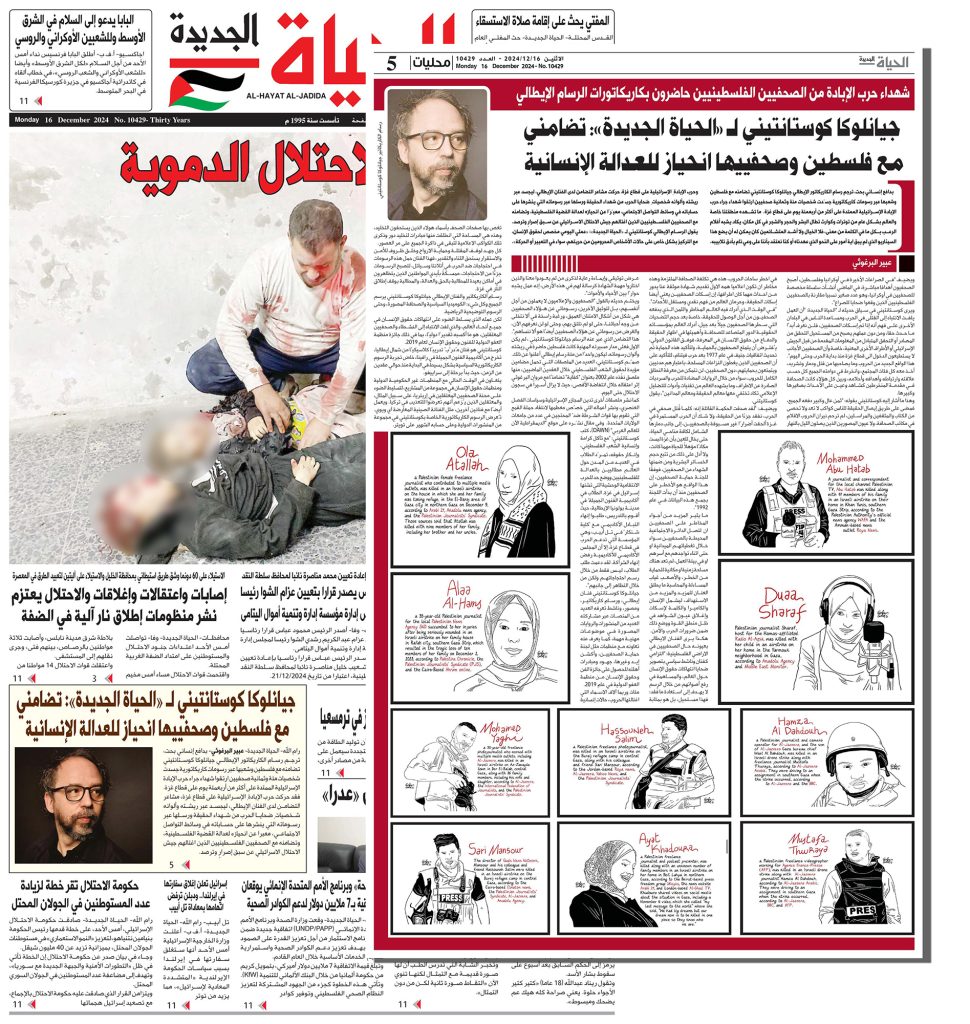
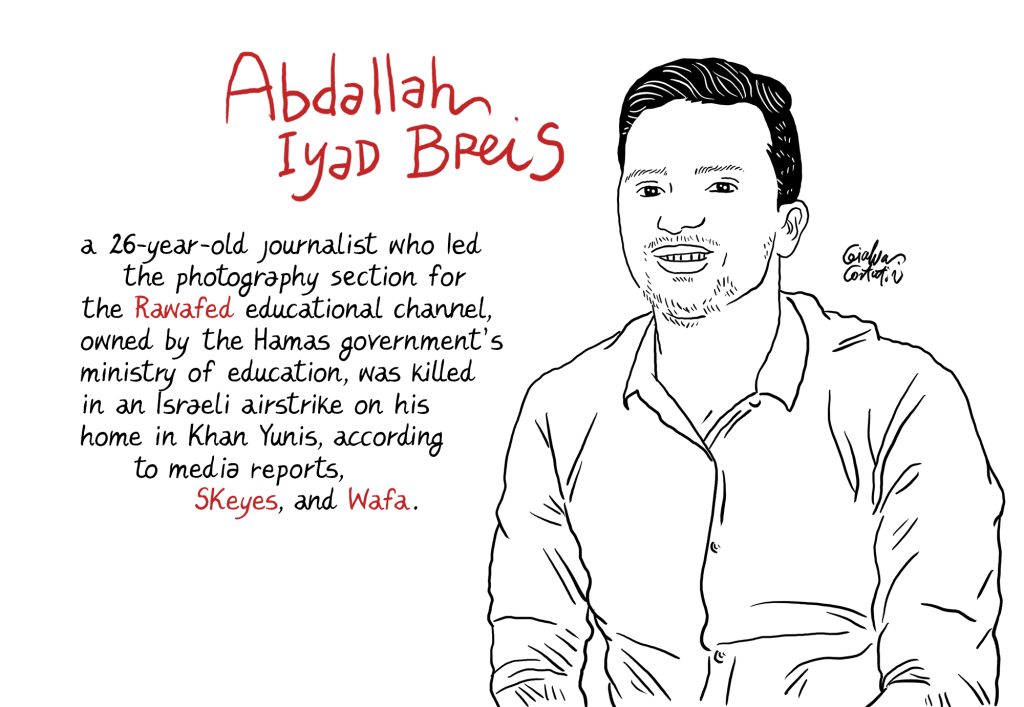
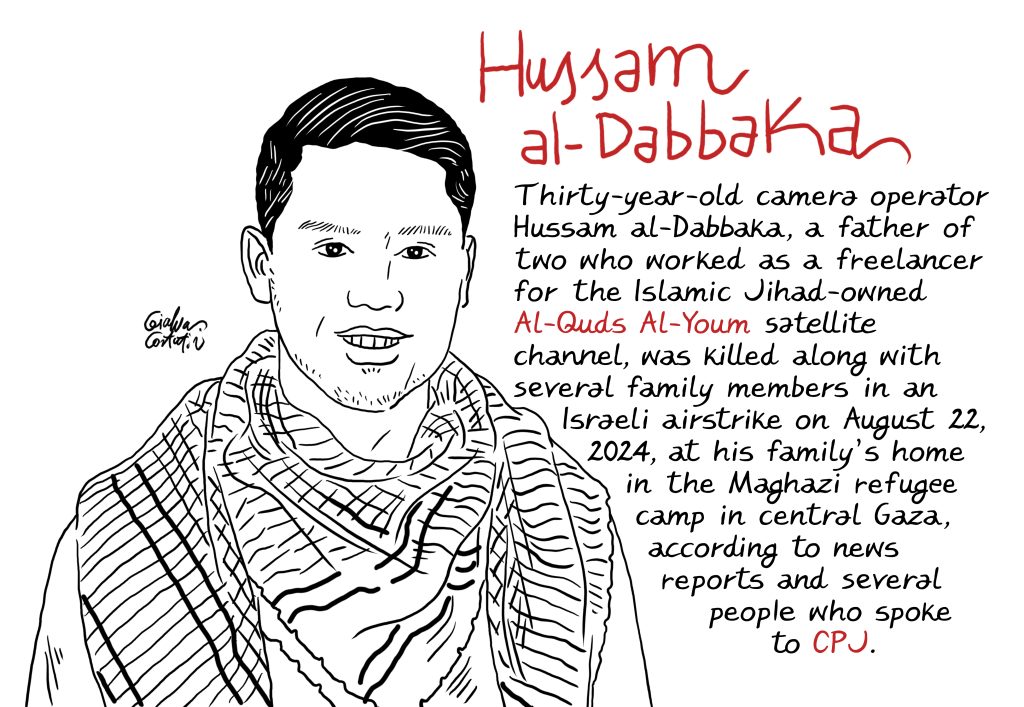
The martyrs of the genocidal war among Palestinian journalists are depicted in the drawings of the Italian cartoonist.
by Abeer Al-Barghouthi for Al-Hayat al-Jadida
Driven by purely humanitarian motives, the Italian illustrator Gianluca Costantini has translated his solidarity with Palestine and its people through portraits representing the personalities of 108 journalist martyrs due to the Israeli genocidal war, which has lasted for over 400 days in the Gaza Strip.
What we are experiencing in our region and in the world in general, with the tensions and catastrophes affecting people, buildings, and nature everywhere, resembles a horror movie in every sense. Neither the imagination nor even the most pessimistic minds could have predicted this scenario, which has left no aspect of life as we knew it, or as we thought we were fully aware of, intact.
The Israeli genocidal war on the Gaza Strip has sparked the feelings of solidarity in the Italian artist, who has used his brush and colors to represent the victims of the war—the martyrs of truth and its messengers—through drawings he publishes on his social media accounts, expressing his support for the justice of the Palestinian cause and his solidarity with Palestinian journalists, who have been deliberately murdered by the Israeli army.


Italian artist Costantini tells Al-Hayat Al-Jadida: “My daily work is dedicated to human rights, with a particular focus on people deprived of their freedom, both of expression and movement.”
He adds: “In the recent conflicts in Ukraine and Palestine, journalists have become direct targets. In the past, I created a series dedicated to Ukrainian journalists, which is relatively small compared to the number of Palestinian journalists who have become victims of the conflict.”
Costantini continues: “This work draws attention to the victims of the war and helps people in other countries understand that, if journalists are silenced, we will never really know what happened. Without their work, it becomes impossible to verify sources or cross-check information provided by the Israeli army or the other parties involved, especially since foreign journalists have not been able to enter Gaza since the beginning of the war.”
This new reality of wars, with its killings, destruction, and displacement, has affected all social categories, involving everyone according to their relationships, connections, goals, and dreams. Among them, journalism has been at the forefront, as a witness and the eye on events, both big and small.




As Costantini emphasizes: “Everyone has paid a high and heavy price. Many writers, intellectuals, and reporters, who have become countless stars on the path to bringing the truth to the people, have fallen. The fires of war have spared neither the pens in the editorial offices nor the eyes of photographers who work day and night in the most dangerous war zones. This is the cost of committed journalism and the risks of being a journalist whose main goal is to provide a documented testimony of events, regardless of which parties are involved. Silencing journalists also means silencing the truth and depriving the world of an independent and critical understanding of the events.”
“The world has begun to recognize the risks and sacrifices that journalists face to reach the truth, especially after the sacrifices made by journalists from generation to generation. Human rights institutions globally have recognized the growing role of the press in revealing the truth and defending human rights in knowing. According to international law, journalists should be protected, and to confirm this protection, the Geneva Conventions were updated in 1977 after the Vietnam War to ensure that journalists covering armed conflicts, as civilians, enjoy protection. Without journalists, we would never be able to understand the full scope of wars, both through anti-war narratives and the accounts of the parties involved, especially since the techniques and tools of disinformation used in the world today make it difficult to distinguish between the truth and who is guilty,” says Costantini.

He adds: “It is true what they say: ‘Every time a journalist is killed in war, we lose a piece of the truth.’ There is no doubt that the ongoing war in Gaza has caused unprecedented damage to journalists, along with the total destruction of all aspects of life. Gaza appears as a place unfit for life, and the extent of human losses, including martyrs among the journalists, is clear. According to the Committee to Protect Journalists, this is the most dangerous reality for journalists since the committee began collecting this data in 1992.”
The further threats journalists face are the dangers extending to their social circles, both during field coverage and when they are with their families or at their workplaces. There is no more time or space to protect themselves from danger, and the most difficult part is the lack of accountability, which allows for further attacks, silencing, and closing the eyes of witnesses under the pretext of war and security needs.
This is how the Italian artist sees the situation of journalists in the Palestinian territories: “My commitment as an artist and political activist in portraying the victims of human rights violations worldwide and contributing to giving them a voice through drawing is not aimed at restoring what has been lost; that would be impossible. Rather, it is a documentary gesture and a tribute to the memory of those who are no longer with us and who have chosen the task of testifying their message on this earth. It is a work that resembles a dialogue between the living and the dead.”


He concludes by saying: “Journalists and media professionals do not work for themselves, but to document others. My drawings of these journalists are a form of deep gratitude and a firm desire not to abandon the faces of our loved ones, even if we have never met them or will never know them. The purpose of my drawings of these journalists is also not to forget them.”
This solidarity expressed by the artist Gianluca Costantini is not the first. Throughout his career, Palestine has always been present in his brush and colors, making him one of the hundred Italian artists who have publicly declared their support.
Costantini has designed several posters with messages in favor of the rights of the Palestinian people over the last two decades, including a poster created in 2002 titled “Enough” in solidarity with Marwan Barghouti after his arrest during the Al-Aqsa Intifada, where he remains a prisoner in the occupation’s jails to this day.
He has also published other posters condemning Israeli massacres and apartheid policies, and has published works in which he criticizes police repression against protesters at various universities in the United States.


In an article published on the Democracy Now for the Arab World (DAWN) website, Costantini wrote: “With the erosion of the dignity and humanity of the Palestinian people and the denial of their rights, students in many cities around the world have rebelled, demanding justice for the Palestinians and the end of the brutal punitive war that Israel is waging on Gaza. The students at the ‘Academy of Fine Arts’ in Bologna, Italy, where I teach, called for the end of the academic exchange with ‘Shankar College’ in Tel Aviv, an institution that supports the war on Gaza, but the academy’s academic council refused to terminate the partnership. I supported the students’ request, not only by drawing their protests but also by manifesting alongside them.”
Gianluca Costantini is an Italian artist, caricature illustrator, photographer, and activist, known for sharing relevant professional topics through numerous posts and illustrated narratives. He has collaborated with organizations such as…


