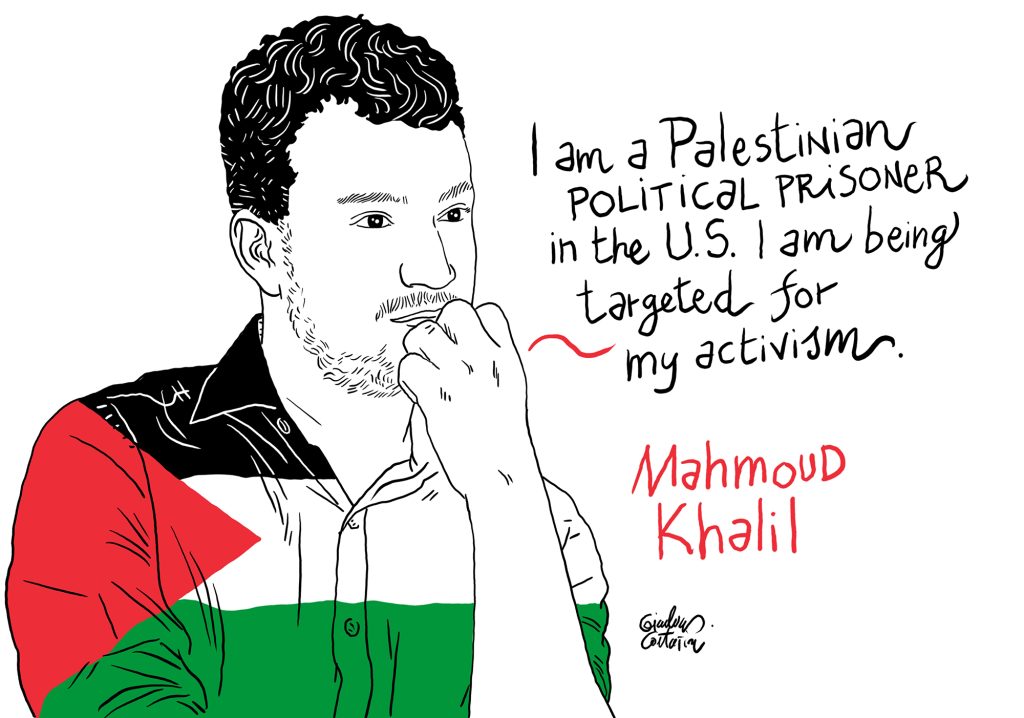
Mahmoud Khalil, Palestinian political prisoner and activist, has been released after more than three months in detention without formal charges in the United States.
Khalil, a prominent advocate for Palestinian rights and a former Columbia University student, was arrested on March 8 by Department of Homeland Security (DHS) agents who provided no warrant and threatened his wife as they returned home from dinner. He was first taken to a detention facility in Elizabeth, New Jersey, and later transferred to a remote and notorious immigration detention center in Jena, Louisiana, where he spent 104 days sleeping on the floor, often without a blanket, and uncertain whether he would be deported at any moment.
This week, a federal judge in New Jersey ordered his release, ruling that there was reason to believe his detention was a form of punishment for his political activism — a clear violation of constitutional rights.
When Khalil walked out of the Jena facility, squinting into the afternoon sun, he passed through razor-wire fences and tall gates into the thick Louisiana humidity. Raising his fist, he approached a handful of waiting journalists, visibly relieved yet calm and soft-spoken. “Although justice prevailed, it’s very long overdue and this shouldn’t have taken three months,” he said.
“I leave some incredible men behind me — over a thousand people — in a place where they shouldn’t be,” he added. “I hope the next time I will be in Jena is to actually visit.”


Standing beside his lawyers on a roadside with the detention center behind him, Khalil told The Guardian how 104 days of detention had transformed him and his politics: “The moment you enter this facility, your rights leave you behind,” he said. Pointing to the sprawling compound, he added: “Once you enter there, you see a different reality. Just a different reality about this country that supposedly champions human rights and liberty and justice. Once you cross, literally that door, you see the opposite side of what happens in this country.”
Khalil is the highest-profile student detained by the Trump administration for pro-Palestinian activism. He was the last to remain in detention after his arrest at his Columbia apartment in New York. The Trump administration labeled him a national security threat and invoked rarely used powers under immigration law to seek his removal. It has aggressively fought to keep him detained and continues to push for his deportation.
Asked about these allegations, Khalil said: “Trump and his administration — they chose the wrong person for this. That doesn’t mean there is a right person for this. There is no right person who should be detained for actually protesting a genocide.”
While in detention, Khalil missed his graduation ceremony at Columbia University and the birth of his first child. Speaking to journalists after his release, he expressed his joy at finally meeting his newborn son without DHS supervision and reuniting with his wife, who had been present during his arrest. He smiled briefly before turning to the car that would take him home.


“My duty is not only to liberate myself from the oppressor, but also to liberate my oppressors from their hatred and fear,” Khalil said, emphasizing that his unjust detention reflects the anti-Palestinian racism perpetuated by both the Trump and Biden administrations, which have continued to supply weapons to Israel and block international intervention to stop the atrocities in Gaza.
Khalil’s case became a rallying cry for civil rights advocates and student activists, who argued he was targeted for exercising his right to free speech and peaceful protest. Columbia University, he said, laid the groundwork for his targeting by disciplining pro-Palestinian students, tolerating racist doxxing campaigns, and yielding to government pressure to disclose student records.
Before leaving, Khalil urged continued resistance: “This moment goes beyond my individual circumstances. We must keep defending the right to protest for Palestine. At stake are not just our voices, but the fundamental civil liberties of all.”
Sources:
- The Guardian: multiple news reports and Khalil’s direct statements (example)
- Khalil’s letter published and circulated by legal support groups and advocacy orgs (same content republished in The Guardian).
- Italian summaries by Internazionale, Open, La Repubblica (translated and paraphrased for context).
- Supplemental references: Democracy Now!, Palestine Legal, and Columbia campus news outlets.


