Five decades of comics, political struggle and collective memory — Gianluca Costantini interviews Seth Tobocman for SOLRAD

For more than five decades, Seth Tobocman has used comics as a way of confronting the world: political conflict, social injustice, memory, death, community and resistance.
My long-form interview with Tobocman, “Drawing as survival, memory, and collective struggle across five decades of comics,” has been published by SOLRAD.
The conversation begins with his childhood in Cleveland, where Marvel superheroes offered an escape from bullying, and follows his path through the underground comics culture of the 1970s, his early friendship and collaboration with Peter Kuper, and the encounter with figures such as Harvey Pekar, Jack Kirby, Robert Crumb, Jeffrey Catherine Jones and Vaughn Bodé.
From there, the interview moves to New York and the founding of World War 3 Illustrated in 1980 — a magazine created at a moment when Ronald Reagan was coming to power and Tobocman and Kuper were searching for a form of comics capable of responding directly to the political reality around them.
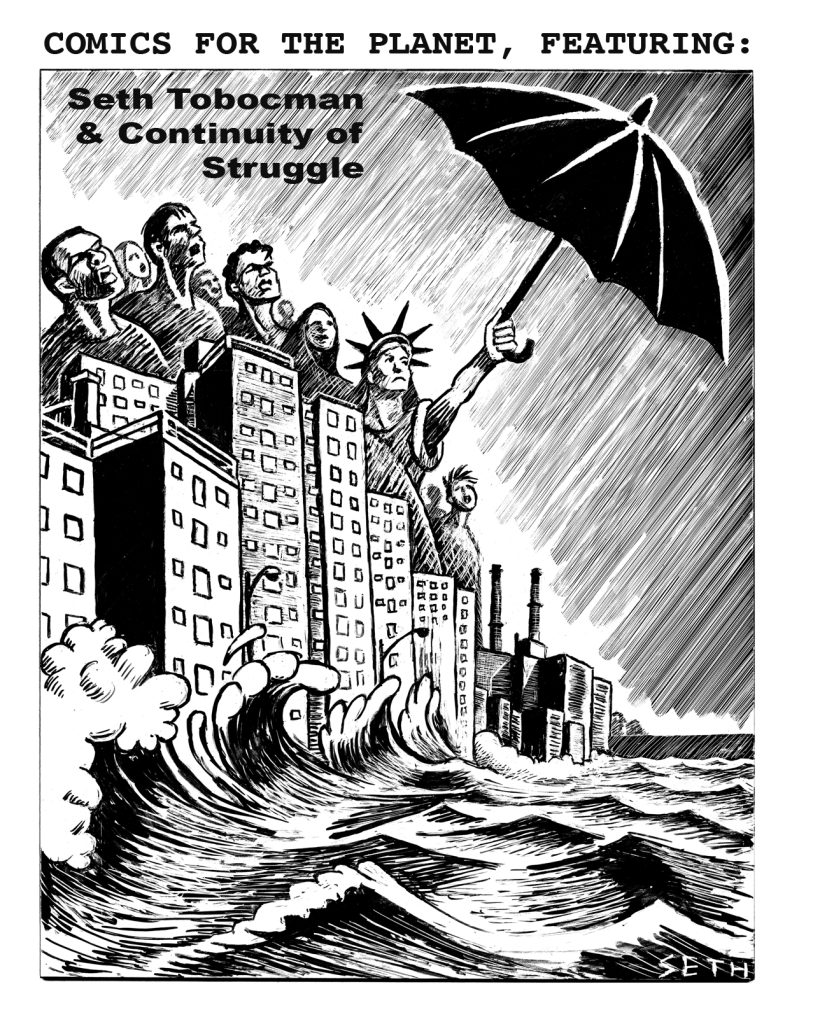

For Tobocman, drawing has never been separate from lived experience:
“Any problem I have, personal or political, I take that to the drawing table and that is where it gets worked out.”
This idea runs through the entire conversation.
We discuss the Lower East Side, squatting and gentrification; War in the Neighborhood; Mumia Abu-Jamal; political prisoners; AIDS and the loss of friends and fellow activists; Palestine and Israel; Disaster and Resistance; the financial crisis; radical lawyer Leonard Weinglass; ABC No Rio; political comics and teaching; and the transformation of underground culture in the age of social media and algorithms.
Tobocman also reflects critically on political art itself: the danger of propaganda, the difficulty of representing moral complexity, the contradictions inside radical movements and the responsibility of an artist who wants to take a position without simplifying the people and realities he depicts.
The result is not only a conversation about the history of underground comics. It is also a reflection on what it means to continue making political art over an entire lifetime — and on how drawing can become a means of survival, a repository of memory and a form of collective struggle.
New York remains at the center of this story: from the Lower East Side of the 1980s to the city Tobocman still calls home today.
The interview is part of my ongoing research into the artists and cartoonists who shaped the political and underground comics culture of New York between the 1970s, 1980s and 1990s.


CHANNELDRAW STUDIO · INDEPENDENT PUBLISHING
Active Art Yearbook
A year of drawings, stories and civic engagement. Discover the Channeldraw annual volumes.
Explore the yearbooks →Read the full interview
Drawing as survival, memory, and collective struggle across five decades of comics: Gianluca Costantini Interviews SETH TOBOCMAN
Published by SOLRAD, October 5, 2026.
ChannelDraw is independent and reader-supported. Your support helps us continue documenting artists, journalists and activists whose voices are threatened or censored.
Other ways to support ChannelDraw
You can also support our independent work by joining us on Patreon or Substack, or by purchasing a ChannelDraw Yearbook. Every contribution helps us keep ChannelDraw independent and continue documenting stories that need to be seen.


