During a series of interfaith gatherings in Washington, D.C., Palestinian Christian leaders and their American allies called on the United States to end its military support for Israel and defend Palestinian communities. Gianluca Costantini’s drawing Christ Died in Gaza became part of a mobilization connecting religious faith, political responsibility, and the memory of children killed in Gaza.
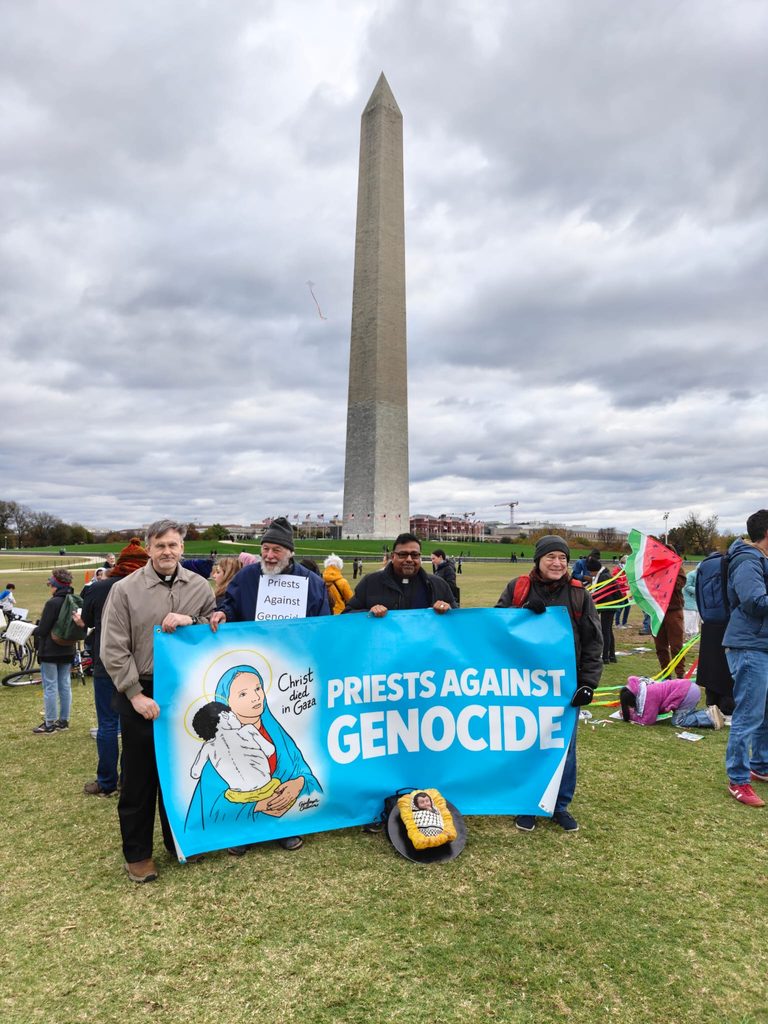
In November 2026, Gianluca Costantini’s drawing Christ Died in Gaza, depicting a Palestinian mother holding her dead child in an image reminiscent of the Christian Pietà, became part of a mobilization in Washington, D.C., where Palestinian Christian leaders, religious communities, and human rights advocates gathered to challenge the political and religious justifications used to defend Israel’s military actions in Gaza and the occupied West Bank. Under the slogan “Not in Christ’s Name,” the participants organized three days of public events, interfaith prayers, testimonies, and meetings intended to bring the experiences of Palestinian Christians directly before American political institutions. The initiative, held between November 14 and 16, brought together Catholic, Orthodox, and Protestant clergy alongside Jewish and Muslim religious representatives, all united by the conviction that religious faith should not be invoked to justify the suffering of civilians or the displacement of communities that have inhabited the Holy Land for generations.
The presence of Christ Died in Gaza within this movement gave particular meaning to an image that Costantini had created to confront viewers with the human consequences of the war. Drawing on one of the most familiar subjects in the history of Christian art, the mother holding the dead Christ, the Italian artist reimagined the scene through the suffering of a Palestinian woman and her child, transforming an established religious iconography into a question addressed to the present. The figures, accompanied by the handwritten words Christ Died in Gaza, invite viewers to recognize in the deaths of Palestinian children the same vulnerability, grief, and injustice that Christian tradition has contemplated for centuries through the story of the Passion. In Washington, where participants were calling on American lawmakers and religious institutions to acknowledge Palestinian suffering, the image entered a context in which its theological and political meanings became closely intertwined.
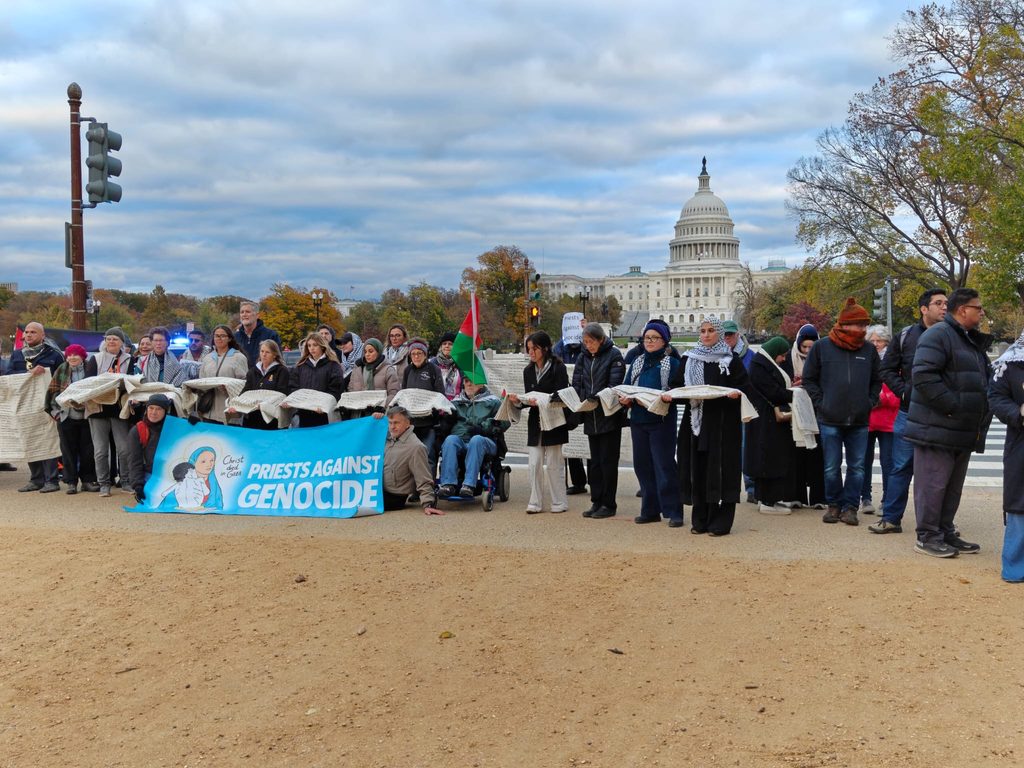
The mobilization culminated on Monday, November 16, with a press conference outside the United Methodist Building on Capitol Hill, just across from the United States Capitol, where Palestinian Christian representatives and their American allies urged Congress to reconsider military assistance to Israel and take concrete steps to protect Palestinian civilians. As reported by Independent Catholic News and Religion News Service, the gathering brought together organizations including Priests Against Genocide USA, Orthodox Christians for Palestine, the Palestinian Christian Alliance for Peace, and Doctors Against Genocide, whose representatives described the impact of the war in Gaza, violence in the occupied West Bank, and the growing insecurity experienced by Palestinian communities. Although their religious backgrounds and political experiences differed, the participants shared a determination to challenge the gap between public expressions of Christian solidarity with the Holy Land and the relative silence surrounding the experiences of Palestinians who continue to live there.
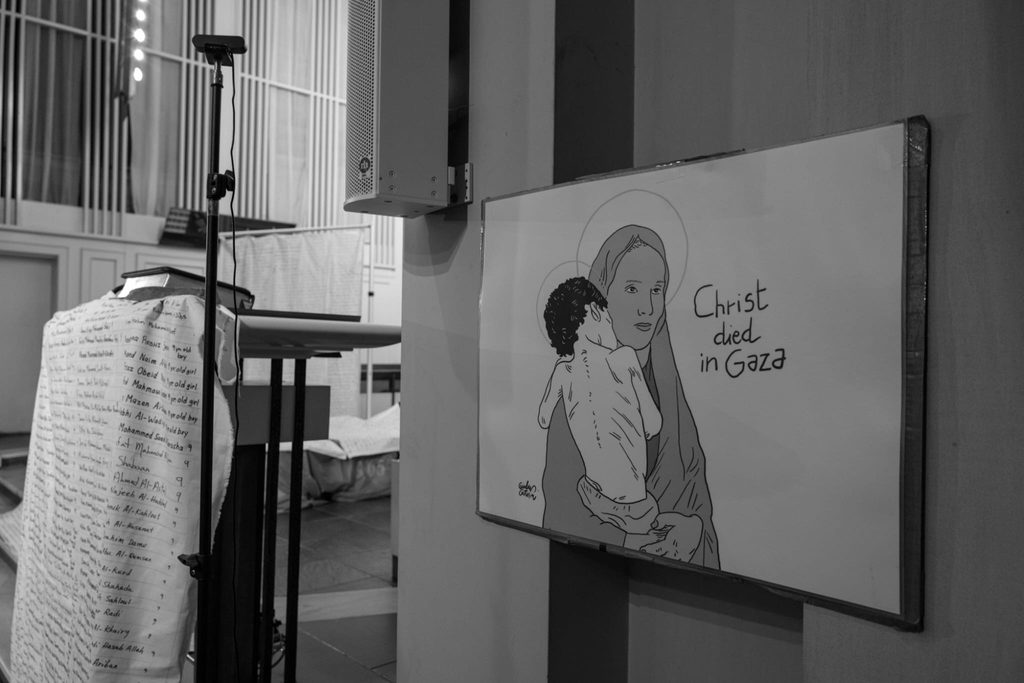
One of the most powerful symbols accompanying the events was the Gaza Children’s Shroud, a long piece of fabric bearing the handwritten names of more than 20,000 Palestinian children reported killed during the war. Created through the collective efforts of volunteers, religious congregations, and community organizations, the memorial transformed a devastating numerical record into thousands of individual names, each written by hand so that the children would be remembered not as statistics but as people whose lives had been violently interrupted. The fabric, approximately 120 yards long, was displayed during an interfaith vigil on November 14 and became a central element of the following days of remembrance and public testimony. Its presence also created a visual dialogue with Costantini’s drawing: where the shroud commemorated thousands of children through their names, Christ Died in Gaza concentrated the experience of loss into the image of one mother holding one child, giving a human form to grief on a scale that is otherwise almost impossible to comprehend.

Among the Palestinian Christian voices participating in the Washington gathering was Father Bashar Fawadleh, Catholic parish priest of Taybeh, a predominantly Christian Palestinian village northeast of Ramallah that has experienced increasing insecurity linked to nearby Israeli settlements and attacks by settlers. Speaking about the pressures facing the community, Fawadleh described the fear that the continued violence and restrictions on everyday life could eventually make it impossible for younger generations to remain in their ancestral homes. His testimony challenged the idea that preserving the Christian heritage of the Holy Land can be separated from protecting the people who have maintained that heritage through centuries of political and religious change. The churches, monasteries, archaeological sites, and ancient stones that attract pilgrims from around the world, he suggested, cannot be treated as more important than the living communities whose traditions give those places their meaning.
This concern was also expressed by Reverend Dr. Mitri Raheb, the Palestinian Lutheran pastor, theologian, and founder of Dar al-Kalima University in Bethlehem, who has long argued that Palestinian Christians must be recognized as active members of their society rather than as a disappearing religious minority confined to the margins of international discussions. For Raheb and other participants, the Washington gathering was an opportunity to remind American religious and political leaders that Palestinian Christianity is not merely a historical inheritance associated with biblical geography, but a living tradition whose members continue to face the consequences of military occupation, restrictions on movement, and uncertainty about their future. Their testimonies placed the survival of Palestinian Christian communities within the wider question of Palestinian human rights, rejecting attempts to separate their experiences from those of their Muslim neighbors.
The difficulties encountered by Palestinian representatives in making their voices heard were illustrated by the experience of Father Issa Thaljieh, a priest associated with the Church of the Nativity in Bethlehem, who was unable to travel to the United States after being denied a visa. His sister, Honey Thaljieh, a Palestinian sports pioneer, spoke on his behalf, drawing attention to the obstacles that can prevent Palestinians from participating directly in international discussions about their own lives. The visa decision became part of a wider conversation about representation and the unequal access that different communities have to institutions capable of influencing political decisions. While American officials emphasized the obligation of visa applicants to satisfy legal requirements, the organizers argued that the absence of the priest deprived the gathering of an important voice from one of Christianity’s most significant places.
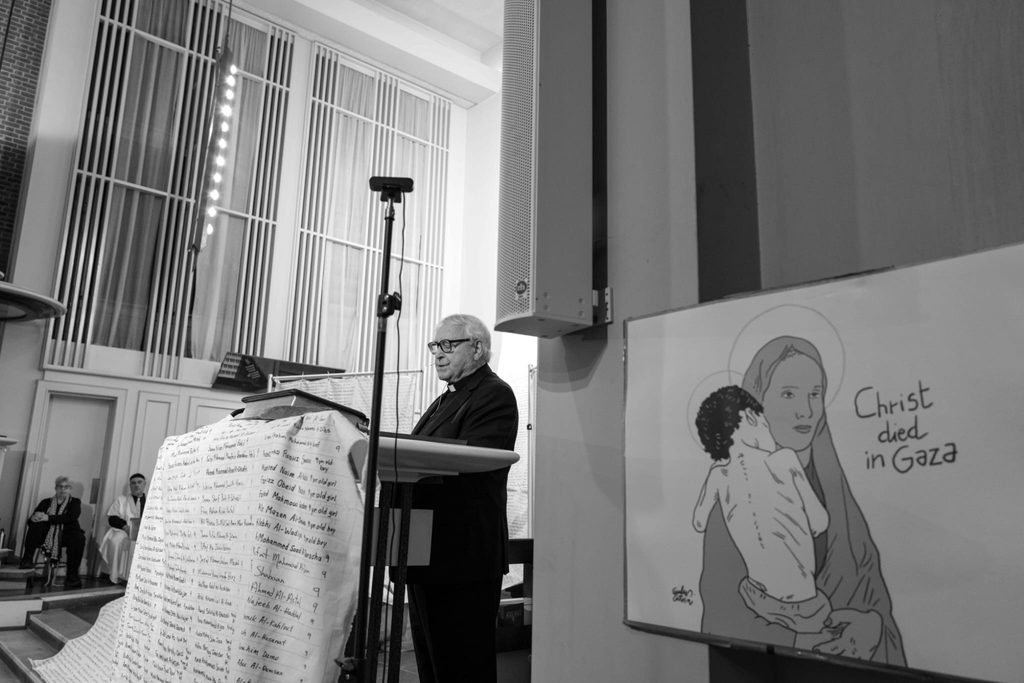
The American religious representatives who joined the mobilization connected these Palestinian testimonies to questions about the responsibilities of churches and faith communities in the United States. Mother Agapia Stephanopoulos, a Greek Orthodox nun who spent many years living in Jerusalem, spoke about the suffering of Palestinian civilians and the need for a different American response, while Father John Heagle, coordinator of Priests Against Genocide USA, emphasized the moral responsibility of Christians toward children killed in war. Bishop Philip Hirsch, of the Metropolitan Washington, D.C., Synod of the Evangelical Lutheran Church in America, connected solidarity with Palestinian communities to decisions involving institutional investments and economic relationships, explaining that his synod had chosen to stop supporting companies doing business with Israeli settlers in the West Bank. The participation of Rabbi Malkah Binah Klein and Imam Saffet Catovic further expanded the gathering beyond Christian denominations, showing how concern for Palestinian lives could bring together religious communities whose traditions and histories are different but whose ethical commitments overlap.
These encounters were the culmination of a weekend in which religious symbolism was repeatedly brought into public space. On November 14, participants gathered for a procession and interfaith vigil accompanied by the Gaza Children’s Shroud, while families assembled on the National Mall for Fly a Kite for Gaza’s Children, an initiative inspired by the place of kite-flying in Palestinian childhood and its association with freedom and hope. Orthodox Christians also met in nearby Potomac, Maryland, for a gathering dedicated to the message Not in Christ’s Name, and the following day Priests Against Genocide USA organized a Catholic event at Holy Trinity Parish in Washington, where Palestinian Christian representatives shared their experiences with American congregations. By the time the different groups assembled on Capitol Hill on November 16, the appeal had taken shape through several forms of public expression, from prayer and personal testimony to political advocacy and visual remembrance.
The gathering came at a particularly sensitive moment for Palestinian communities in the occupied West Bank, where settler attacks, restrictions on access to land, and displacement have contributed to a growing humanitarian emergency. The United Nations Office for the Coordination of Humanitarian Affairs has repeatedly documented the impact of settler violence and movement restrictions on Palestinian families, including communities that have been forced to leave their homes and agricultural lands. Against this background, the Washington participants argued that protecting Palestinian Christians requires more than expressing concern for churches and religious monuments, because the future of those sites is inseparable from the security and dignity of the people who live around them. Their appeal was directed particularly toward American Christian communities whose political and theological support for Israel may not always be accompanied by an awareness of the experiences of Palestinians who share their faith.
It is within this relationship between Christian imagery, religious identity, and contemporary violence that Costantini’s Christ Died in Gaza acquires its most direct meaning. The image is not intended as a conventional representation of the historical crucifixion, nor as an attempt to transform a contemporary tragedy into a religious illustration. Rather, it draws on the enduring visual power of the Pietà to confront viewers with a moral contradiction: how can the suffering of Christ remain central to religious devotion while the suffering of children living in the lands associated with Christianity risks being accepted as a distant political reality? The mother holding her dead child becomes a contemporary figure of grief, and the familiar Christian image is transformed into an invitation to reconsider whose pain is recognized, whose lives are mourned, and whose suffering is allowed to remain invisible.
The drawing had already followed a significant path before reaching the Washington mobilization. In November 2025, works from Christ Died in Gaza were presented at St. Paul’s Within the Walls in Rome, where they became part of an encounter between contemporary art, prayer, and reflection on the war in Palestine. The exhibition brought together people from different backgrounds and encouraged conversations about the relationship between religious images and the political responsibilities of the present. During its closing event, Palestinian Ambassador to Italy Mona Abuamara spoke about the relationship between Christian history and the suffering of Palestinian children, connecting the biblical significance of Bethlehem with the destruction experienced by families in Gaza. Her speech, subsequently published on ChannelDraw, offered another perspective on the need to recognize Palestinians not simply as inhabitants of a contested territory, but as people whose lives and cultural traditions are inseparable from the history of the region.
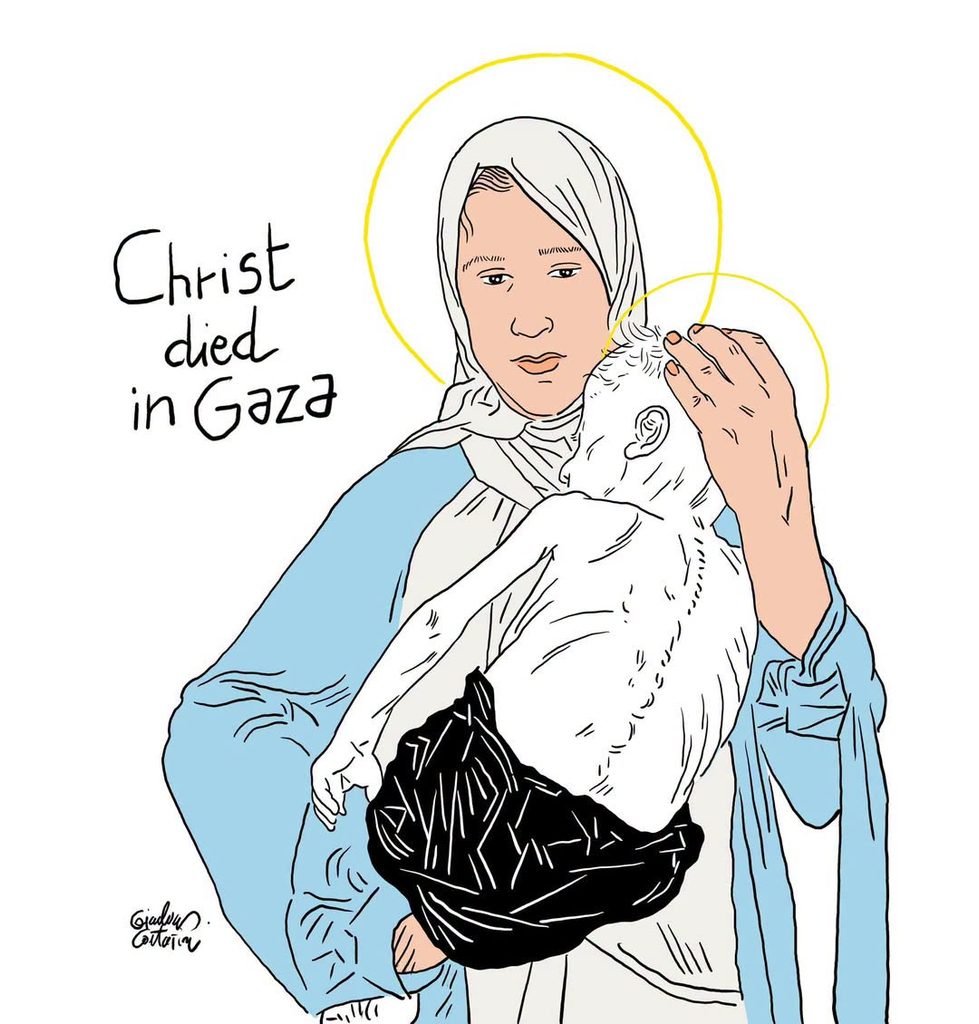
The image continued to circulate during 2026, becoming associated with the international movement Priests Against Genocide, whose members have organized public appeals, religious gatherings, and demonstrations concerning Gaza. On September 22, priests participating in a march through Rome carried Costantini’s drawings, bringing the image from the interior of a church into the streets, where its meaning could be encountered by people outside the religious communities that had initially gathered around it. The relationship between the drawing and Christian theology was also explored by Father David Neuhaus, a Jesuit priest based in Jerusalem, who discussed the image during an online meeting organized by Priests Against Genocide. As documented in Where Is Jesus? David Neuhaus on Gaza and the Image of a Dead Child in His Mother’s Arms, Neuhaus reflected on the possibility of recognizing the suffering Christ in the suffering of Palestinian children, interpreting the drawing as a challenge to the distance that can emerge between religious language and contemporary human experience.
In October 2026, the same visual project reached another audience when a drawing from the series was published in the French magazine Le Cri, accompanying an article about the mobilization of priests speaking out against the destruction of Gaza. What began as a single image had gradually become part of a wider conversation taking place across different countries and religious contexts, appearing in exhibitions, publications, public demonstrations, and gatherings where participants sought to connect faith with the defense of human dignity. Its use during the Washington initiatives represented another stage in this process, this time within a movement addressing American lawmakers and challenging the political influence of religious interpretations that overlook Palestinian rights.


CHANNELDRAW STUDIO · INDEPENDENT PUBLISHING
Active Art Yearbook
A year of drawings, stories and civic engagement. Discover the Channeldraw annual volumes.
Explore the yearbooks →For Costantini, this continuing circulation reflects an important aspect of political drawing: an image does not necessarily complete its purpose when it is first published, because its significance can develop through the people who choose to carry it, display it, or use it to express their concerns. The meaning of Christ Died in Gaza changes according to the places it enters without losing its essential subject. Inside a church in Rome, the drawing becomes part of a reflection on suffering and religious responsibility; during a procession, it acquires the visibility of a collective act of protest; in an editorial publication, it accompanies arguments and testimony; and in Washington, it becomes associated with an appeal directed toward the institutions responsible for decisions that affect Palestinian lives. These different settings demonstrate how a drawing can move between art, journalism, religious experience, and political advocacy, preserving its capacity to raise questions even as the circumstances surrounding it change.
The relationship between Christ Died in Gaza and the Gaza Children’s Shroud is particularly revealing because both works confront the difficulty of representing suffering on an overwhelming scale. The shroud gathers thousands of names, written individually to resist the reduction of children’s deaths to numbers, while Costantini’s drawing concentrates that suffering into the intimate relationship between a mother and her child. Although their forms are different, they share the conviction that remembrance must begin with the recognition of individual lives. In a political environment where discussions of war frequently become dominated by military strategies, diplomatic arguments, and competing interpretations of events, such images insist on returning attention to the people whose lives have been destroyed.
The organizers of Not in Christ’s Name sought to bring the same recognition into the heart of the American political debate, asking lawmakers and religious leaders to consider what responsibilities follow from the principles they publicly profess. Their demands concerning military assistance, civilian protection, accountability, and the future of Palestinian communities remain matters of political disagreement, but the gathering was also an attempt to make the voices of Palestinian Christians more visible in conversations often conducted without them. The participants did not present religious identity as a reason to separate Christian Palestinians from the wider Palestinian population; instead, they used their own traditions to argue that the protection of human life must extend beyond religious, national, and political boundaries.
Through its presence in Washington, Christ Died in Gaza became part of this broader effort to connect remembrance with responsibility, transforming a familiar image from Christian art into a contemporary question about the suffering of innocent people. The drawing cannot resolve the political conflict or replace the work of journalists, humanitarian organizations, diplomats, and human rights advocates, but it can encourage viewers to confront the reality that lies behind the language of war, and to recognize that every child killed leaves behind a family, a history, and a future that will never be lived.
As Palestinian Christian leaders and their allies gathered near the United States Capitol, the words Not in Christ’s Name expressed their refusal to accept the use of religion as a justification for violence. Costantini’s drawing gave that refusal a visual form, returning to an image that has shaped Christian art for centuries and asking viewers to consider what it means today.
If Christians recognize Christ in the suffering of the innocent, can they look at the children of Gaza without recognizing him there?