Exploring Comics, Memory, and Social Reflection in Santarcangelo
The days of “Zàca! Reality and Poetry through Comics,” held in Santarcangelo, were engaging and above all deeply formative. Together with Giovanni Boccia Artieri, I brought to this small town — famous for its poets (Nino Pedretti, Tonino Guerra, Raffaello Baldini…), its contemporary theatre festival, and the Mutonia camp — a glimpse of the contemporary comics scene I love.
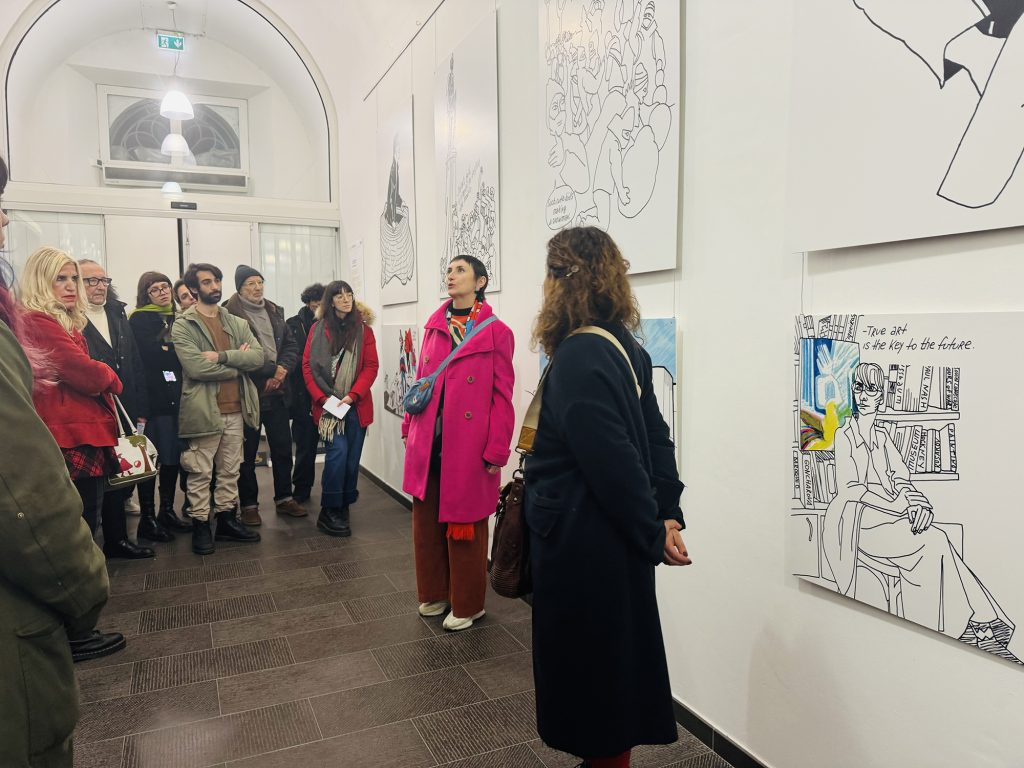
We began with our most important guest, Victoria Lomasko, a Russian artist and cartoonist of international renown, known for her work in graphic journalism and for a practice that intertwines drawing, political activism, and social research. At the Biblioteca Baldini — which also served as the central hub for all the festival’s activities — we inaugurated her exhibition “Political Statement: From Sketch to Symbol,” a journey that highlights the power of her line as a tool of testimony, capable of transforming direct observation of reality into strong and symbolic images.
In the evening, at the Supercinema, the film “Tree of Violence” by Anna Moiseenko was screened—an intense and necessary work that engages in an ideal dialogue with Lomasko’s practice, addressing themes of repression, memory, and resistance through the language of cinema. The screening broadened the festival’s perspective, bringing comics, documentation, and film into conversation as different yet complementary ways of narrating reality.

The following morning, Victoria Lomasko led the workshop “Transforming a Sketch into a Symbol: Between Politics and Poetry,” with nine young artists: Maxem, Chiara Raimondi, Kizazu, Irip, Chiara Fanelli, Mariagiulia Pedrotti, Vittoria Adorno, and Riccardo Pedone. During the workshop, Lomasko guided the young illustrators — students and recent graduates of the Academy of Fine Arts in Bologna — through an in-depth reflection on the role of the artist in relation to history. At the heart of the meeting was not only the practice of drawing, but also the responsibility of the gaze: how an image emerges from a historical context and how, over time, it can be transformed into a symbol.
To address this theme, Lomasko proposed a comparative analysis of several illustrated editions of “The Twelve,” the celebrated poem by Alexander Blok written in the aftermath of the October Revolution of 1917. The first edition, published in 1918 with illustrations by Yury Annenkov, was read as a direct testimony to the shock of the revolution. Annenkov, who like Blok lived in Petrograd and witnessed the events firsthand, conveys in his drawings the disorientation and violence of a historical transformation that also had a dramatic impact on his personal life.
A radical shift in perspective emerges instead in the 1920 edition published in Paris, illustrated by Mikhail Larionov and Natalya Goncharova. Despite being artists of extraordinary talent, their geographical and existential distance from revolutionary Russia — now experienced through the condition of emigration — translates, according to Lomasko, into an inability to grasp the true essence of the poem and the spirit of the revolution. In the workshop, this distance became an opportunity to reflect on the cultural and symbolic cost of exile.
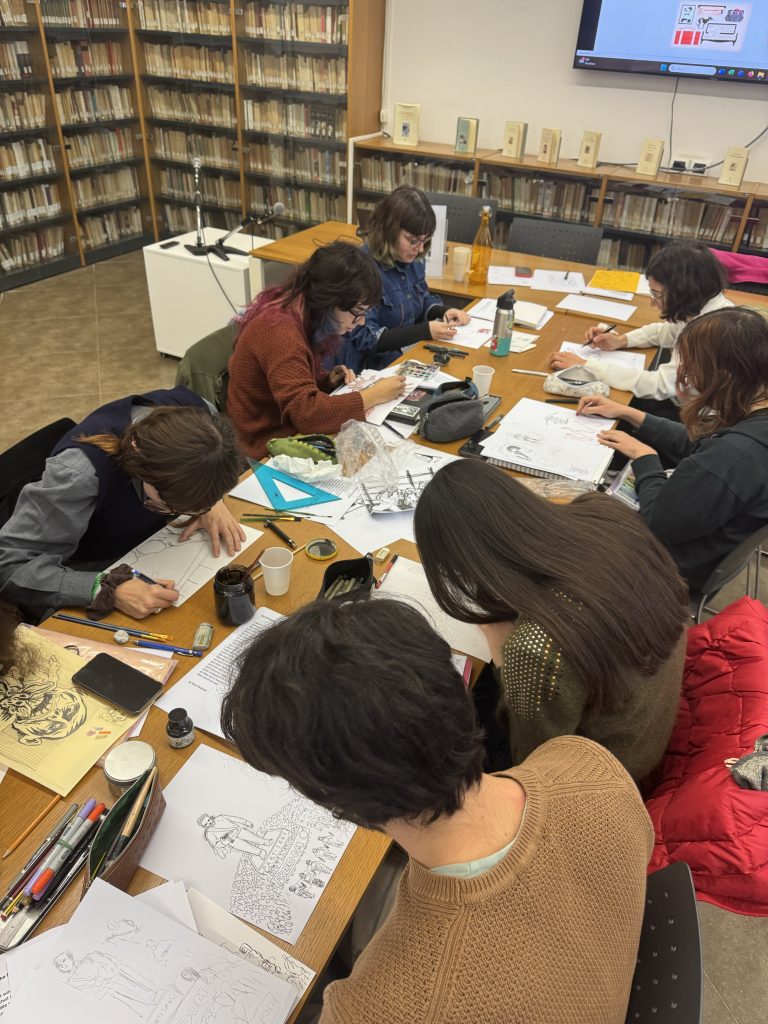
Finally, attention shifted to the editions from the 1940s and 1950s, during the height of the Stalinist period and the years immediately following. In these publications, Lomasko emphasized, ambiguities and questions disappear: the revolution is portrayed as an epic and unquestionable event, the twelve Red Guards as heroes without shadows, and 1917 as the origin of an empire destined to last forever. Through this journey, the workshop demonstrated how images not only reflect history, but also reveal its tensions, erasures, and ideologies, offering students critical tools to understand their own positioning as artists in the present.
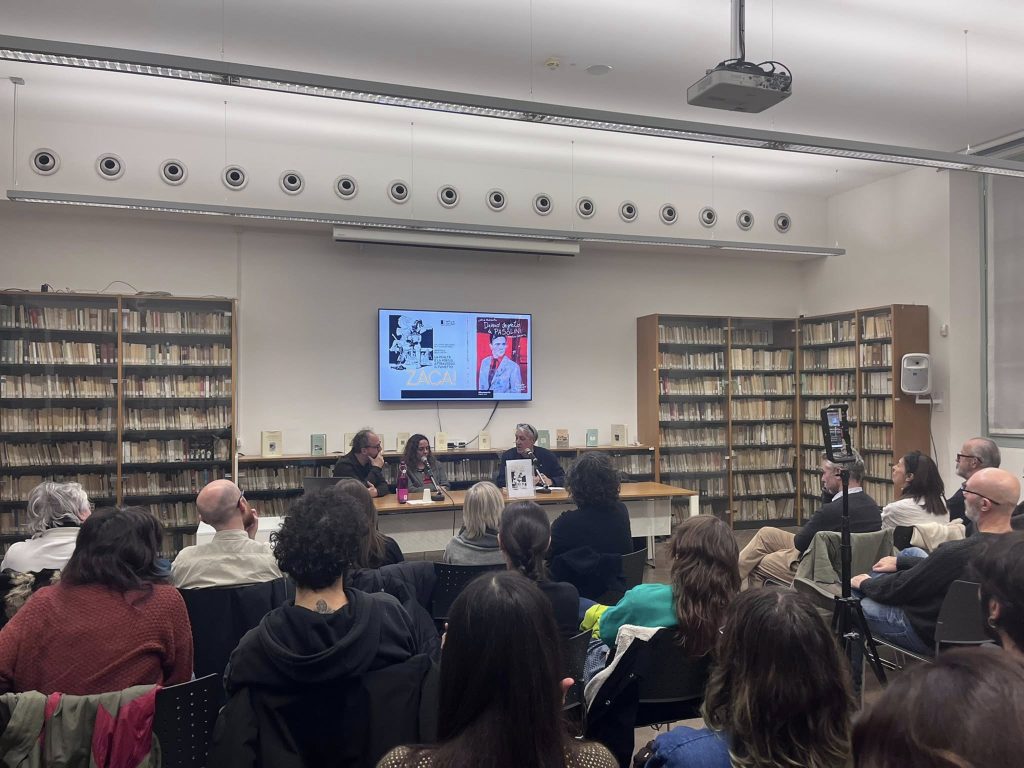
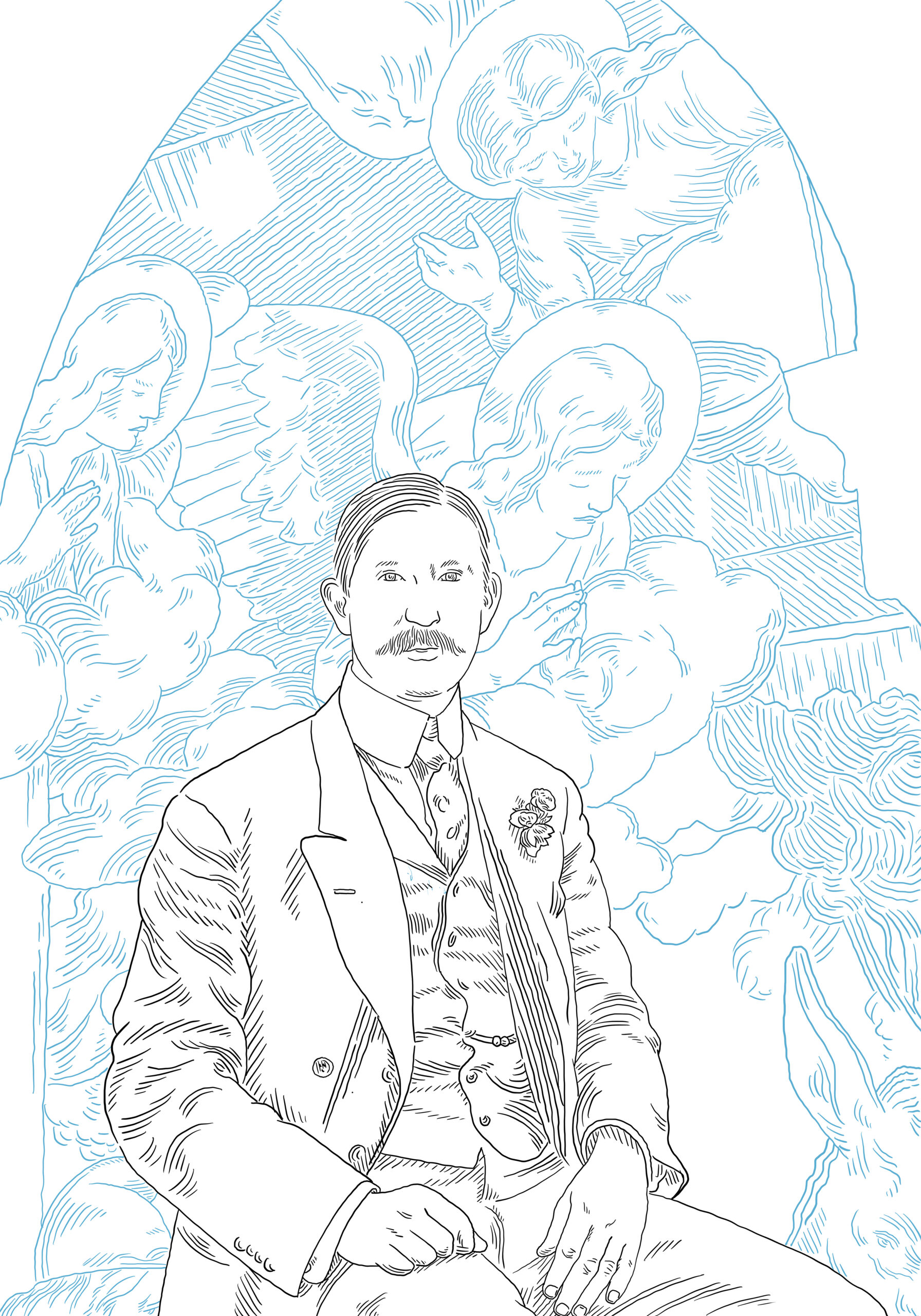
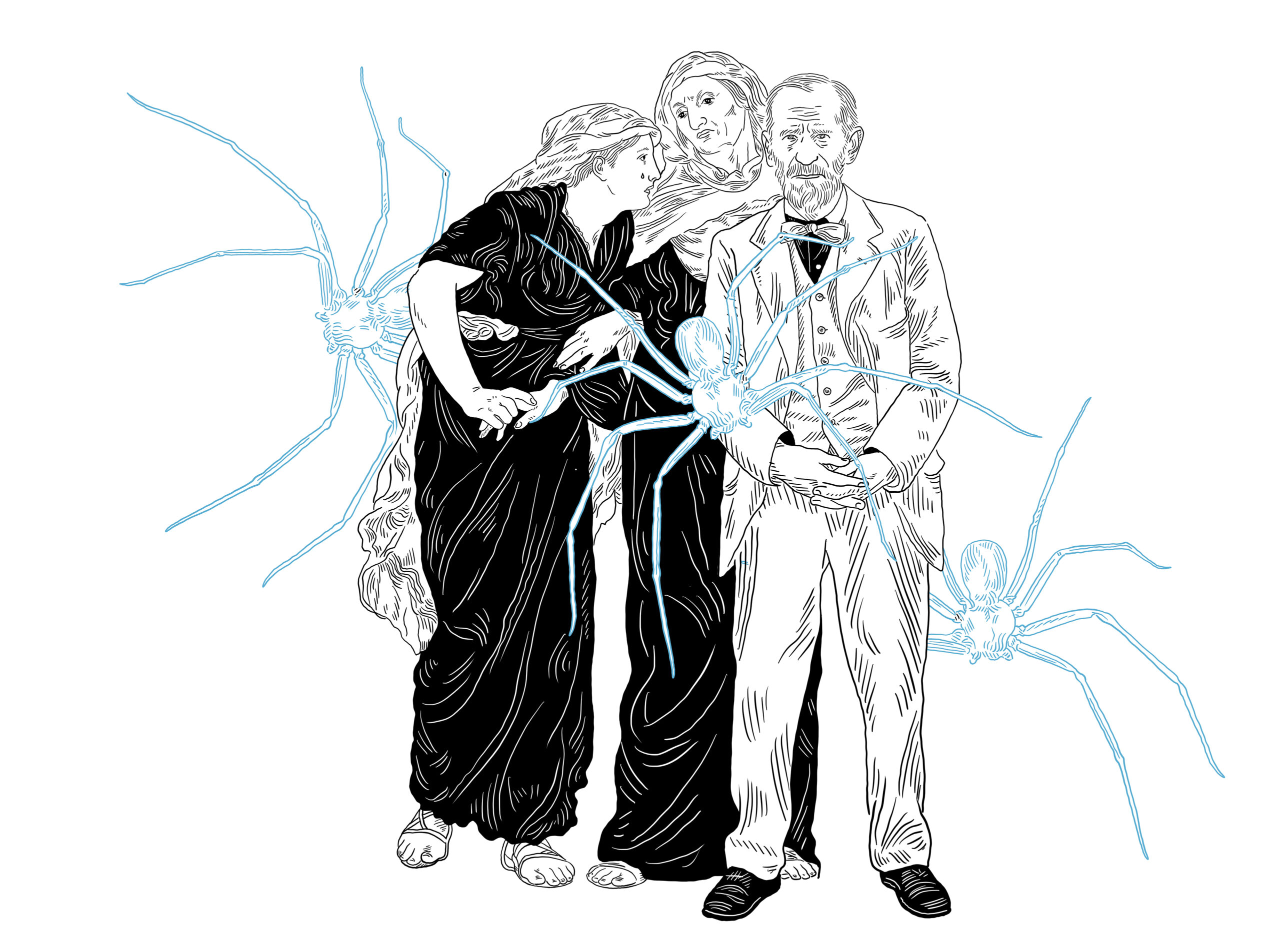
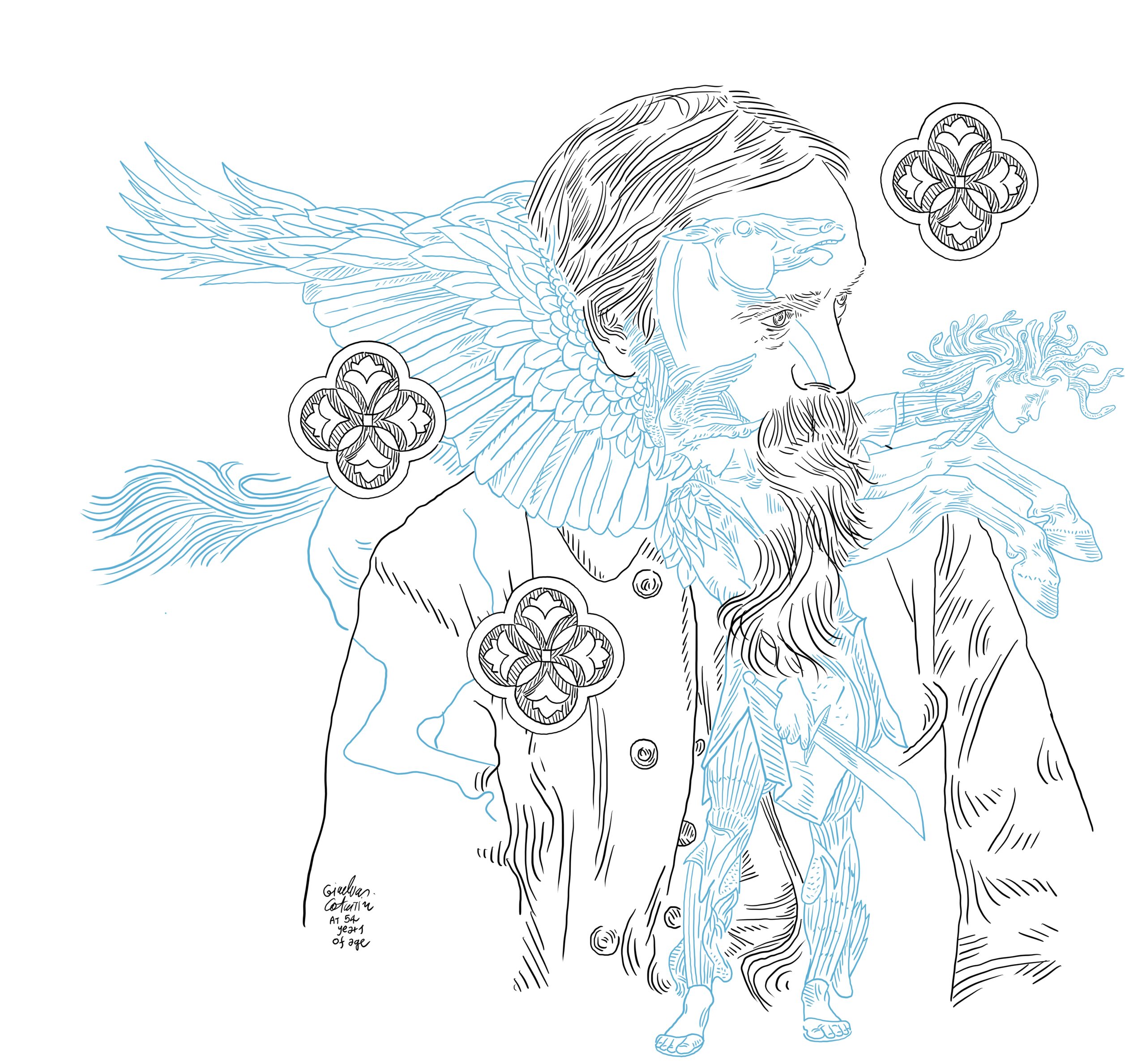
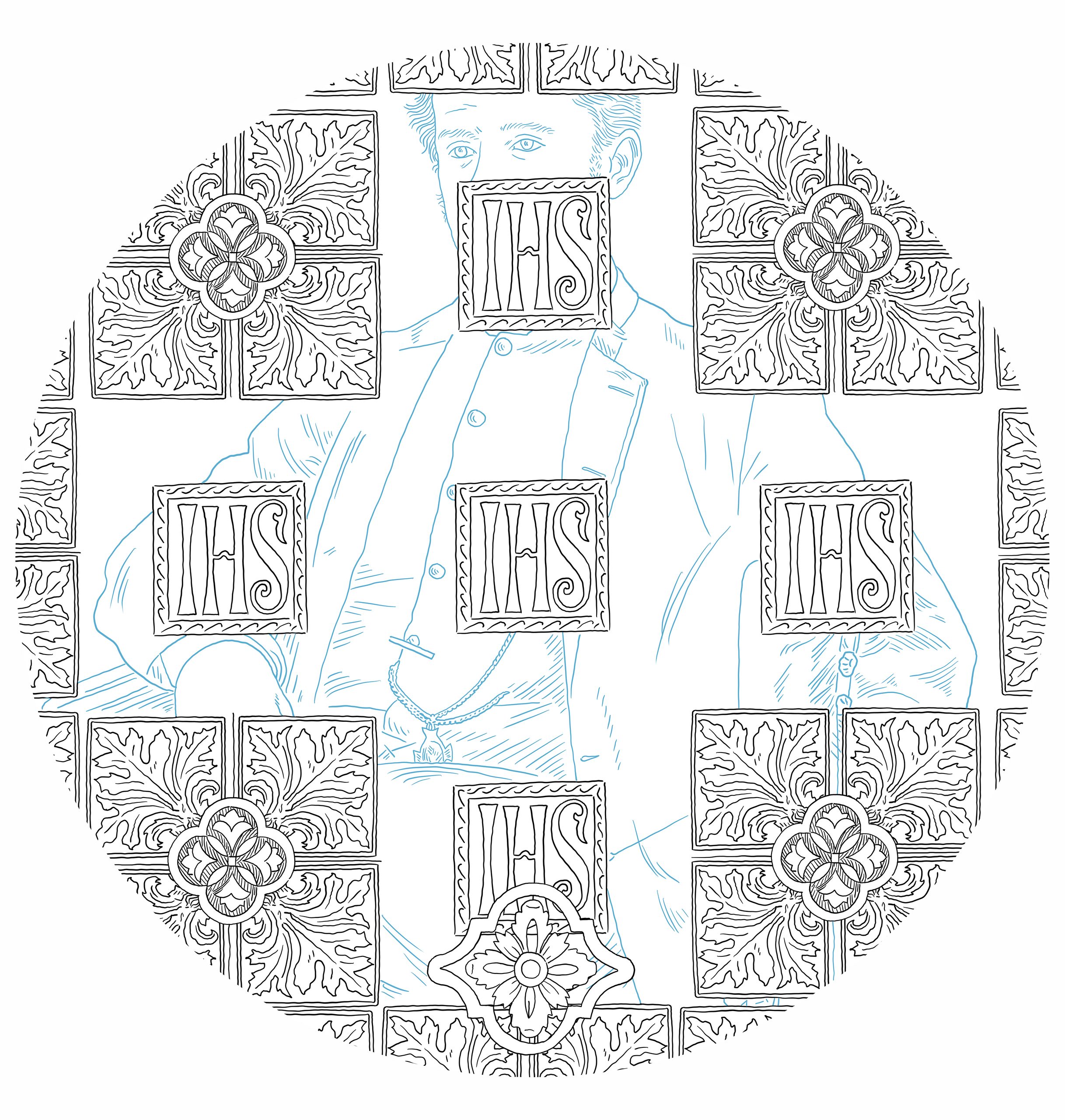
In the afternoon, together with Elettra Stamboulis and Giovanni Boccia Artieri, I presented our book “Secret Diary of Pasolini,” published by Altreconomia. The volume originated as a complex editorial and authorial project, intertwining research, critical imagination, and the language of comics to offer an original and layered portrait of Pier Paolo Pasolini.
The book is conceived as a fictional diary—an intimate and speculative narrative space in which text and images engage in dialogue to evoke Pasolini’s thoughts, obsessions, and contradictions, connecting his private dimension with the political, cultural, and media context of twentieth-century Italy. Through drawing and writing, Secret Diary of Pasolini does not aim to reconstruct a definitive biographical truth, but rather to question Pasolini’s figure as an uncomfortable intellectual, a secular prophet, and a body exposed to the conflict between the individual and society.


The final day of the festival began with the presentation of the book HIU. Happening International Underground 1993–2003, curated by Marco Teatro, together with several representatives of the Mutoid Waste Company. The volume is a true visual and narrative archive of a decade of European underground culture, documenting events, performances, and installations that redefined the concept of participatory and collective art. Through photographs, texts, posters, and historical reconstructions, the book conveys the intensity and creativity of a community that was able to transform urban and industrial spaces into an open laboratory for artistic experimentation.
The Mutoid Waste Company, key figures in this scene, embody the spirit of the movement: itinerant artists and performers who, since the late 1980s, have recycled industrial and urban waste materials to create unique sculptures, installations, and performance vehicles, turning art into collective action. Their presence at the presentation made it possible to hear firsthand the stories, challenges, and freedoms experienced along a creative path that blends art, performance, and communal life.
The conversation with the curator and members of the collective showed how HIU is not merely a book of memories, but a living document that tells of art’s ability to build spaces of freedom, provocation, and sharing, restoring the energy of a decade in which underground culture and experimentation came together to redefine the very idea of the cultural happening.
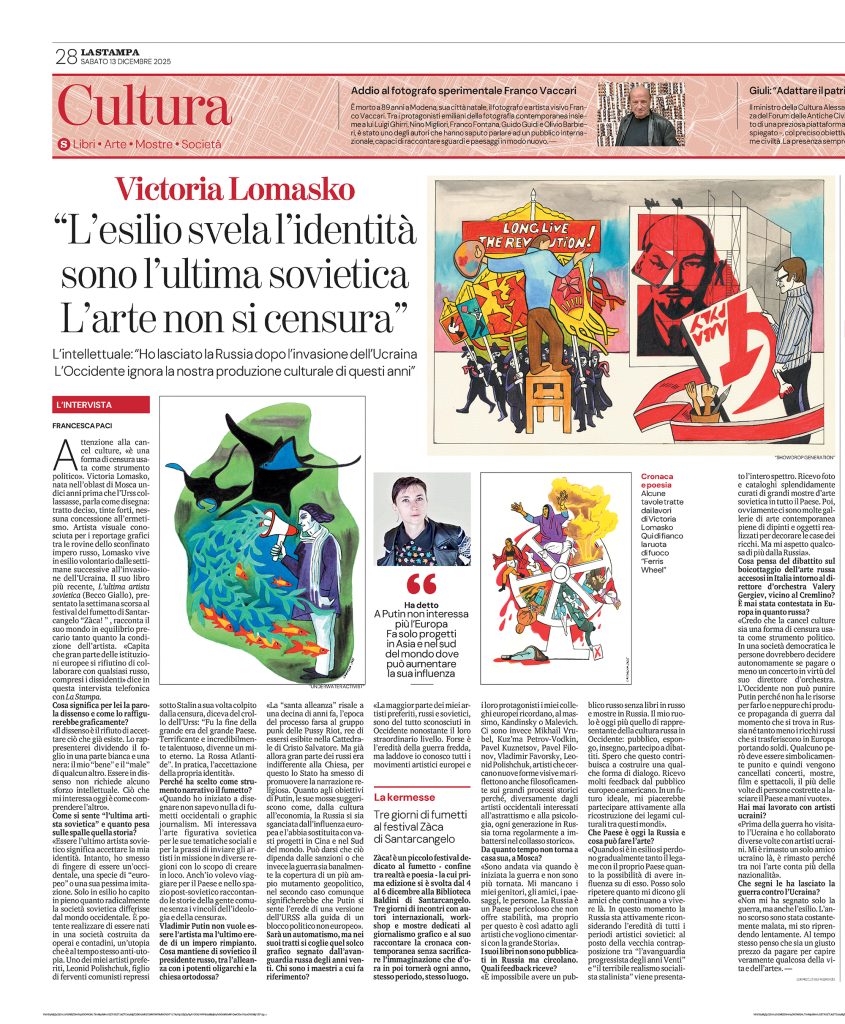
As a grand finale, Victoria Lomasko returned to the stage to present, together with Elettra Stamboulis and Giovanni Boccia Artieri, the book “The Last Soviet Artist,” published in Italy by BeccoGiallo Edizioni. The volume offers an intense exploration of history and memory through the language of comics, focusing on artists and intellectuals who lived through the final decades of the Soviet Union and bore witness to radical political and social changes.
The book portrays with great delicacy and precision the conflict between art and ideology, showing how creativity can become a tool of resistance and critical reflection. With her incisive, documentary-style line, Lomasko alternates personal stories and social observations, restoring for the reader the atmosphere of an era marked by tensions, contradictions, and shattered dreams.
The presentation highlighted not only the artistic value of the book, but also the ability of comics to transform into a medium of historical and civic testimony. Through The Last Soviet Artist, Lomasko invites the audience to reflect on the role of the artist in society and on the power of art to tell stories often overlooked by official historiography, offering a unique perspective on the last generation of creatives in the Soviet world.

On November 22, as an “off” event of the festival days, a meeting with Pietro Scarnera took place, dedicated to his book Viaggio in Italia, published by Coconino Press. The volume brings together travel diary, comics, and social observation, offering a contemporary and personal взгляд on today’s Italy.
Through his clear yet poetic graphic style, Scarnera guides the reader along a journey that crosses cities, small towns, and landscapes often overlooked by mainstream media. Viaggio in Italia is not merely a geographical account, but a reflection on the country’s cultural, social, and economic transformations: from local communities to urban dynamics, from the contradictions of the present to the traces of the past that still mark the territory.
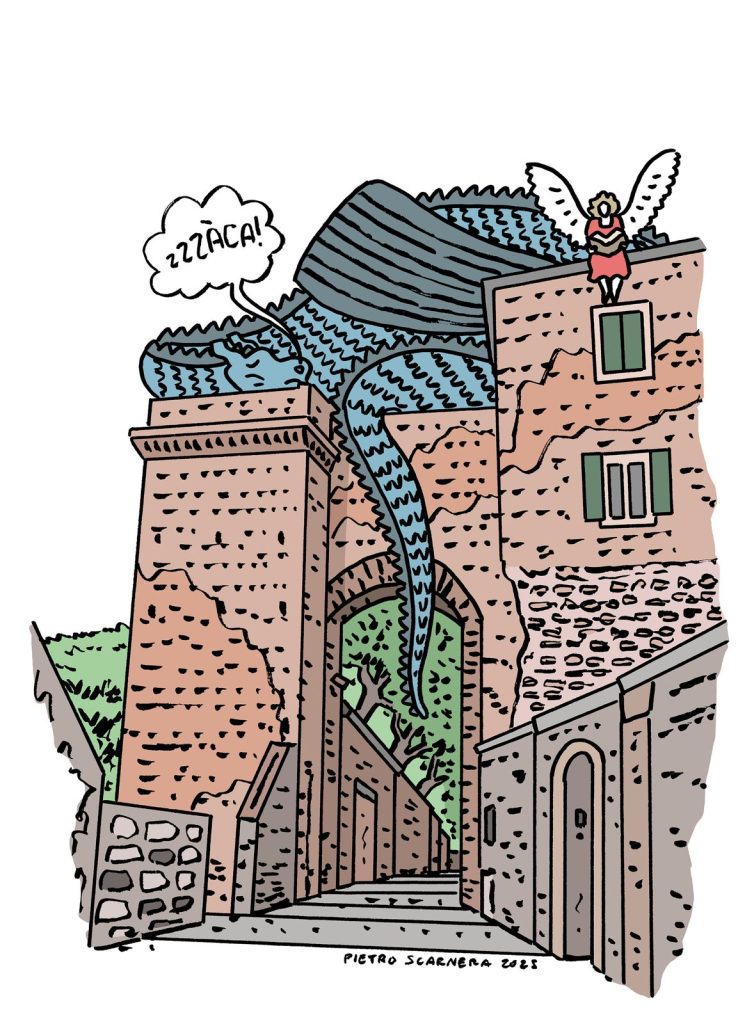
During the meeting, Scarnera delved into the creative process behind the book, explaining how graphic and narrative choices help convey the atmospheres and emotions of the places visited. For the occasion, Pietro Scarnera dedicated this beautiful drawing to Santarcangelo…
These intense days in Santarcangelo thus traced a rich and varied path through comics, art, cinema, and memory, bringing different generations of artists and authors into dialogue. From the workshops and exhibitions by Victoria Lomasko, to the previously unpublished account of Pasolini and the critical journey through contemporary Italy by Pietro Scarnera, and finally to the visionary power of the Mutoid Waste Company, the festival demonstrated how comics and the visual arts can become tools for observation, reflection, and testimony.

Santarcangelo, with its history of poets, theatre festivals, and creative workshops, once again proved to be the ideal setting for an event capable of combining experimentation with cultural depth. The days of “Zàca! Reality and Poetry through Comics” thus celebrated not only the talent and research of the participating authors, but also the ability of comics and art to depict reality, to question the present, and to keep collective memory alive.
A festival that leaves a lasting mark, inviting artists and audiences alike to continue the dialogue between reality, poetry, and image, beyond the boundaries of any page or performance.