From November 19 to 21, Ravenna hosts the eighteenth edition of Transmissions Festival, dedicated to Theodoric the Great, 1,500 years after his death. The official artwork by Gianluca Costantini connects the city’s ancient history with a contemporary festival of experimental music, visual art, and cultural encounters.
Fifteen centuries after the death of Theodoric the Great, Ravenna is preparing to bring the Ostrogothic king back into the contemporary cultural imagination. From November 19 to 21, 2026, the Italian city will host the eighteenth edition of Transmissions Festival, an international event dedicated to experimental music, sonic exploration, and artistic research. This year’s edition, entitled Transmissions XVIII – Teodorico, takes one of the most complex figures in Ravenna’s history as the starting point for three days of performances, encounters, and dialogue between different artistic languages.
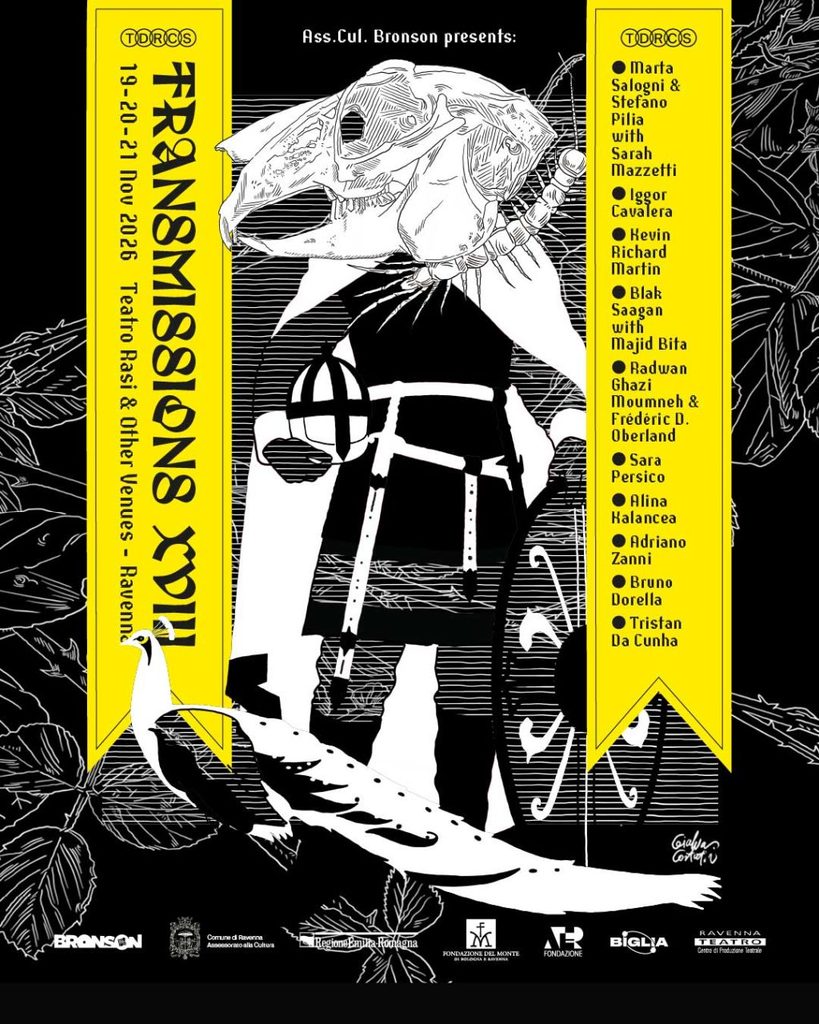
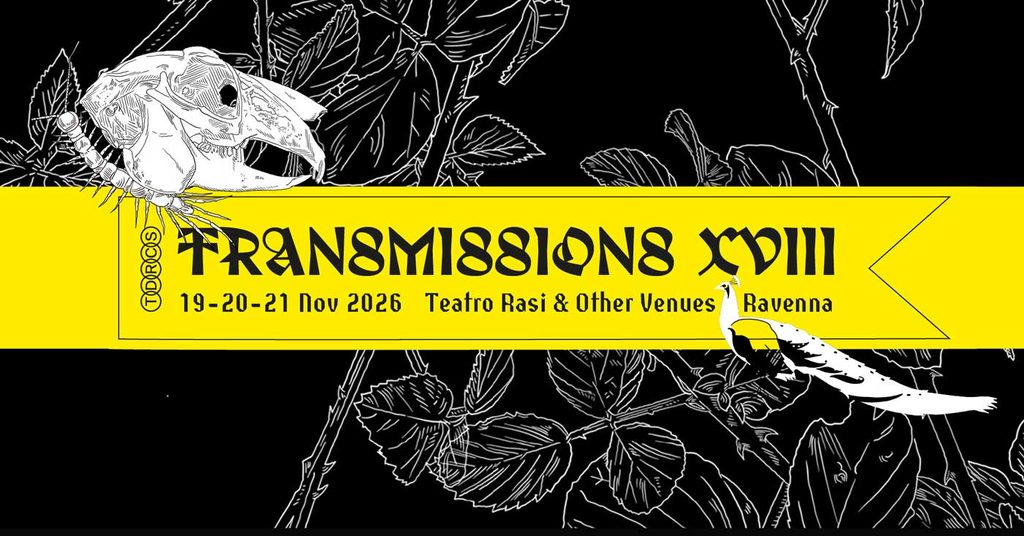
The official artwork for the festival was created by Gianluca Costantini, the Italian cartoonist, illustrator, and artist known internationally for his drawings supporting human rights campaigns and freedom of expression.
For Costantini, who was born in Ravenna and received his artistic training in the city, the project represents a return to a familiar historical landscape. Theodoric is not simply a figure from a distant past. His legacy remains present in Ravenna’s architecture, monuments, streets, and collective memory.
Organized by Bronson Produzioni, Transmissions has established itself as an important meeting place for experimental and avant-garde music. Since its first edition in 2008, the festival has explored the boundaries between sound, visual art, performance, and the cultural histories of the places in which it takes place.
The 2026 edition marks the 1,500th anniversary of Theodoric’s death on August 30, 526. Rather than organizing a conventional historical commemoration, the festival approaches his life as an opportunity to reflect on cultural encounters, the coexistence of different traditions, the instability of political arrangements, and the ways historical memory is continually transformed.
Theodoric, king of the Ostrogoths, ruled Italy from 493 until his death in 526. Having spent part of his youth in Constantinople, where he encountered the political and cultural traditions of the Eastern Roman Empire, he governed a kingdom in which Gothic and Roman institutions, languages, and religious communities existed alongside one another.
His reign was marked by attempts to maintain elements of Roman administration while preserving the political identity of the Ostrogoths. The relationship between the Arian Christianity professed by the Gothic ruling elite and the Nicene Christianity of much of the Roman population was particularly significant.
Yet this coexistence was never free from tension. The political compromises of Theodoric’s kingdom, and the conflicts that eventually undermined them, complicate any simplified image of the king as a symbol of tolerance or cultural unity.
The festival draws on precisely these historical complexities. Theodoric becomes a point of departure for thinking about the encounters and divisions that continue to shape contemporary societies.
Ravenna preserves some of the most extraordinary surviving evidence of his period. The Basilica of Sant’Apollinare Nuovo, the Arian Baptistery, and the Mausoleum of Theodoric bear witness to a city that became a meeting place of Roman, Gothic, and Byzantine cultural traditions.
The Mausoleum of Theodoric, built during the king’s lifetime and distinguished by its monumental stone construction and remarkable monolithic dome, is among the eight Early Christian Monuments of Ravenna recognized as UNESCO World Heritage Sites.
These buildings are not simply monuments to a vanished civilization. They remain part of the visual environment of a city whose identity has been shaped by centuries of contact between different cultures.
For Costantini, this historical inheritance has a particular personal significance.
He studied at the Gino Severini Art Institute in Ravenna and subsequently attended the mosaic decoration course at the Academy of Fine Arts of Ravenna. His early artistic education was deeply influenced by Byzantine mosaics, particularly those of San Vitale and the Mausoleum of Galla Placidia.

In a 2013 interview published on ChannelDraw, he reflected on how the mosaic tradition had shaped his visual language, even as his artistic practice moved increasingly toward drawing, political illustration, comics, and digital experimentation.
That relationship between historical imagery and contemporary artistic expression forms an important background to his collaboration with Transmissions.
The artwork created for the eighteenth edition moves away from a conventional historical portrait. Instead of presenting Theodoric through the familiar iconography of kingship, the festival’s visual identity combines stark black-and-white drawing, organic forms, the image of an animal skull, and a striking yellow graphic band carrying the festival’s name and dates.
The result establishes a visual tension between the historical theme and the contemporary language of an experimental music festival. Its skeletal and natural imagery invites associations with mortality, survival, and the persistence of traces across time.
Theodoric is present as a historical reference rather than as a monumental image of power.
This visual approach reflects the wider artistic character of Transmissions, where history is not treated as something fixed and untouchable, but as material that can be reinterpreted through sound, performance, drawing, and collective imagination.

Costantini’s relationship with Bronson Produzioni also extends beyond this year’s edition. His work for the Ravenna-based cultural organization forms part of a longer artistic dialogue, which included the publication Bronson Drawings, already mentioned among his projects in 2013.
The 2026 artwork follows his contribution to Transmissions XVII, the 2025 edition dedicated to Red Desert, Michelangelo Antonioni’s 1964 film shot in Ravenna.
That edition began a thematic cycle exploring different aspects of the city’s identity. While Red Desert examined Ravenna through industrial landscapes, cinema, and the transformations of modernity, Teodorico travels much further back in time, toward the political and cultural world of Late Antiquity.
The relationship between the two editions reveals an essential aspect of the festival: Ravenna is not simply the place where the concerts take place. It becomes an active part of the artistic project.
The eighteenth edition brings together musicians and artists whose work crosses geographical, cultural, and disciplinary boundaries.
On Thursday, November 19, the festival opens at Teatro Rasi with Kevin Richard Martin, also known as The Bug, presenting Sub Zero, a project moving between dub, electronic experimentation, and glacial ambient sound.
The same evening features Radwan Ghazi Moumneh, founder of Jerusalem In My Heart, performing with French multi-instrumentalist Frédéric D. Oberland. Their project Eternal Life No End establishes a dialogue between Middle Eastern musical traditions and European experimental drone.
The program also includes Sara Persico, the Italian sound artist and performer whose work combines reverberating voices, drones, and traces of sacred music.
On Friday, November 20, Brazilian musician Iggor Cavalera, co-founder of the metal band Sepultura, presents a solo performance built around improvisation, percussion, and ritualistic sound.
He is joined by Romanian sound artist Alina Kalancea, whose compositions explore dark ambient and gothic drone, and Italian field-recording artist Adriano Zanni, presenting Post Dub Cities, a project investigating urban memory through echoes, rhythms, and recorded sounds.
The concluding evening, Saturday, November 21, brings a particularly interesting encounter between music and drawing.
PHREN, a collaboration involving producer Marta Salogni, guitarist Stefano Pilia, and illustrator Sarah Mazzetti, explores the relationship between sonic and visual storytelling.
Another project, Un sequestro lungo 10.000 anni, brings together Italian electronic musician Blak Saagan and Iranian illustrator and graphic novelist Majid Bita, combining industrial music, Iranian punk influences, and visual narrative.
Both projects emerge from Opale, an initiative dedicated to exploring the connections between music, drawing, and storytelling, developed by Maple Death and Canicola.
Their presence within the program is particularly significant for a festival whose official visual identity has been entrusted to a cartoonist. Illustration is not merely a promotional element, but part of a broader exchange between artistic disciplines.
The final evening also includes Tristan da Cunha, a project situated between post-rock, drone, and ambient experimentation.
One of the most symbolic moments of the festival will take place on Saturday, November 21, at 3 p.m., when musician and longtime Transmissions curator Bruno Dorella performs Concerto per chitarra solitaria at the Mausoleum of Theodoric.
The performance brings contemporary experimental music directly into contact with the monument associated with the festival’s historical protagonist.
The choice of location transforms the relationship between music and history into a physical experience. A contemporary musician performs in a space built more than fifteen centuries ago, where the architectural memory of an ancient kingdom encounters sounds produced in the present.
Alongside the concerts, Transmissions OFF extends the festival into other parts of Ravenna, including Fargo Café and the foyer of Teatro Rasi, with DJ sets and public conversations.
The program includes a meeting with Iggor Cavalera on November 20, in conversation with journalist Marco Jim De Vidi, offering an opportunity to explore the musician’s career and artistic influences.
These events contribute to the festival’s broader identity as a meeting point between artists, audiences, and cultural communities.
For Costantini, the relationship between Ravenna’s public spaces and contemporary art has long extended beyond music and illustration.

In April 2021, for example, Parco Teodorico hosted a kite designed by Costantini in solidarity with imprisoned Egyptian student Patrick Zaky. The initiative brought a campaign for human rights into one of the city’s public spaces, connecting artistic expression with civic participation.
Five years later, Theodoric’s name returns in a different artistic context.
The connection between these projects is not their subject matter but the conviction that images can establish relationships between places, histories, and the people who inhabit them.
The work created for Transmissions XVIII belongs to the same broader exploration of visual communication, although its purpose is different from that of Costantini’s drawings for political campaigns.
Here, drawing becomes the visual language of a cultural event that encourages experimentation and exchange between different traditions.
The festival also offers an opportunity to reconsider the place of Ravenna within contemporary international culture.
Known throughout the world for its Byzantine mosaics and Late Antique architecture, the city is often approached primarily through its historical monuments. Transmissions proposes another perspective: a city where the past can become a starting point for contemporary creation rather than an obstacle to it.
The eighteenth edition, dedicated to Theodoric, brings together music from different continents, drawing, experimental performance, and historical reflection.
The image created by Gianluca Costantini accompanies that encounter, linking Ravenna’s ancient visual inheritance with a festival devoted to artistic innovation.
Fifteen hundred years after Theodoric’s death, his memory continues to be reinterpreted.
In Ravenna, from November 19 to 21, 2026, that reinterpretation will take the form of sound, drawing, and the encounter between cultures.
And once again, a contemporary image will open a dialogue with the city’s long and complicated history.
Transmissions XVIII – Teodorico takes place in Ravenna, Italy, from November 19 to 21, 2026, at Teatro Rasi and other venues. The festival is organized by Bronson Produzioni, with support from the Municipality of Ravenna, the Emilia-Romagna Region, and the Fondazione del Monte di Bologna e Ravenna, in collaboration with the National Museums of Ravenna.
Official artwork: Gianluca Costantini / ChannelDraw.
Full program and tickets: transmissionsfestival.org