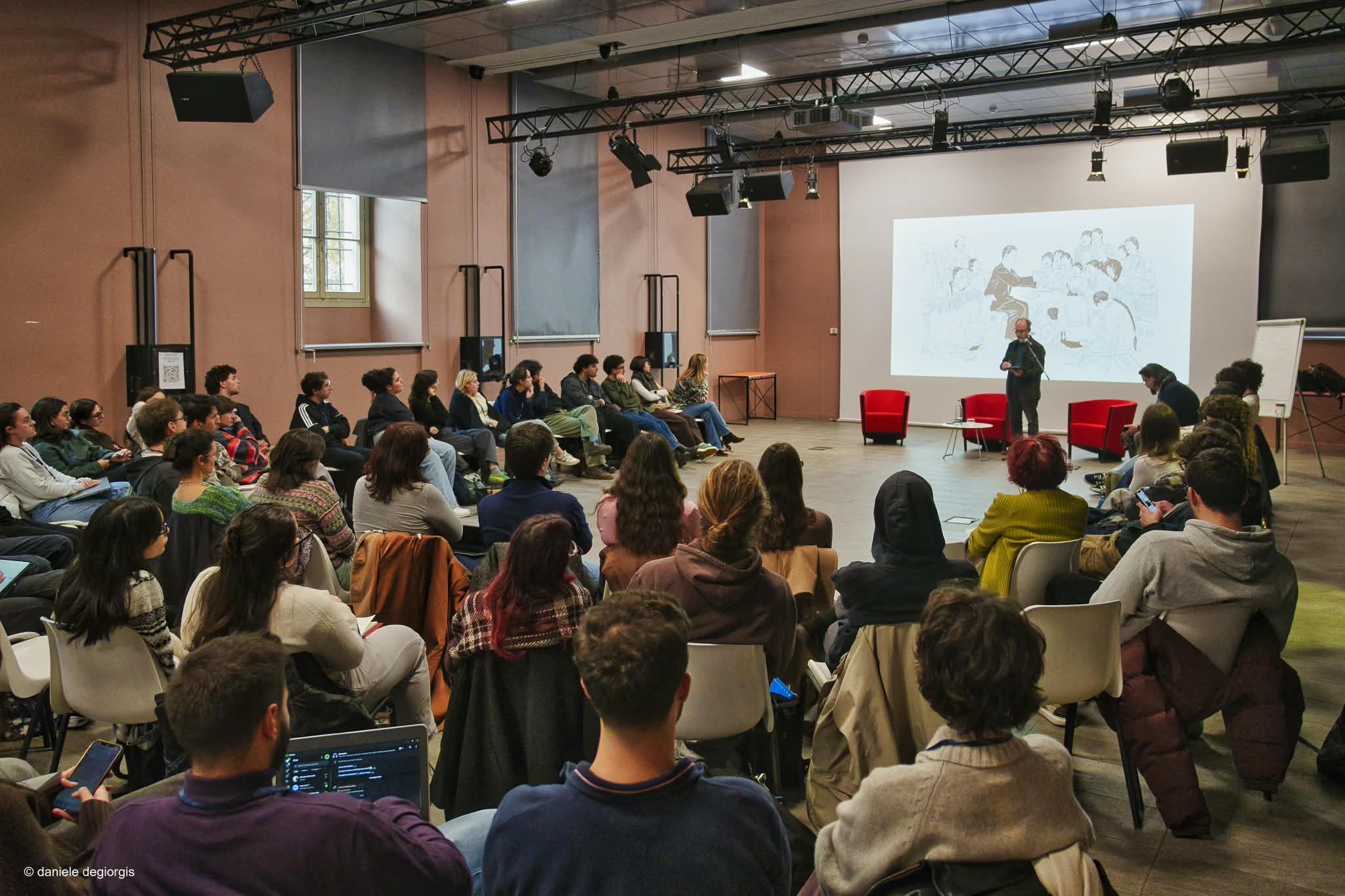
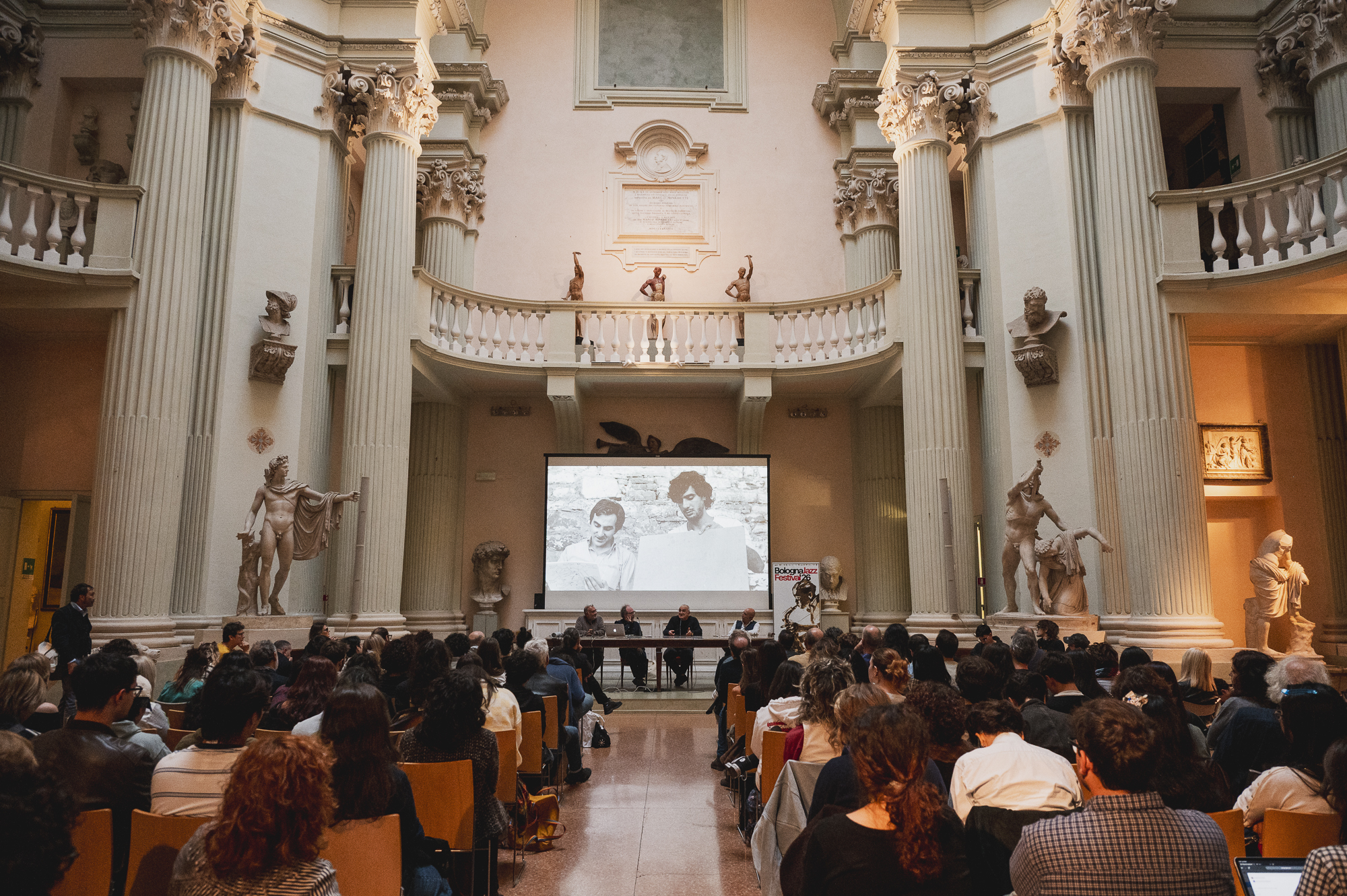
A conversation with Gianluca Costantini and students at the Academy of Fine Arts of Bologna, October 20, 2026
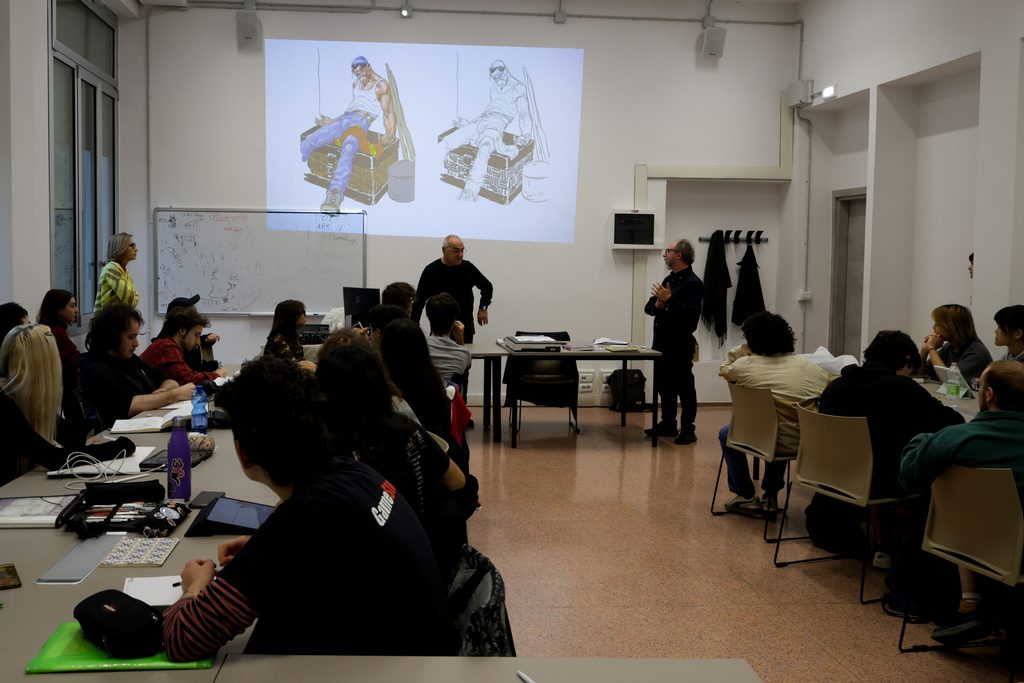
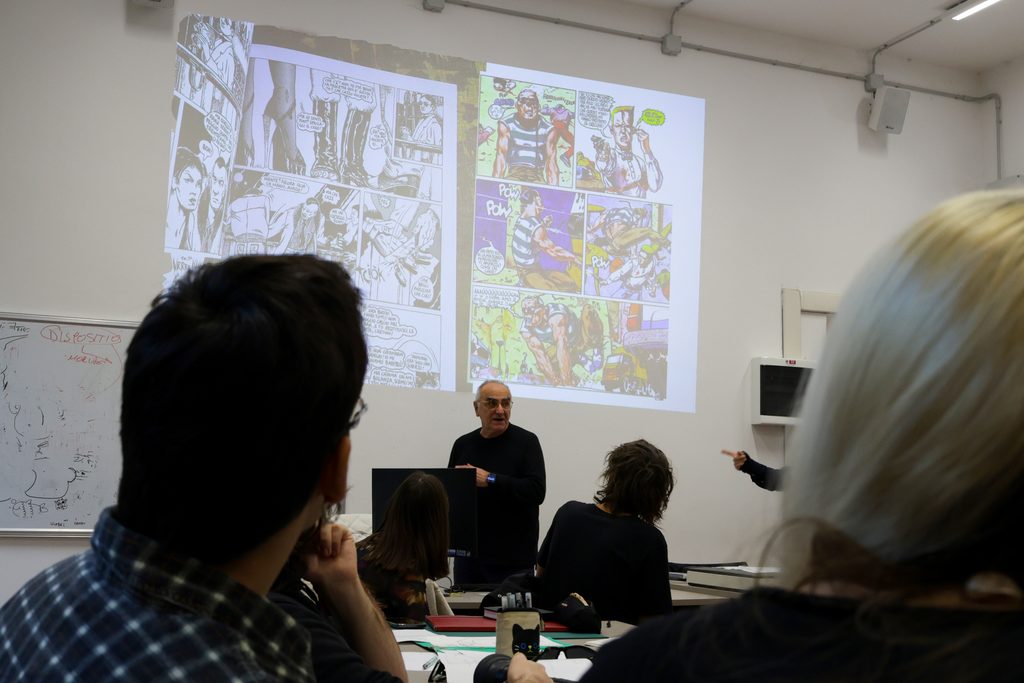
From constructing a page of Ranxerox to exploring the possibilities of digital drawing, from discovering Michelangelo to returning to charcoal. Tanino Liberatore discusses his work through the tools, mistakes, and solutions he has encountered at the drawing board. A conversation about craft, the importance of criticism, and the need to keep experimenting.
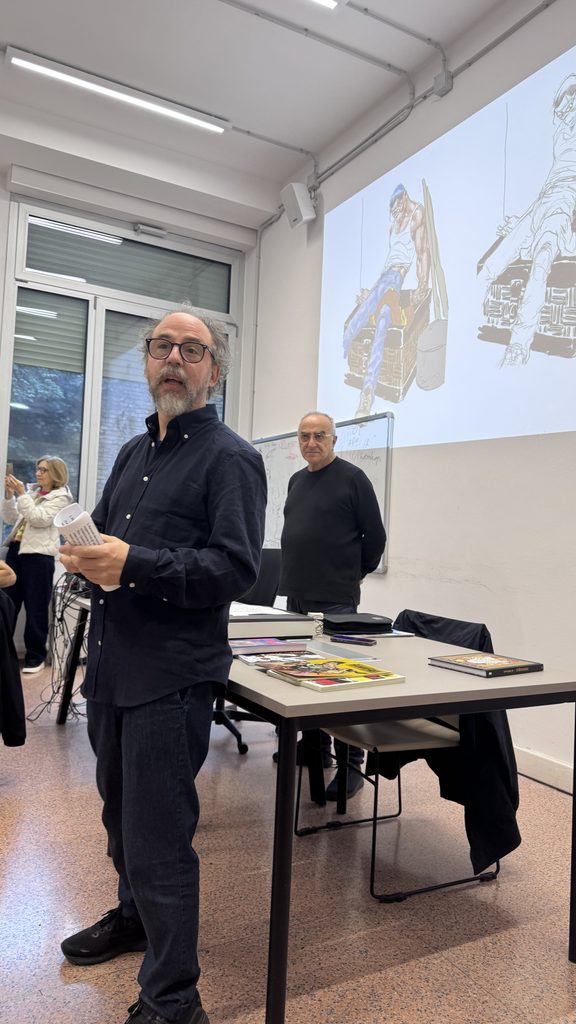
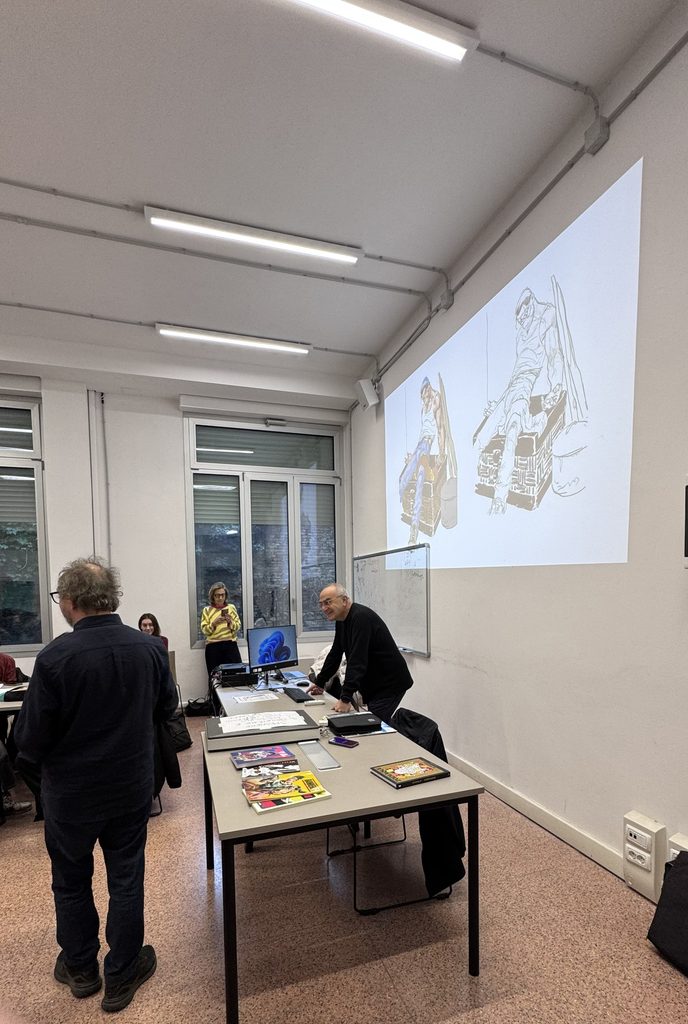
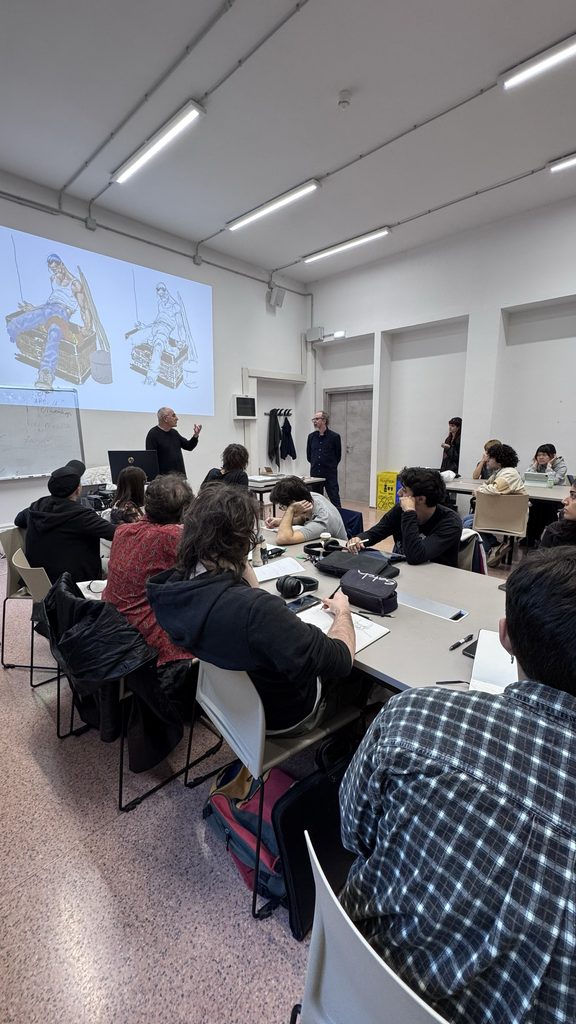
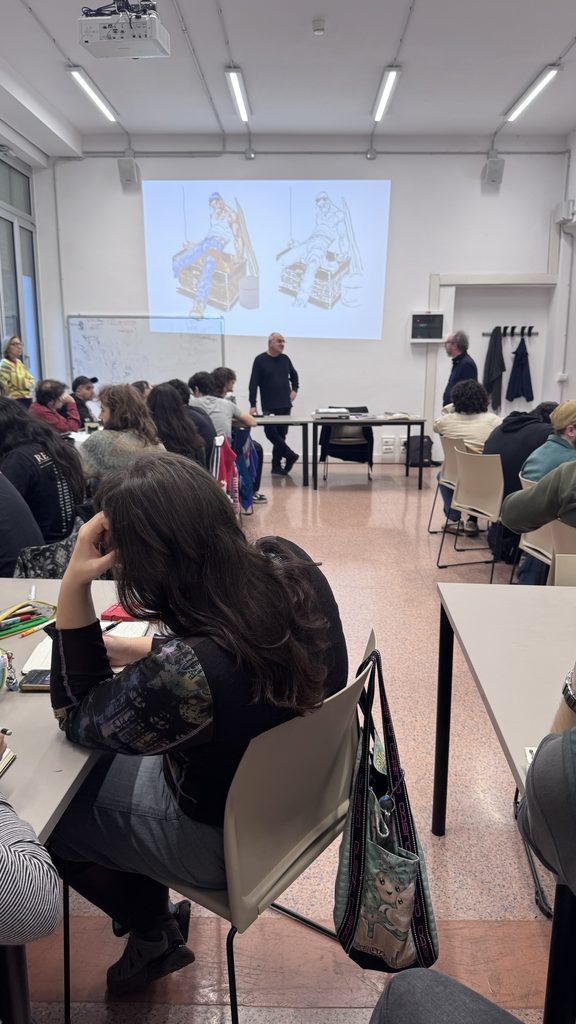
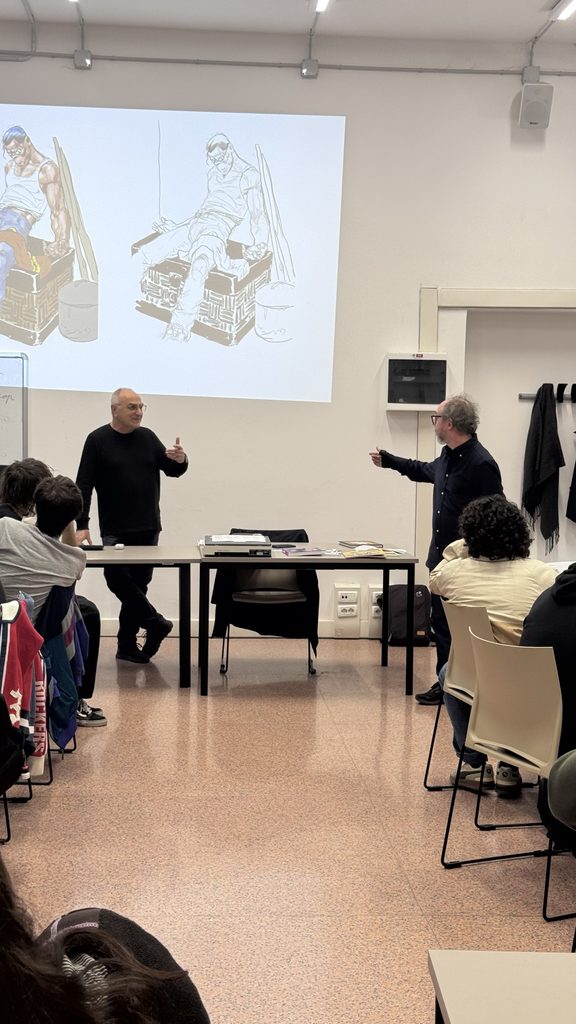
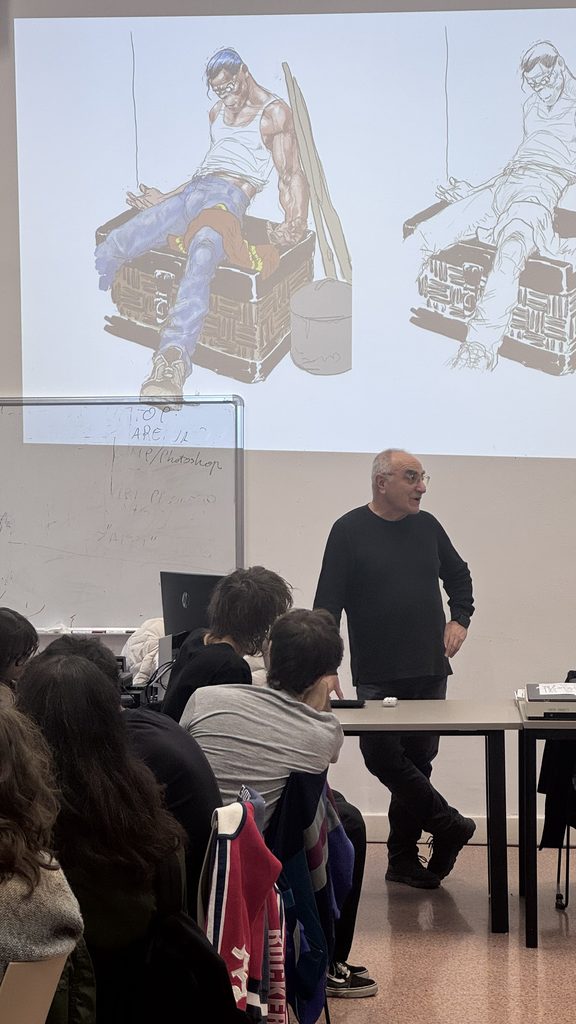
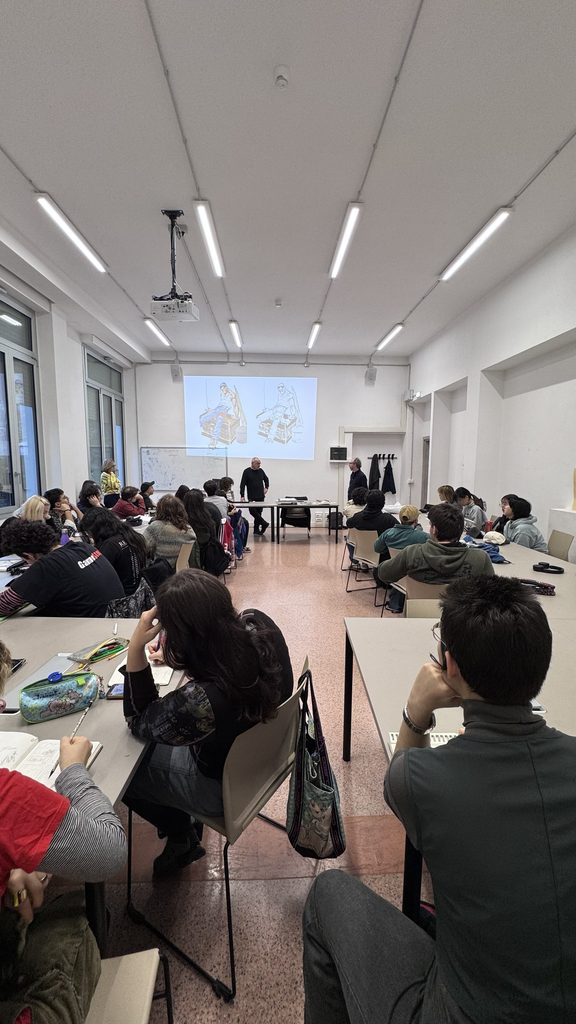
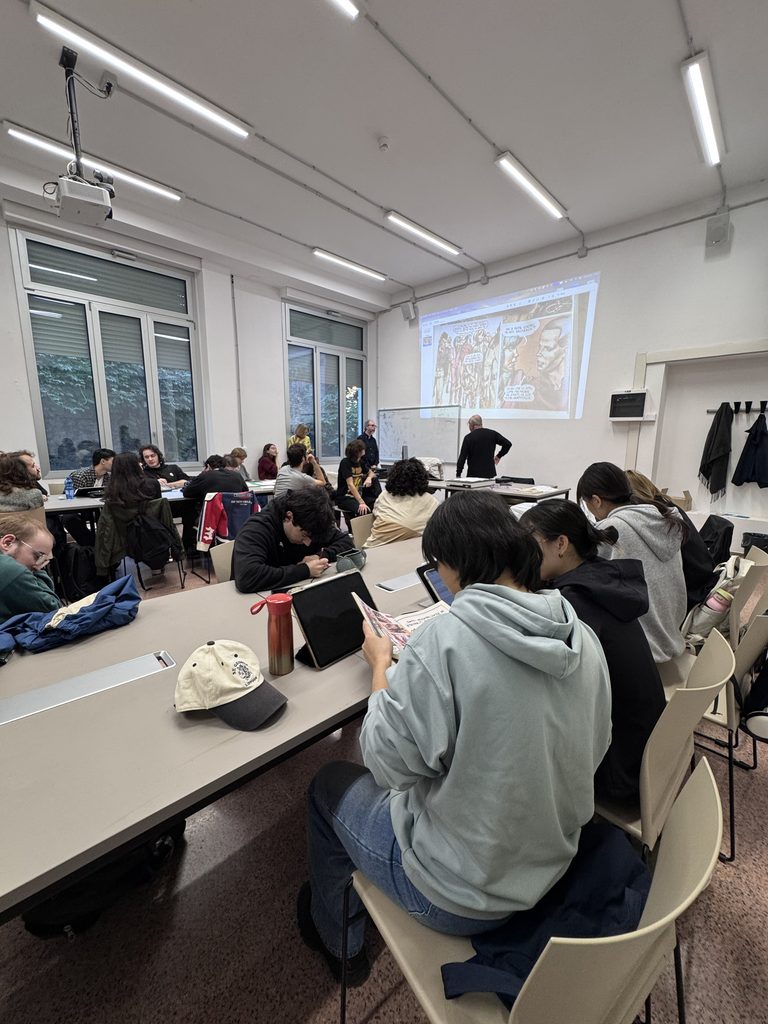
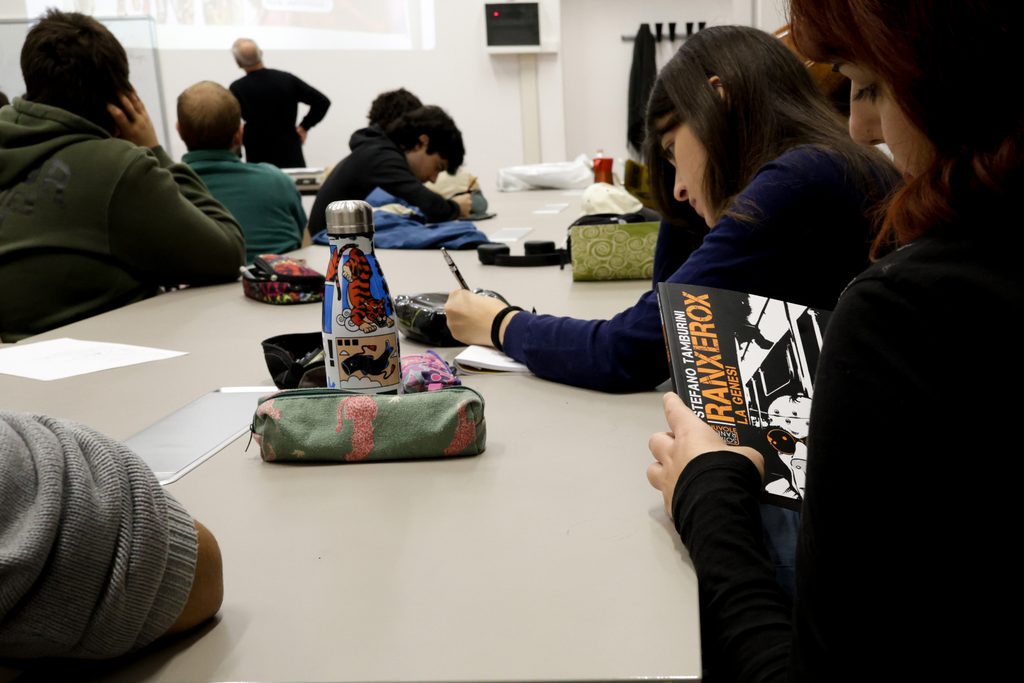
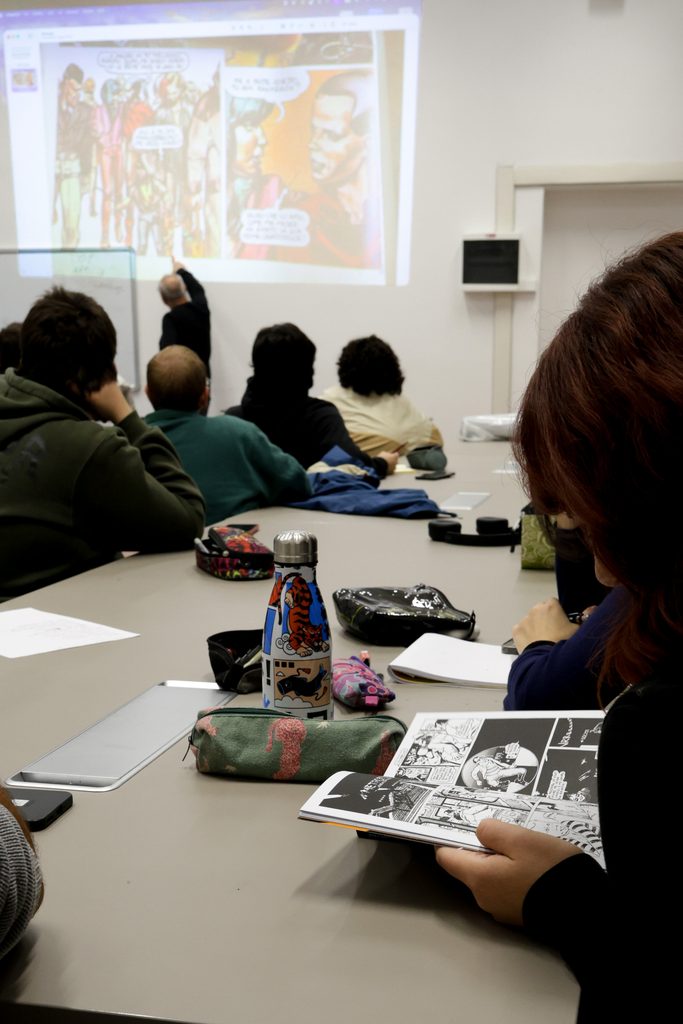
After our public conversation about his life and artistic career, I invited Tanino Liberatore to talk to the students about the practical side of his work: how an image takes shape, how to choose a technique, why a knowledge of anatomy matters, and what it means to find your own freedom within a script. The resulting session brought memories together with practical explanations, delivered with the frankness and humour that characterise his storytelling.
This text has been adapted from the recorded conversation. Repetitions, hesitations, and exchanges referring solely to the projected images have been shortened or omitted. Some questions have been combined to improve readability while preserving the meaning of the discussion. Autobiographical recollections are presented as Liberatore’s personal testimony.
Drawing What You Have in Your Head
Gianluca Costantini: I’d like to start with the child who was always drawing. What did drawing give you?
Tanino Liberatore: When I was little, up to a certain age, it also gave me plenty of frustration: I couldn’t make things look exactly the way I wanted. But I always kept going.
Even my father helped me in that respect, despite not wanting me to draw. My mother would say, “Come on, he draws well.” And he would reply, “He always draws the same little figures.” It annoyed me, but he was right.
In drawing, as in any kind of work, criticism is essential. You have to know how to take it and never rest on your laurels. Your most important critic, though, is yourself. Other people’s opinions can be gratifying, but they come second.
I’ve always been very critical of myself. The main thing wasn’t to produce a beautiful drawing: it had to be the drawing I had in my head. A beautiful drawing can happen by accident. Achieving what you set out to do is something else. When you manage it, you’re happy and you can move forward.
Gianluca Costantini: Your parents would have preferred you to choose a more secure profession.
Tanino Liberatore: For that generation, who had lived through the war, the secure professions were medicine and law. My father was a primary school teacher, like my mother, and he was a self-made man. He was a capable person.
Eventually, he agreed to let me attend art school, but insisted that I take the architecture course. As far as he was concerned, drawing led nowhere; at least architecture involved building things. Above all, he was worried about my future.
Then, almost by accident, I started working on record covers for RCA. He prepared my first tax return. At that point, he gave in: “All right.”
Curiosity and Meeting Andrea Pazienza
Gianluca Costantini: You were a quiet, shy child. Did art school help you come out of your shell?
Tanino Liberatore: Yes. I came from a village of a thousand people, and for the first time I found myself alone in a completely unfamiliar environment. Once I started drawing at school and things were going well, my relationships with other people changed too. I opened up.
I lived at a Jesuit boarding school, but it was fairly open-minded. Because I was doing well at school, they gave me a certain amount of freedom. It was the same boarding school Andrea Pazienza attended for a while.
Gianluca Costantini: What was it like to see a boy with that kind of drawing ability? Was there a little competition between you?
Tanino Liberatore: I’ve never been jealous of anyone. Andrea was lively, hyperactive, but above all curious. And curiosity is one of the most important things in our work. His desire to draw was unstoppable.
Comics were always his language. Even then, he was inventing stories. He made one based on the Divine Comedy: I was Dante, someone else was Virgil, and the priests ended up in the deepest circles of hell. He drew constantly, including with felt-tip pens.
Michelangelo and the Expressive Body
Gianluca Costantini: Did your relationship with the great masters of Italian painting begin before art school?
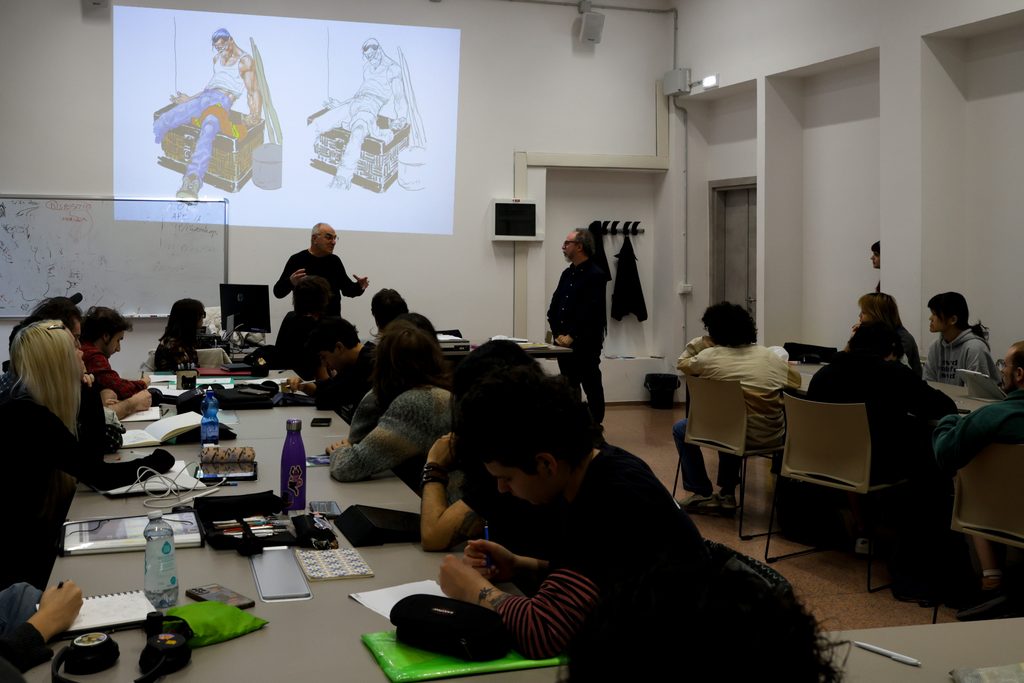
Tanino Liberatore: Yes. I remember watching a television drama about Michelangelo’s life, with Gian Maria Volonté, and a few years later one about Caravaggio. What struck me most were Michelangelo’s preparatory drawings for the Sistine Chapel: the pencil studies, the sketches, those bodies. I would go to my room and try to draw them from memory. In that sense, I owe it to Rai.
It was one of my first encounters with art, and it stayed with me. Later, I looked at all kinds of other work, including contemporary art. One of my favourite artists is Paul Klee, who apparently has nothing to do with what I do.
I recognised Michelangelo’s influence more clearly later on. I realised that, in my own small way, I was using some of his tools: the body not simply to show muscles, but to express something.
Working Alone and Working with Others
Gianluca Costantini: It’s important for students to meet, form groups, create magazines, and publish their own work. How much did exchanging ideas with the other Cannibale artists mean to you?
Tanino Liberatore: Before we met, we were all lone wolves. We came together almost by chance: five very different people, in terms of personality and background. A connection developed that we never even tried to explain. Music had a lot to do with it.
It wasn’t a group we had planned to form. We enjoyed being together and sharing things, including criticism. Encountering Cannibale was fundamental because it freed my spirit. It didn’t teach me how to draw: it allowed me to bring out what was inside me, the worst and the best.
Gianluca Costantini: What role did the people at Il Male play?
Tanino Liberatore: They made Cannibale possible. They paid for the printing and paid us too, essentially giving us a salary. That allowed us to work. And there were no restrictions: we were free to do whatever we wanted.
We also worked for them. Andrea did an enormous amount, Stefano too, and I made illustrations. Andrea could arrive on a Saturday afternoon and keep going until Sunday morning.
Gianluca Costantini: Were there disagreements about the work?
Tanino Liberatore: Of course, especially about the magazine’s content and how to present it. But it was a debate, a form of constructive criticism. In the end, we tried to choose the best solution.
The early issues of Frigidaire are the ones I’m most attached to: we were all there. One difficulty was that there were so few of us, and we had to handle almost all the graphics and comics.
Inventing a Technique for Ranxerox
Gianluca Costantini: How did you work on the original black-and-white Ranxerox?
Tanino Liberatore: The character belonged to Stefano Tamburini. He would ask Andrea and me to do the pencils, then ink them himself. It was a collaboration between friends, a way of helping him with his work.
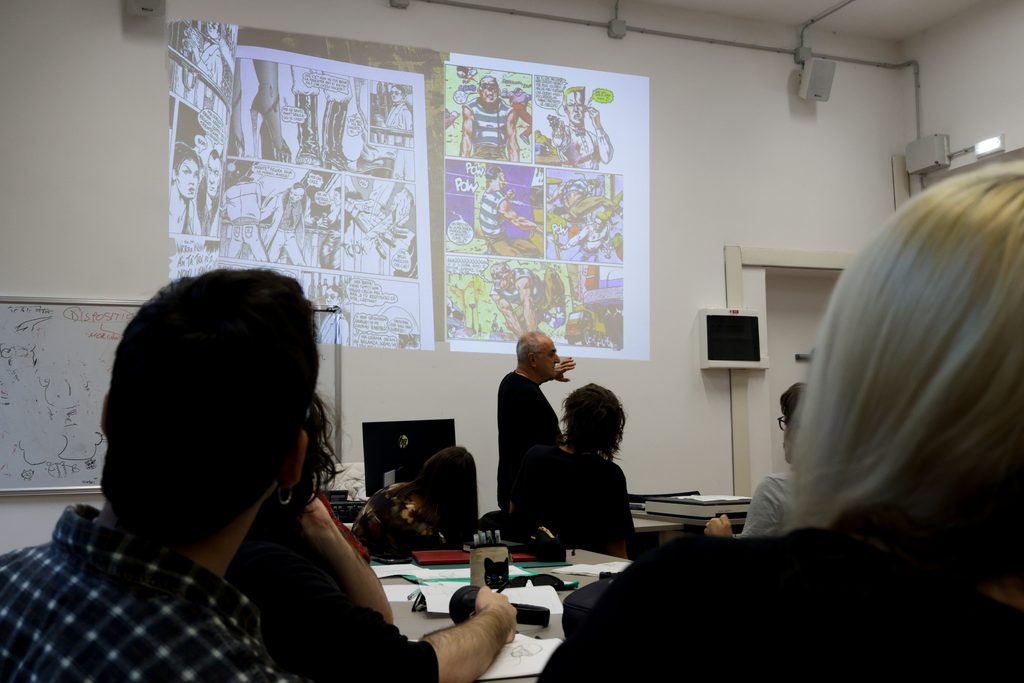
When he proposed Frigidaire, he wanted a magazine that was different from Cannibale: more colourful, more glamorous, with writing and comics. He asked Andrea and me whether we wanted to take on the character. In the end, I did, but I hadn’t worked in colour that way before. I had to invent a technique.
Almost all my changes in technique have happened like that: a character or a story has required me to change the way I work.
Gianluca Costantini: Where did you start?
Tanino Liberatore: Andrea had introduced me to Pantone markers. He used them on Fabriano paper, mainly producing flat areas of colour, but with extraordinary skill.
I used a German paper called Schoeller, which was very hard and not particularly absorbent. That gave me time to work on the colour. I could apply it, go over it with an eraser, then work over it again. That was how I built the base.
For the shading, I used other markers. At first, I even used eyeliner pencils for skin tones. I was looking for a way to work faster and ended up taking even longer.
With lower-quality markers on that paper, I had a few extra seconds to blend the colour with my finger or with another marker that had completely run dry. The second album was done entirely in marker: no eyeliner pencils, no coloured pencils.
Gianluca Costantini: What about the airbrush?
Tanino Liberatore: Not on the comics pages. I used an airbrush for a cover, an illustration, but that wasn’t the technique behind Ranxerox. The shading came from working with the markers and the paper.
Gianluca Costantini: How many stages did a page require?
Tanino Liberatore: First the sketches, then the pencils, the blacks, the flat colours, and finally the shading. The same page passed through my hands five times. By the second time, I couldn’t stand looking at it anymore.
But it had to turn out the way I wanted, so I kept working on it. Eventually, that technique became too restrictive. It’s one of the reasons I stopped making comics that way.
The White of the Paper and the Life of Original Artwork
Gianluca Costantini: How did you create the highlights?
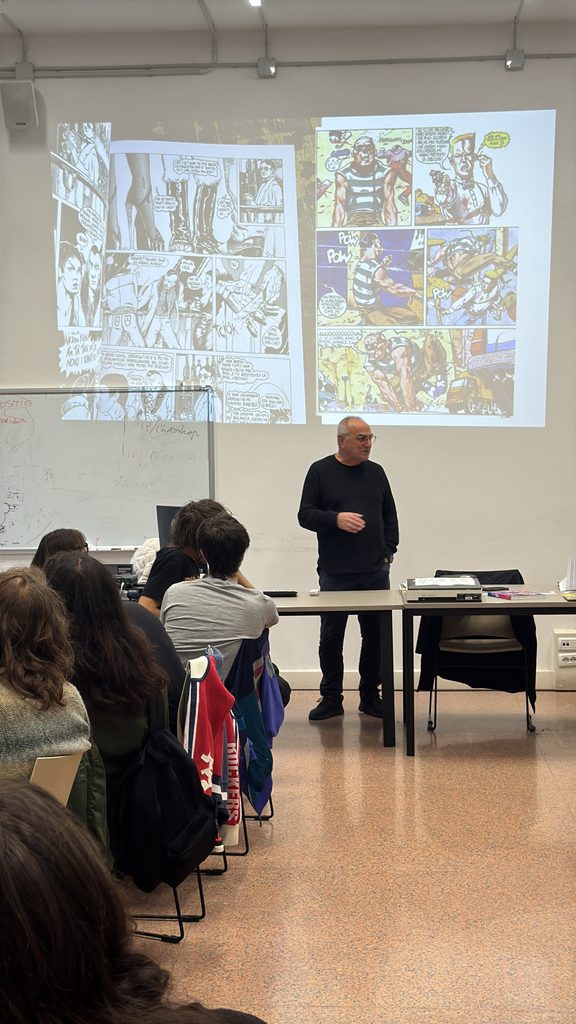
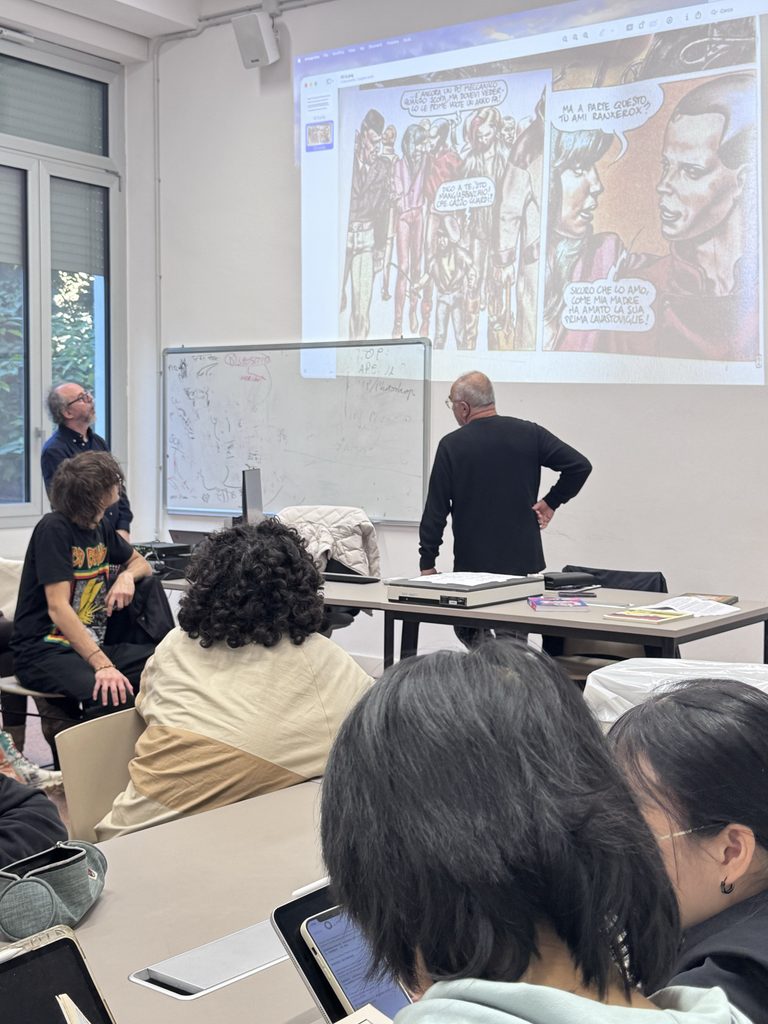
Tanino Liberatore: In the first two albums, the white is always the white of the paper. I didn’t go back over it with correction fluid: I left those areas untouched as I worked.
For the third album, I changed again. In the first fifteen pages, I used a lot of white, then worked over it with markers. In the second part, I used Pantone markers and coloured pencils. I had noticed that other markers faded when exposed to light. I’ve had to restore some of my illustrations with pencils after they lost their contrast.
Back then, I didn’t think much about what would happen to the original artwork. You pay more attention to that now, but at the time the priority was getting the work done.
Gianluca Costantini: Did you always apply the black and the colour to the same sheet?
Tanino Liberatore: Yes, directly. Other artists kept the black separate from the colour, partly for printing reasons. But for me, black is an essential reference: without it, it’s hard to judge how much colour to apply and what the final contrast will be.
The Artist as Director
Gianluca Costantini: How detailed were Tamburini’s scripts?
Tanino Liberatore: He told me what needed to happen in the panels. Then it was up to me to decide where to place the characters, how to frame the scene, whether to use a close-up or a wider shot. I had asked him not to be too precise: an excessively detailed description would have restricted me.
I was the director. I handled the camera, the costumes, the characters.
Gianluca Costantini: Did the world of Ranxerox give you that freedom too?
Tanino Liberatore: I like the near future, because you can still use things from our own world and change them without having to justify everything. I’ve never enjoyed reproducing a historical period in every detail: I would feel too constrained.
In that future, I could invent objects and clothes. Fashion houses have asked me to design clothes for them. But when I sat down specifically to do that, nothing came out. Within the story, they came naturally.
Understanding Anatomy, Then Transforming It
Gianluca Costantini: How much study goes into the anatomy of your characters? Do you use photographs when you draw?
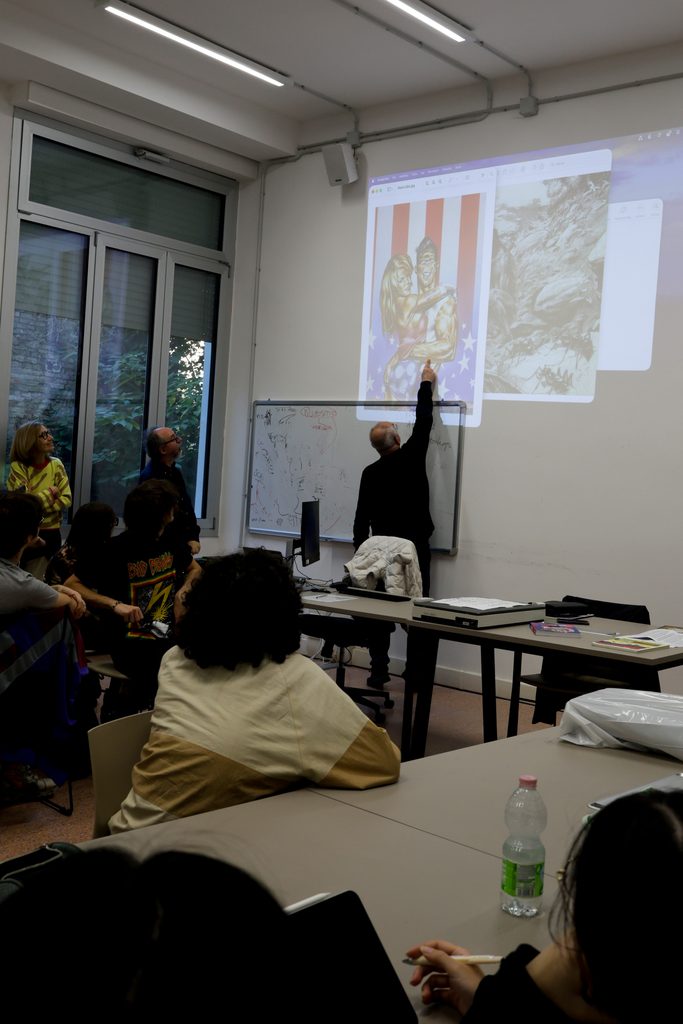
Tanino Liberatore: When I’m drawing, I generally don’t look at references anymore. I’ve always loved anatomy: at art school, I even did the anatomy drawings for other students. I was interested in bodies, hands, and veins even before that.
I’ve used photographic references for details, but I noticed something: I would start with a detail and end up copying the entire photograph. I was never satisfied, because reality wasn’t as expressive as I wanted the drawing to be. So I decided to stop. It was difficult at first, but eventually I managed it.
Gianluca Costantini: What interests you about drawing a vein, for example?
Tanino Liberatore: Not the vein itself, but the fact that it’s beneath the skin. You can’t just put down a line: you have to convey the skin covering it. That’s extremely difficult in black and white.
And you can invent muscles too. If I needed an extra muscle, I put one in. It happens in superhero comics as well: some of those muscles don’t exist, but they help convey power.
Drawing with an Eraser
Gianluca Costantini: What role does the eraser play in your pencil drawings?
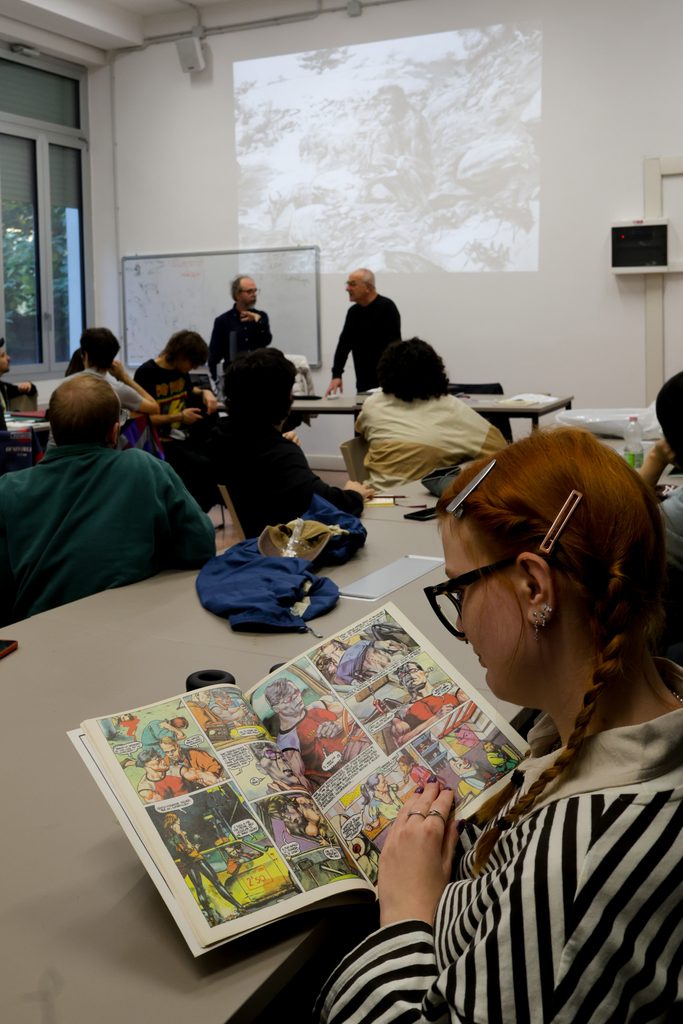
Tanino Liberatore: For me, the eraser isn’t just for cleaning up or correcting mistakes: it’s a drawing tool. I rest my hand heavily on the sheet and the paper gets smudged, but those smudges allow me to bring out the highlights.
A friend who travelled to Japan brought me an electric eraser. Before that, I did those things by cutting an ordinary eraser into small pieces. The electric one made everything simpler. I could create tiny points of light, blades of grass, details that had previously required much more work.
Lucy and Discovering Digital Drawing
Gianluca Costantini: Your way of working changed again with Lucy. How did that happen?
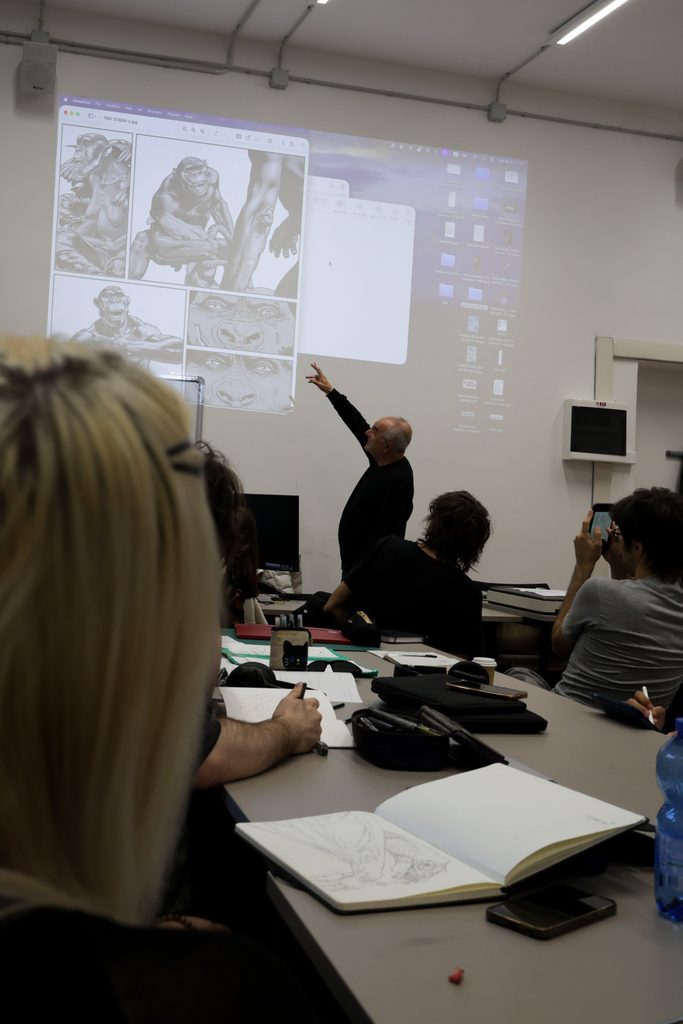
Tanino Liberatore: First, I had made some pencil illustrations connected with the subject. Then I was offered work to accompany a film project being pitched to producers. When that didn’t work out, the idea emerged of turning it into a comic.
At first, I said no: I had already stopped. Then they made me an offer I couldn’t refuse. It took me a very long time.
I began in pencil, but to achieve the result I wanted, I needed a computer, which I had never used before. Learning a new method is fascinating: as I went along, I kept discovering new possibilities.
I used to say I had done what Lucy did: she had risen from all fours; I had lifted my head from the paper towards the screen.
Gianluca Costantini: How did you build the images?
Tanino Liberatore: At first, I worked in black and white, with shades of grey. I assembled everything in Photoshop and used another program for the brushes. Then I moved into colour.
I learned to keep the different elements separate: skin on one layer, hair on another, the tongue on another still. That allowed me to change the colours. But I had built the first pages as though I were working on paper, without properly separating the layers. When I tried to colour them, I realised I had to redo a lot of the work.
Gianluca Costantini: How much room was there for invention when reconstructing the bodies?
Tanino Liberatore: We tried to stay as close as possible to what is known. I had an australopithecine skeleton as a reference, but certain parts can’t be reconstructed with absolute precision. Inevitably, some invention is involved. An anthropologist oversaw the work.
I was very drawn to that world, to the question of where we come from. And there was a love story in there too.
Returning to Physical Materials
Gianluca Costantini: After Lucy, you returned to working on paper.
Tanino Liberatore: For years, I had drawn almost exclusively on a computer. Once I finished Lucy, I needed to return to traditional methods, to physical materials. I wasn’t making comics anymore: I wanted to make illustrations and paintings.
I returned to techniques I hadn’t touched since art school. Watercolour, for example. I bought books, studied, and became really enthusiastic about it. Then I moved on to oils and finally charcoal, which, along with pencil, is my favourite medium.
I also work standing up on very large sheets. From the painstaking detail of Ranxerox, I moved towards larger, more pared-down drawings. At a certain point, the gesture becomes increasingly important.
Batman and Freedom Within a Story
Gianluca Costantini: What was it like working on Batman, within such a different publishing system?
Tanino Liberatore: I made two stories with American writers and, strangely enough, I felt completely free. The Batman: Black and White story was eight pages long. I enjoyed it partly because it was only eight: if there had been many more, I would have died.
Batman is one of my favourite superheroes. For that story, I did the pencils and then applied the black directly to photocopies.
Gianluca Costantini: How do you protect your own creative space when working with a writer?
Tanino Liberatore: I follow what they’ve written, but I prefer not to discuss too much how they visualise every single panel. If they start explaining all the images in their head, it influences me. And because I respect other people’s work, I then feel obliged to follow those images.
I try to do it my way, but to serve the story, not to work against the writer. Someone once told me, “It isn’t how I imagined it, but it is what I wrote.” To me, that’s a compliment.
Pencil remains essential. I can’t go straight to the finished drawing: I need the pencil and the eraser.
Music at the Drawing Board
Gianluca Costantini: Music runs through your whole career, right up to the drawings for Bologna. Do you listen while you work?
Tanino Liberatore: Always. And I really listen: if I concentrate on the drawing and miss a passage, I go back. Music is essential, partly because drawing is solitary and it keeps you company.
I really like electric jazz. I used to follow everything that came out and read lots of music magazines. These days, I sometimes discover something new, but I mostly listen to musicians from my own era, including those who are still making music today.
Gianluca Costantini: Your first jobs came through music too.
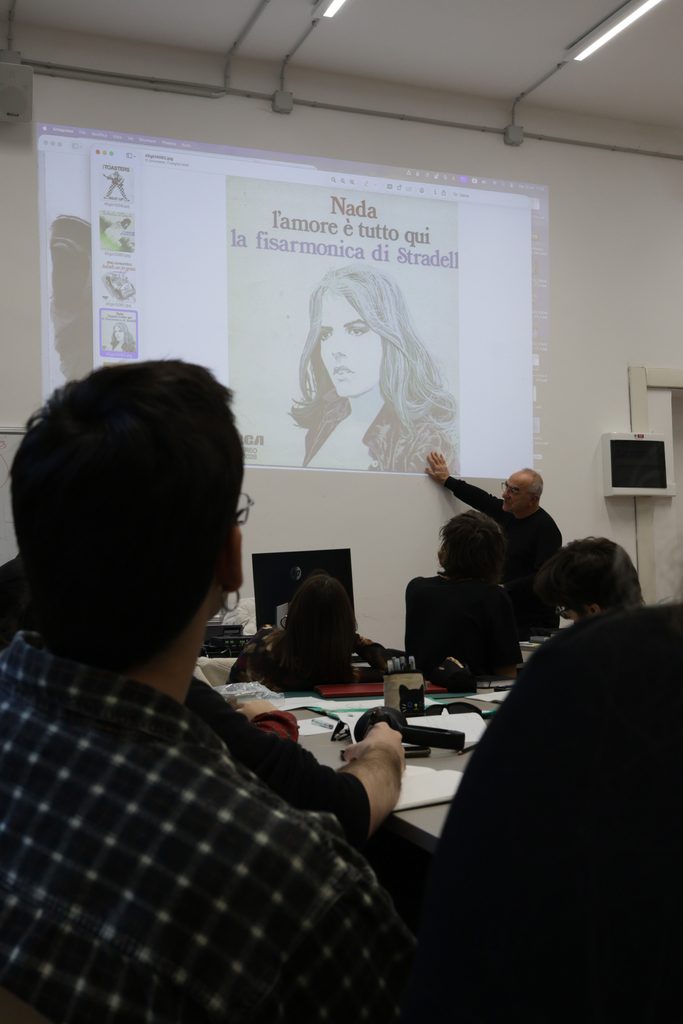
Tanino Liberatore: Yes, but I was trying to make comics. I was looking for a writer and, by chance, I ran into someone in Rome whom I had known as a boy. He put me in touch with a friend who wanted to write. That friend came to my house with a young woman who was recording an album for RCA.
She saw my drawings and suggested I try making the cover, without promising me anything. We took the work to RCA, and they offered me more work. I made record covers for three years: some beautiful, some horrible.
Back then, I worked in gouache, using flat colours, almost like a screen print. When Ranxerox came along, I had to find something completely different.
Music was decisive with Stefano too. I brought him portraits of musicians. I looked like a shepherd from Abruzzo, with my beard, but I listened to music that intrigued him. He must have thought, “Someone who looks like that and listens to this stuff must have something strange about him.” And he helped me discover it.
Gianluca Costantini: What did working for Frank Zappa mean to you?
Tanino Liberatore: He was an idol of mine. Being approached by someone you admire is extraordinary.
He wanted the cover to show the bad things that had happened during his Italian tour. I suggested, “I’ll do what I have in mind on the front, and put what you want on the back.” He agreed.
I had erased the fly swatter from the sketches because I thought it was too much. The first thing he told me was to put it back. It was a fantastic experience.
Keeping Going and Meeting Other People
Gianluca Costantini: What would you say to these young people who want to make comics?
Tanino Liberatore: If you have the passion, keep going. In our work, that’s the most important thing. If you start out only calculating how much you might earn, it’s difficult.
Then, of course, there’s your relationship with the public and with publishers. You work for yourself, but also to give something to other people. First, you have to be honest with yourself; then your passions may connect with those of others.
And you need luck. I’ve had plenty: chance encounters, people I met again, a phone call made at the right moment. I started working through a coincidence. And reconnecting with Andrea led me to meet Stefano.
Tanino Liberatore: Luck matters, but you also have to recognise the opportunity. I reconnected with Andrea just as he was meeting the people behind Cannibale. A year earlier, we might simply have said hello. Instead, everything else followed from that encounter.
Reaching an Audience Beyond Comics
Student: Today, it’s easier to print, self-publish, and distribute work online. But it seems difficult to reach beyond people who are already interested in comics. Did Cannibale and Frigidaire reach a wider audience through newsstands? Or were they still within a niche?
Tanino Liberatore: Cannibale came out of underground comics and fanzines, so it was closer to the situation you’re describing. Frigidaire became a more open magazine, something for a broader readership.
But you shouldn’t imagine enormous numbers. It was well known, but we’re talking about around thirty thousand copies, not two hundred thousand or four hundred thousand. Those were good figures at the time. As far as I remember, the first Ranxerox album also sold very well in Italy.
We were limited to those copies. With the Internet, you have the potential to reach millions of people. The question is how, and I don’t have a ready answer. I don’t have a magic wand.
Entertainment and the Risk of Everyone Looking Alike
Student: Your work also criticised the entertainment industry. How do you see the situation today, with social media, the endless scrolling of images, and algorithms?
Tanino Liberatore: The situations are different. Today, it’s much more complex. The Internet has amplified everything, and entertainment is one of the industries that has benefited most.
The problem, as I see it, is that it has made so much uniform. We have a tool that could allow us to do things differently in millions of ways, yet so much ends up looking alike. I see it in clothing too: different brands sell the same things.
We were trying to be as different as possible. Now it seems that people try to stand out while remaining exactly the same. But I also think something is changing, because people are starting to get angry. Now it’s your turn.
The session closes with a practical invitation to the students: “Do you want to publish? Do you want to create a website where you can publish your work? Do you have ideas? Do it. Don’t think: perhaps it isn’t good enough, who knows what people will say. Do it, and you’ll find people who follow you.”