An evening in Bern, between images of resistance, memory and solidarity with Iranian women
Bern, Switzerland, November 25, 2026
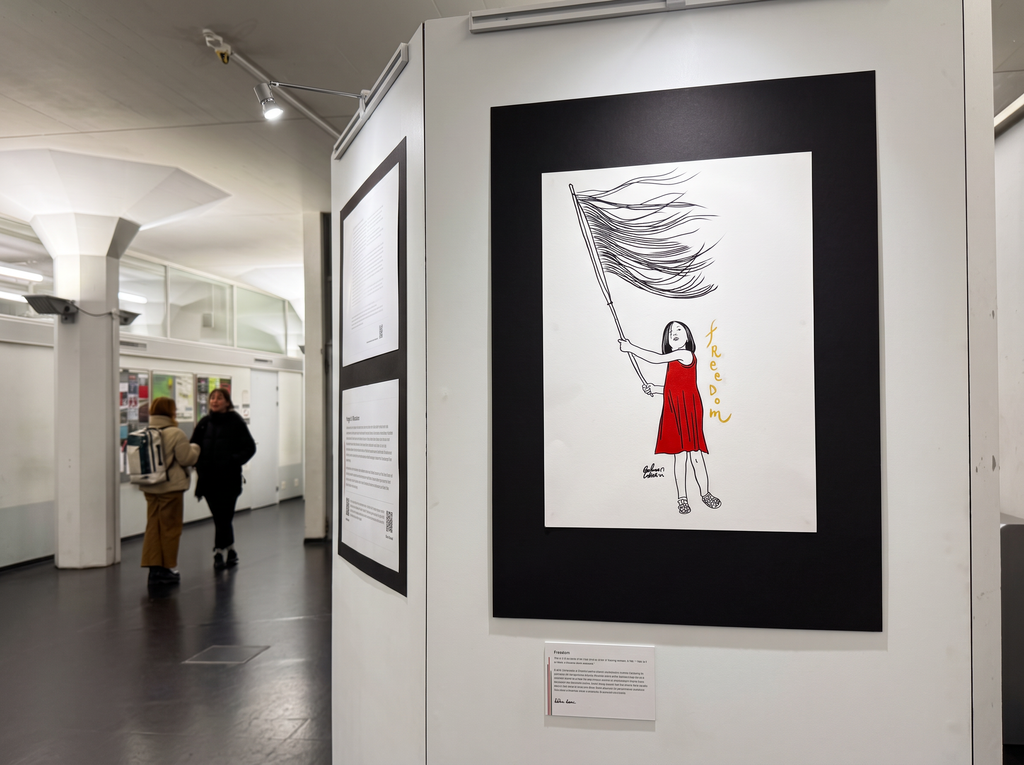
In the corridors of the University of Bern, among lecture halls, noticeboards and students passing through the spaces of Unitobler, a young girl in an orange dress raises a flag made of flowing strands of hair. Beside her, a single word is written in yellow: Freedom.
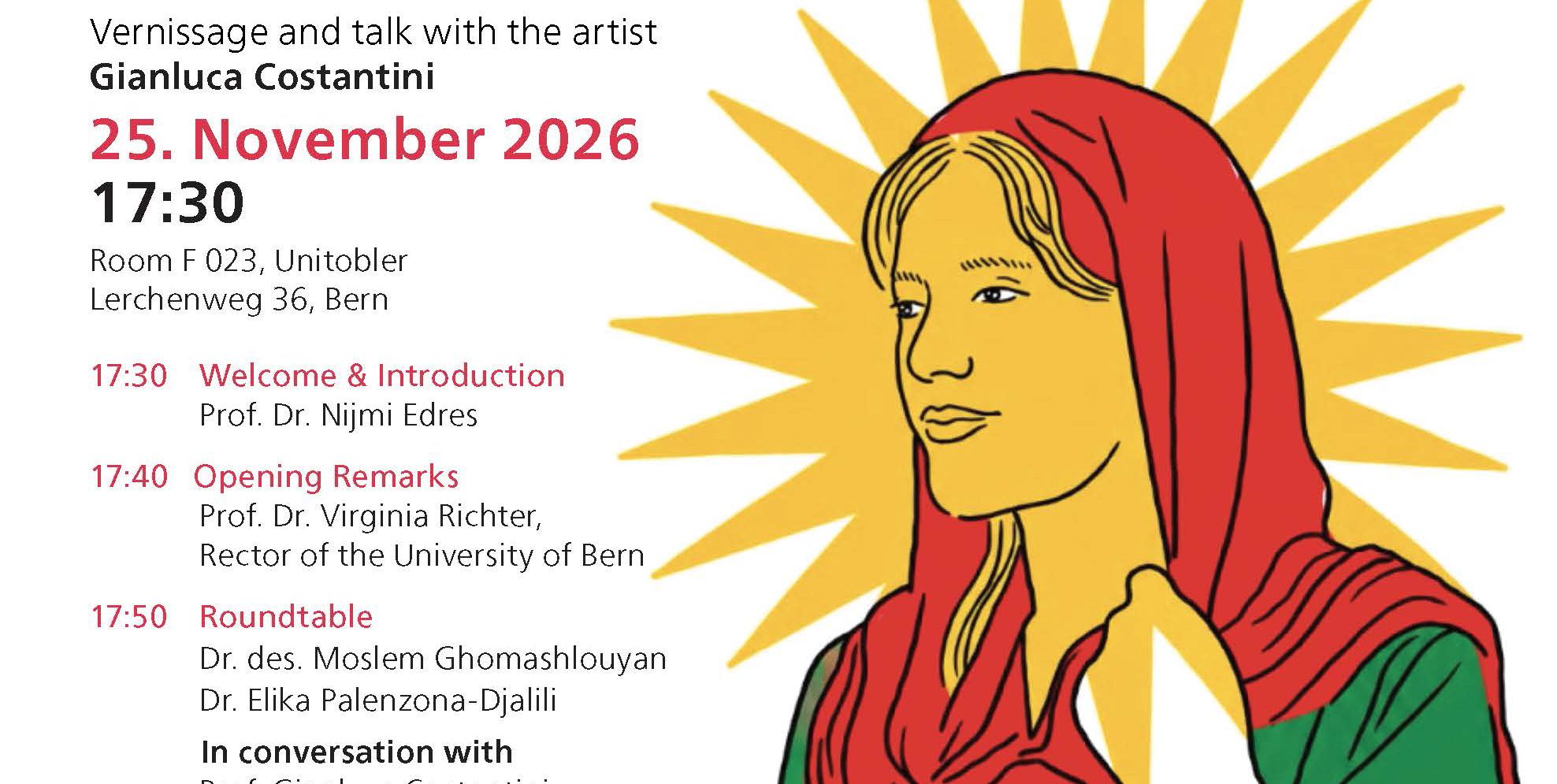
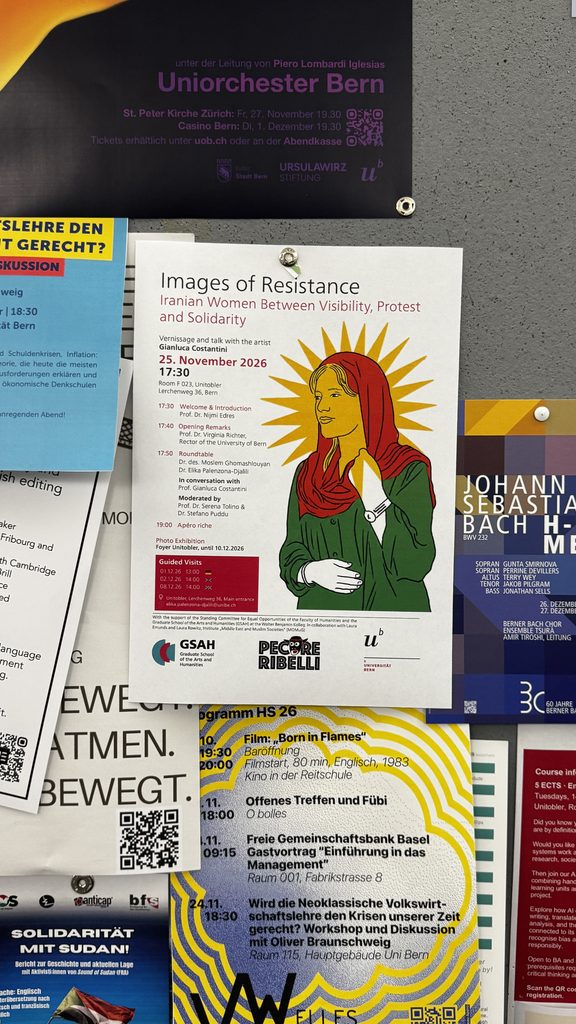
It is one of the images welcoming visitors to Images of Resistance: Iranian Women Between Visibility, Protest and Solidarity, an exhibition of my drawings dedicated to the Iranian protests and the Woman, Life, Freedom movement, which opened on November 25, 2026, at the University of Bern, on the International Day for the Elimination of Violence against Women.
Four years have passed since I began making many of these drawings. In September 2022, following the death of Jina Mahsa Amini, images of the Iranian protests crossed national borders, reaching our screens and entering our collective consciousness. I began drawing faces, gestures and bodies, attempting to create a visual record of what was happening.
Encountering these drawings again, displayed within a Swiss university, means confronting the distance between the immediacy of the news and the slower passage of memory.
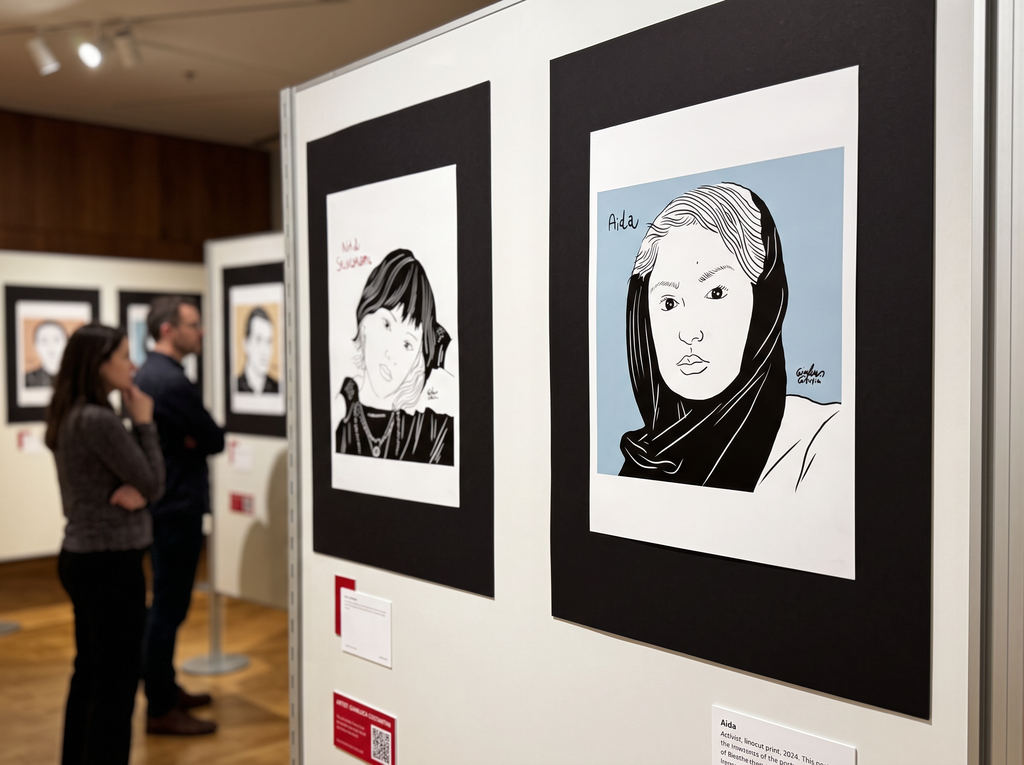
On the exhibition panels, Jina Mahsa Amini is surrounded by a golden sun, its rays emerging from behind her red headscarf. Nearby are the young faces of Nika Shakarami, Sarina Esmailzadeh, Armita Geravand and Aida Rostami.
There is something particularly painful about encountering these faces together. Their portraits speak of interrupted lives, of youth and aspirations, and of a generation that refused to accept the conditions imposed upon it.
I have always felt that drawing a face is fundamentally different from drawing an anonymous figure. A portrait establishes a relationship. It asks us to look at someone, to recognise their individuality and, above all, to remember their name.
Further along the exhibition, the portrait of Narges Mohammadi, the Iranian human rights defender and 2023 Nobel Peace Prize laureate, is surrounded by the three words that have become inseparable from this struggle: Woman, Life, Freedom.
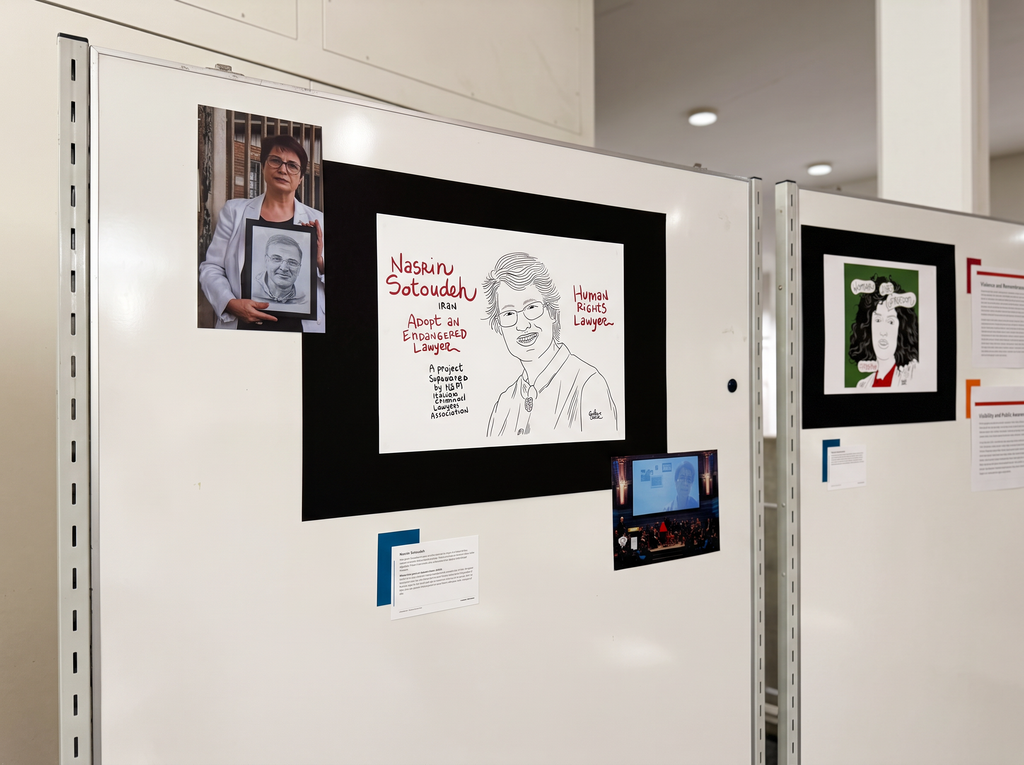
There is also a portrait of Nasrin Sotoudeh, the Iranian human rights lawyer, made as part of the Adopt an Endangered Lawyer campaign, supported by the Italian Criminal Lawyers’ Association. The drawing acquires a particularly meaningful presence here, at the university that awarded her an honorary doctorate in 2023.
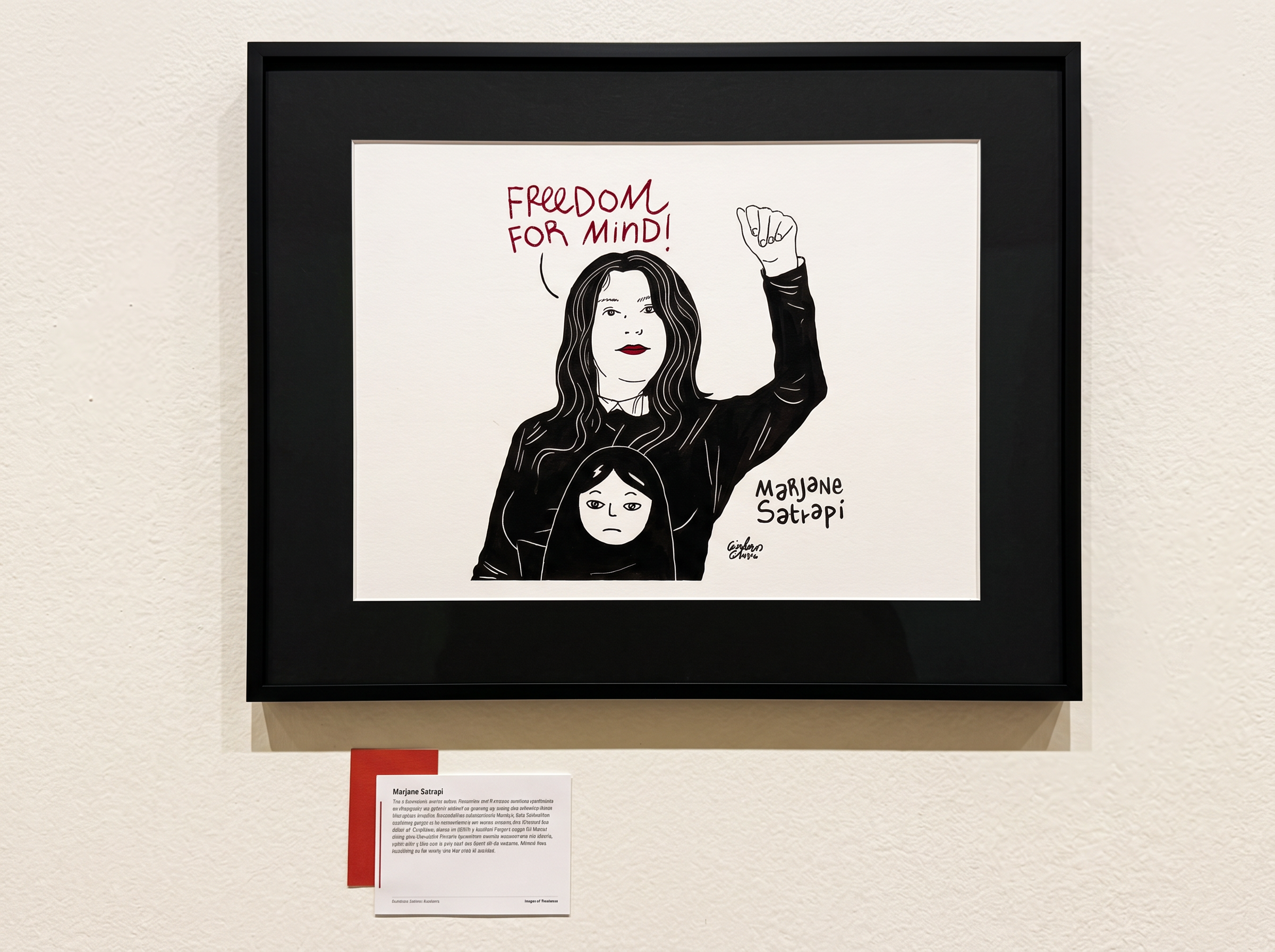
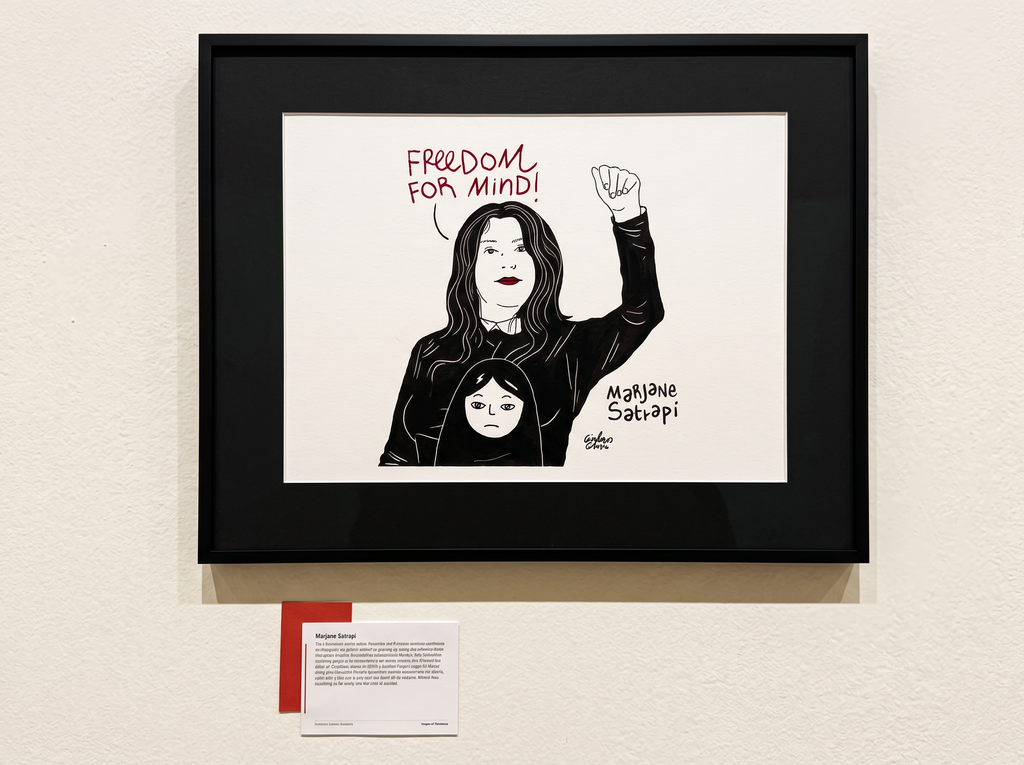
Another panel is dedicated to Marjane Satrapi. In my drawing, she raises her fist, accompanied by the small figure of Marji from Persepolis. Above them are the words Freedom for Mind!
For those of us who work with comics and drawing, the presence of Satrapi in this exhibition carries a particular significance. Her work demonstrated how personal memory, political history and the language of comics could become inseparable, allowing experiences rooted in Iran to enter the lives of readers across the world.
These portraits form a collective narrative, but each retains its own history. They are not interchangeable symbols of resistance. They are individuals whose lives, choices and experiences deserve to be remembered.
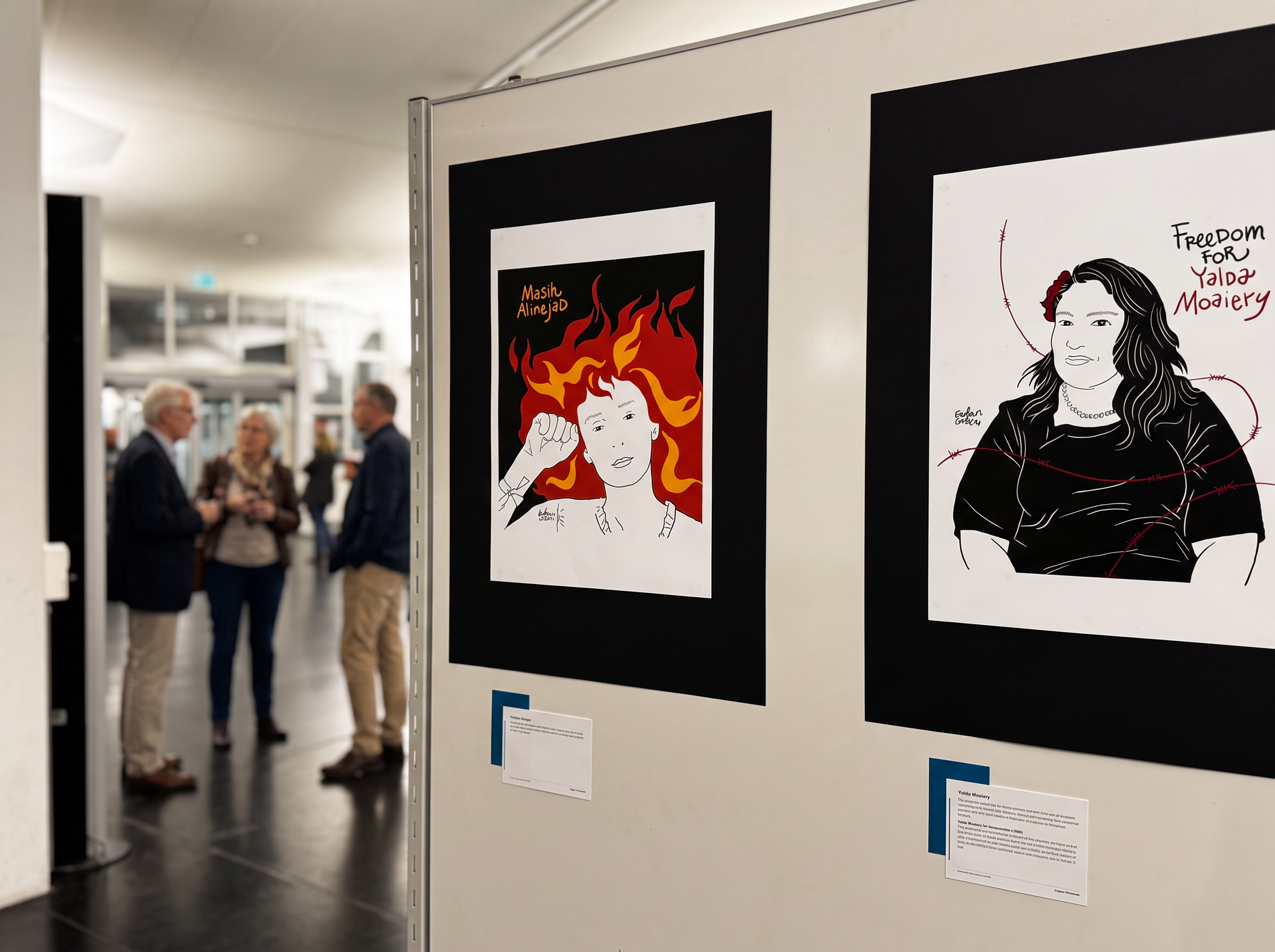
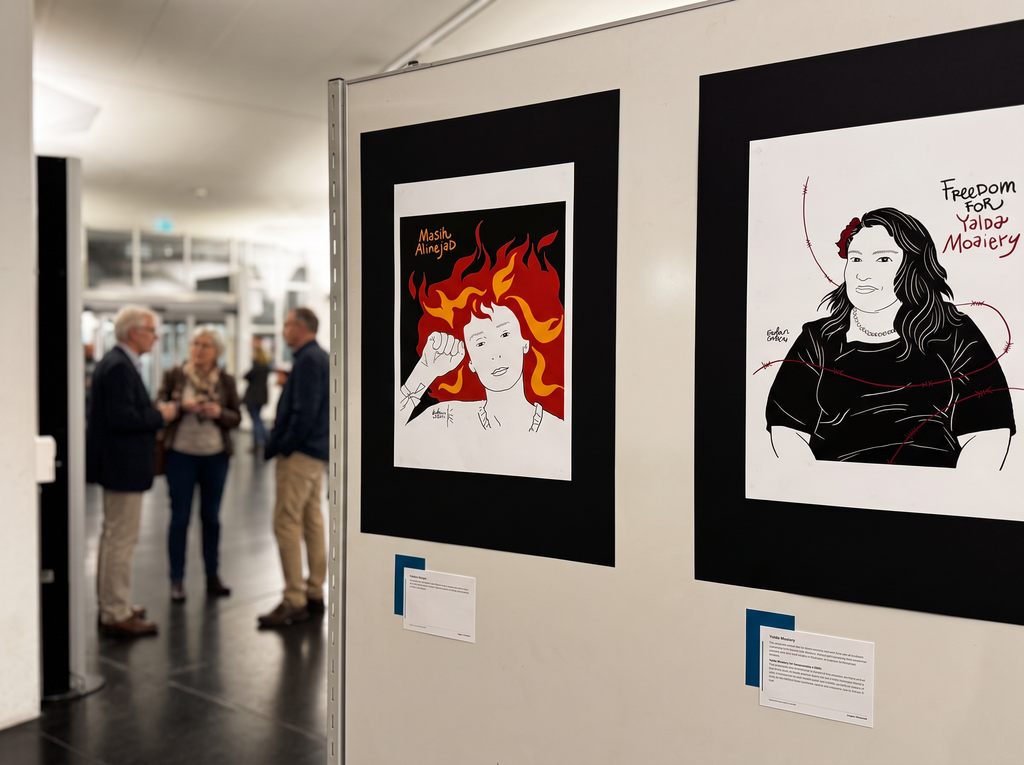
Among them are journalists whose work has exposed them to repression. Yalda Moaiery, the Iranian photojournalist, appears surrounded by red barbed wire. Niloofar Hamedi and Elaheh Mohammadi, whose reporting helped bring the circumstances surrounding Jina Mahsa Amini’s death to public attention, are portrayed together against an orange background.
Below them is a drawing of the Italian journalist Cecilia Sala, made during her detention in Iran.
Seeing these portraits alongside one another reveals a geography of repression that extends beyond national borders. It also reminds us of the essential relationship between the freedom of women and the freedom of information.
Without journalists, photographers and witnesses, many stories of violence and resistance would never reach us. The work of those who document repression is itself frequently subjected to repression.
When I make a drawing in response to a protest, an arrest or a human rights violation, I often work within the urgency of unfolding events. The images enter the daily circulation of news. They are shared, reproduced and used in solidarity campaigns and demonstrations. Sometimes they reach the families of the people I have portrayed.
Then the news cycle moves on. Other events occupy the front pages, and other images take their place.
An exhibition interrupts this process. It restores a different rhythm to the images, allowing us to stop in front of a face, read a name and reflect on the story behind it.
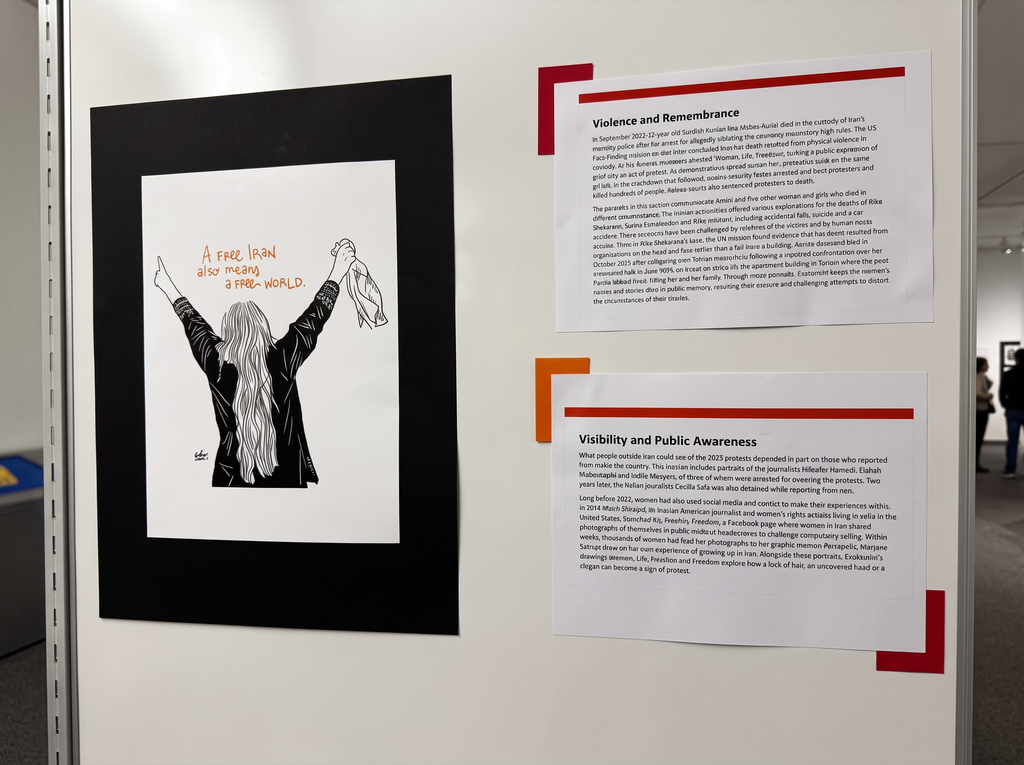
In the everyday spaces of Unitobler, the drawings coexist with the ordinary life of the university. They are encountered by people on their way to lectures, by researchers, students and visitors who may not have specifically come to see an exhibition.
I find this particularly meaningful. The images become part of a shared public space, entering people’s lives without necessarily requiring a deliberate encounter with art.
Drawing cannot replace the voices of those who experience repression, nor can it claim to speak on their behalf. But it can help sustain attention, resist oblivion and establish relationships between people living thousands of kilometres apart.
One of the most significant moments of the evening was the screening of a video message from Iran.
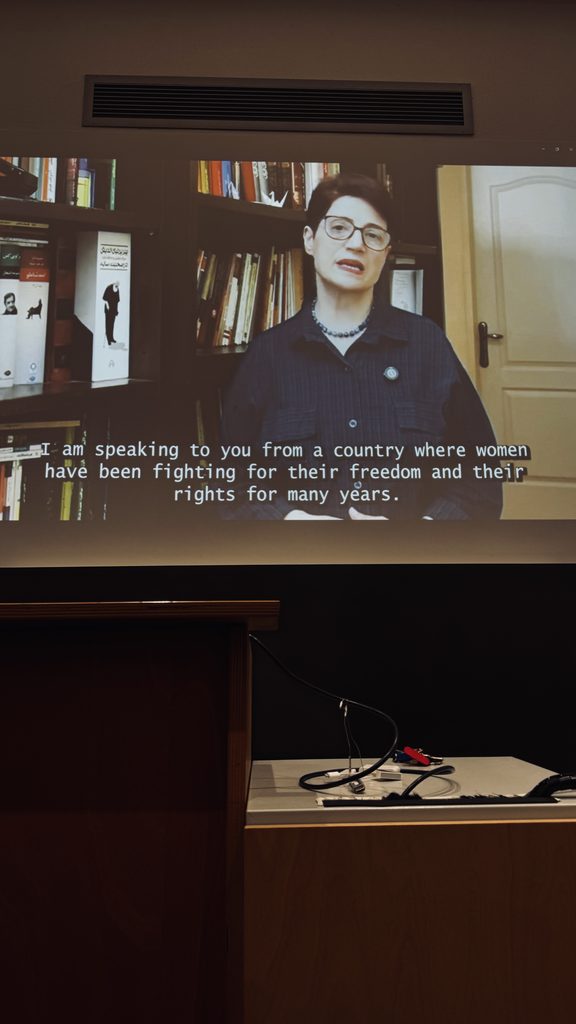
“I am speaking to you from a country where women have been fighting for their freedom and their rights for many years.” Nasrin Sotoudeh
These words appeared in English subtitles on the screen, bringing the lived reality of the people to whom the exhibition is dedicated back to the centre of our gathering.
The struggle of Iranian women did not begin with the images of the 2022 demonstrations. It has a much longer history, shaped by everyday acts of resistance, demands for equality, achievements, sacrifices and repression. It is a history that continues even when international attention diminishes.
In that lecture hall in Bern, thousands of kilometres from Iran, the geographical distance seemed to diminish through the simple but profound act of listening.
The drawings displayed in the corridors and the voice heard in the lecture hall belonged to the same conversation.
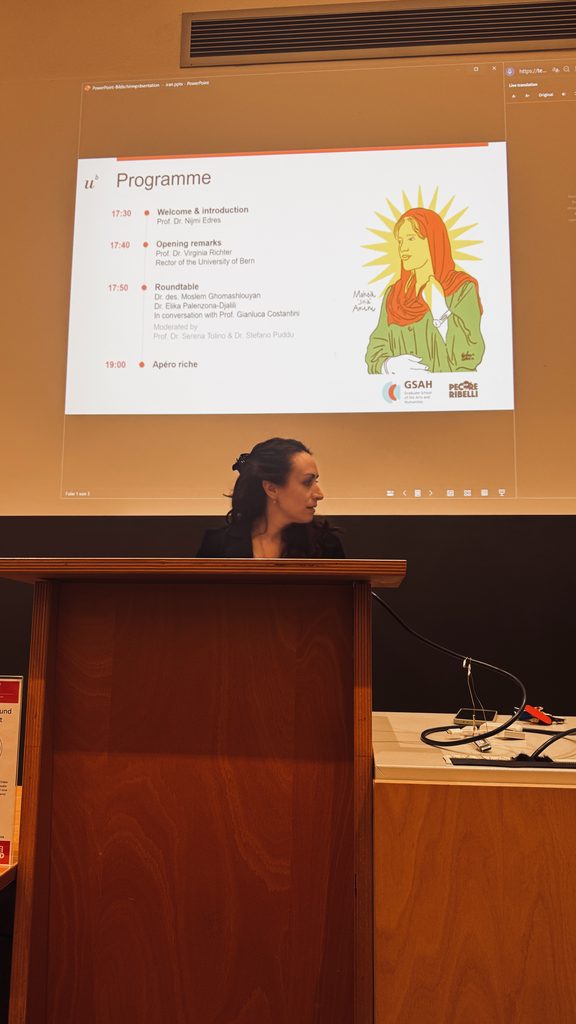
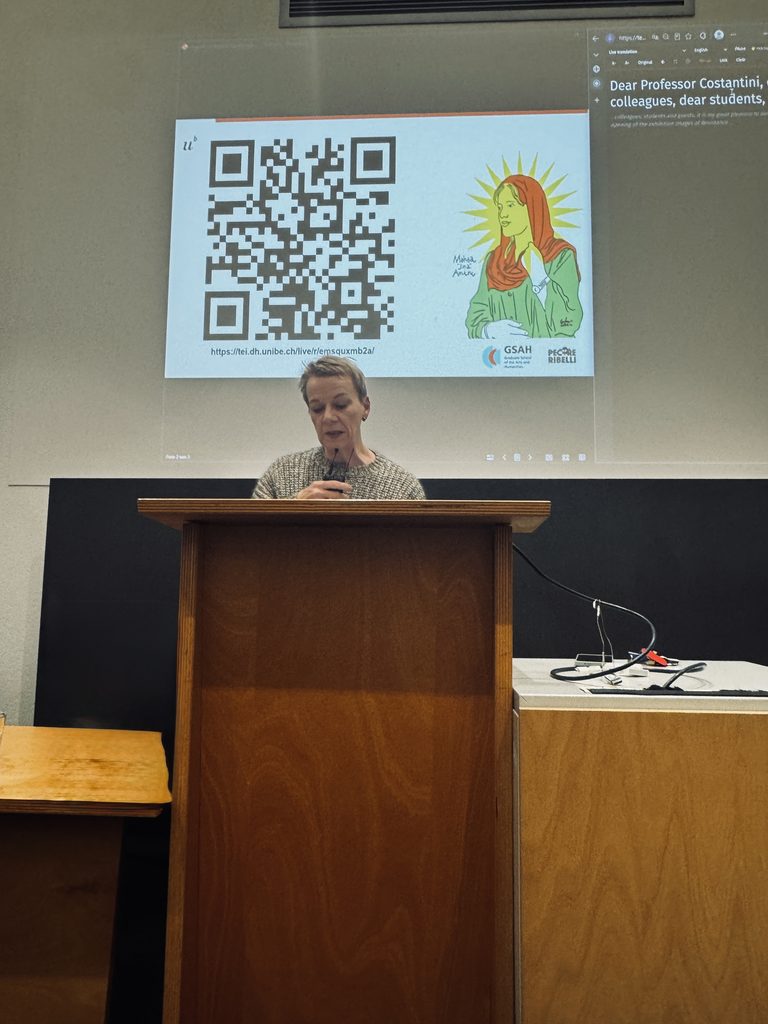
The evening opened with an introduction by Professor Nijmi Edres, followed by welcoming remarks from Professor Virginia Richter, Rector of the University of Bern.
The roundtable brought me into conversation with Moslem Ghomashlouyan and Elika Palenzona-Djalili, moderated by Serena Tolino and Stefano Puddu of the cultural association Pecore Ribelli.
It was an opportunity to bring my artistic practice into dialogue with different perspectives, experiences and fields of research.
I am particularly interested in what happens when my drawings leave the spaces traditionally associated with art and enter universities, places of research, education and critical inquiry. Here, images can become instruments of discussion. They can be questioned, interpreted and placed in relation to history, politics, gender studies and social transformation.
In front of me were academics, researchers, students and people who had come to listen and participate. On my computer screen, alongside my portrait of Farhad Meysami, with his emaciated body and a red heart on his chest, the words of the live translation appeared as the conversation unfolded.
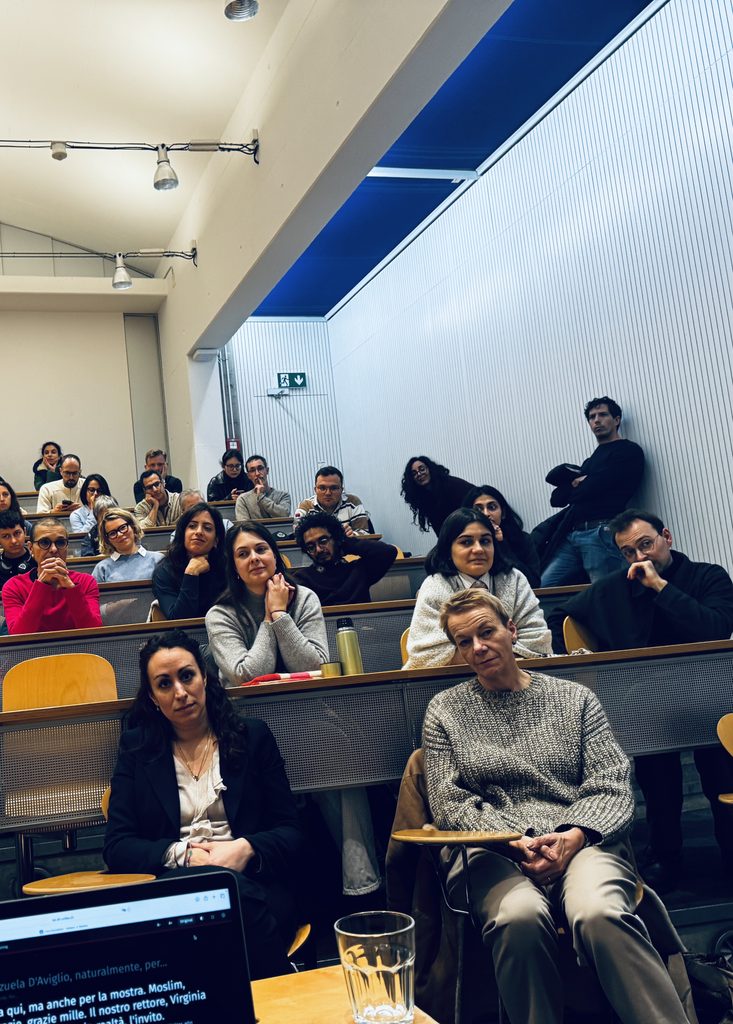
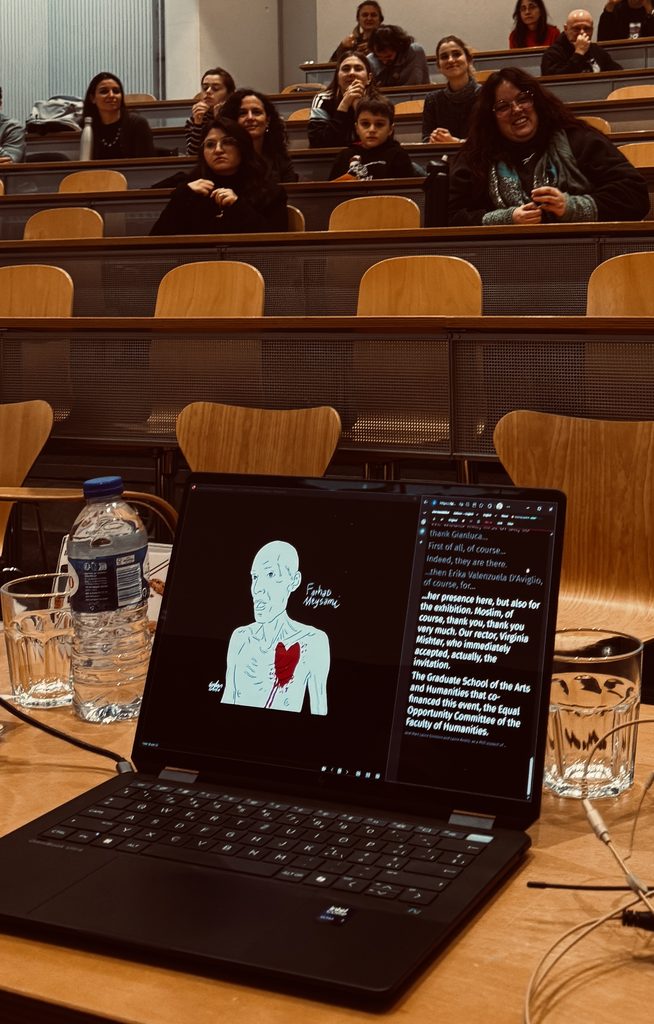
The possibility of overcoming linguistic barriers and finding common ground between different languages and cultural experiences was another important aspect of the evening for me.
Drawing often crosses these boundaries before words do. Yet it is through words, listening and dialogue that we can explore the deeper meanings of an image.
The encounter between visual language and spoken testimony is not simply a question of communication. It is also a way of recognising the experiences of others without erasing their differences.
Over the years, I have watched many of my drawings travel far beyond the places where they were made. They have appeared in streets, demonstrations, newspapers, human rights campaigns, galleries and universities.
Each time, they have encountered different people, acquired new meanings and created relationships that I could not have imagined when I first drew them.
I like to think of this movement as a geography of solidarity: a map composed not only of cities and countries, but above all of people, encounters and shared responsibilities.
Bern has now become another point on this map.
I would like to express my gratitude to Nijmi Edres and Rector Virginia Richter for their warm welcome, to Moslem Ghomashlouyan and Elika Palenzona-Djalili for the dialogue, and to Serena Tolino and Stefano Puddu for moderating the discussion.
My special thanks also go to Laura Emunds and Laura Rowitz of the Institute of Middle East and Muslim Societies (MOMuG) for their collaboration, to the Equal Opportunities Committee of the Faculty of Humanities, and to the Graduate School of the Arts and Humanities (GSAH) at the Walter Benjamin Kolleg for supporting this project.
And to everyone who joined us for the opening, bringing their attention, experiences and willingness to listen.
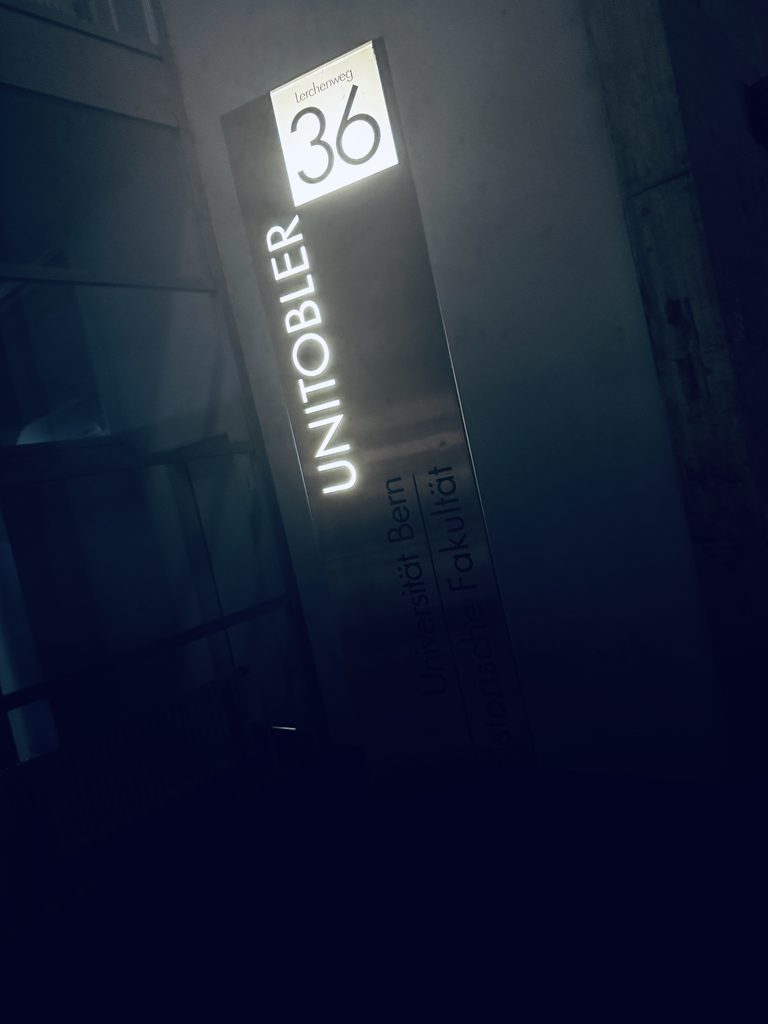
Outside the university, in the November darkness, the illuminated Unitobler sign marks the entrance at Lerchenweg 36.
Inside, the drawings remain.
Over the following days, students will continue to walk through those corridors. Some will stop in front of a portrait. Others may recognise a face, discover an unfamiliar name or read a story they had never encountered before.
I will no longer be there, but the images will continue to inhabit that space.
Perhaps this is one of the most meaningful things that can happen to a drawing: to continue living in the absence of the person who made it. To encounter strangers, provoke questions, preserve memories and establish new connections.
Four years after the first drawings dedicated to the Woman, Life, Freedom movement, their journey is not over.
Neither is the struggle they bear witness to.
Woman, Life, Freedom.
Jin, Jiyan, Azadî.
Images of Resistance: Iranian Women Between Visibility, Protest and Solidarity
November 25 – December 10, 2026
University of Bern – Unitobler foyer
Lerchenweg 36, Bern, Switzerland