The artist’s testament between memory, symbolism, and social consciousness
Text and drawings by Gianluca Costantini
Behind my hotel, the H2 on Toulouser Allee, there is a large green area where people run, meet, and constantly cross paths, all day long. In the evening, young people play beach volleyball, read books, or kiss. I enjoy walking through this lively space.
To reach the K20, I follow a long route that crosses streets and parks, eventually arriving in a very modern area: the Stadtmitte district, adjacent to the famous Königsallee and the Hofgarten, where the Kö-Bogen II complex rises. Designed by architect Christoph Ingenhoven and inaugurated in 2020, the building stands out for its bold ecological choice: both its facades and roof are completely covered in grass and vegetation, transforming the structure into a true urban hill.
Considered the largest “green” building in Europe in terms of vegetated surface area, the roof of Kö-Bogen II is walkable, offering citizens an unusual urban promenade and a tangible example of sustainable architecture. The project is part of the broader redevelopment of the Kö-Bogen, harmoniously integrating with Düsseldorf’s historic center and the adjacent Hofgarten, setting a new standard for contemporary urban buildings that combine aesthetics, functionality, and environmental responsibility. I love this city, and I love its people.
Just beyond lies the old town of Düsseldorf, full of bars and restaurants, overlooking the Rhine with its ever-moving barges. Today, I return to the museum to take a closer look at a work by Joseph Beuys, moving through the galleries, almost indifferent to the incredible masterpieces around me, to reach quickly the rooms dedicated to Beuys.
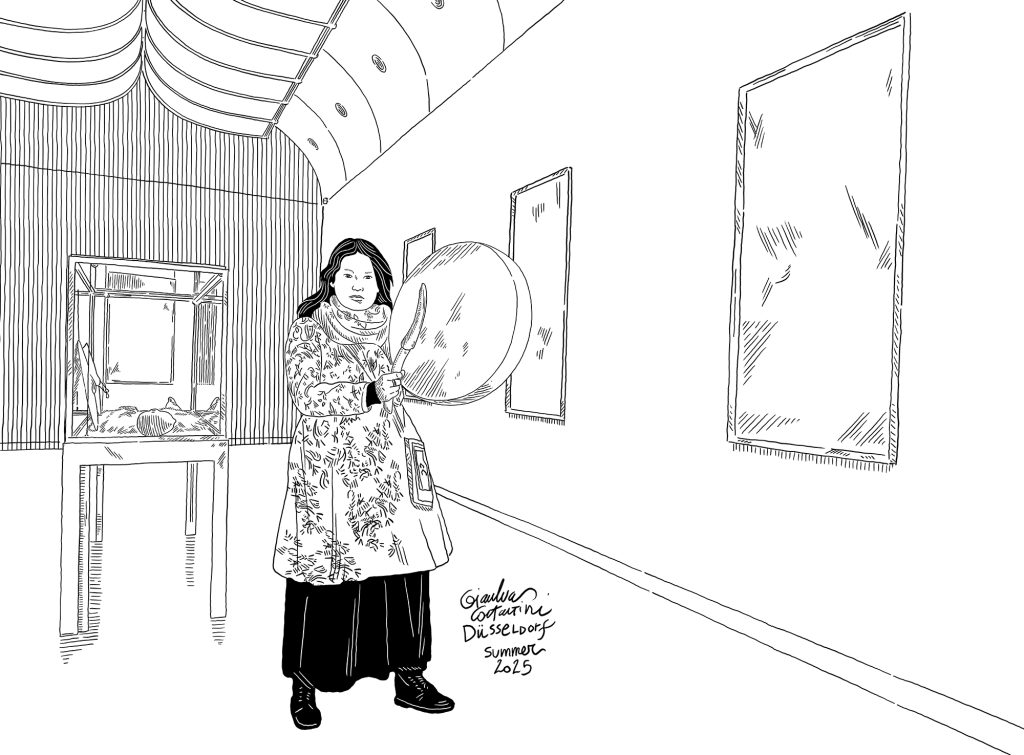
In one gallery of the K20 at the Kunstsammlung Nordrhein-Westfalen in Düsseldorf is Palazzo Regale, the work commonly regarded as Joseph Beuys’ artistic testament. The environmental installation was created in December 1985 for a solo exhibition of the artist at the Museo di Capodimonte in Naples, where it was presented to the public on December 23 of the same year, just weeks before Beuys’ death in January 1986.
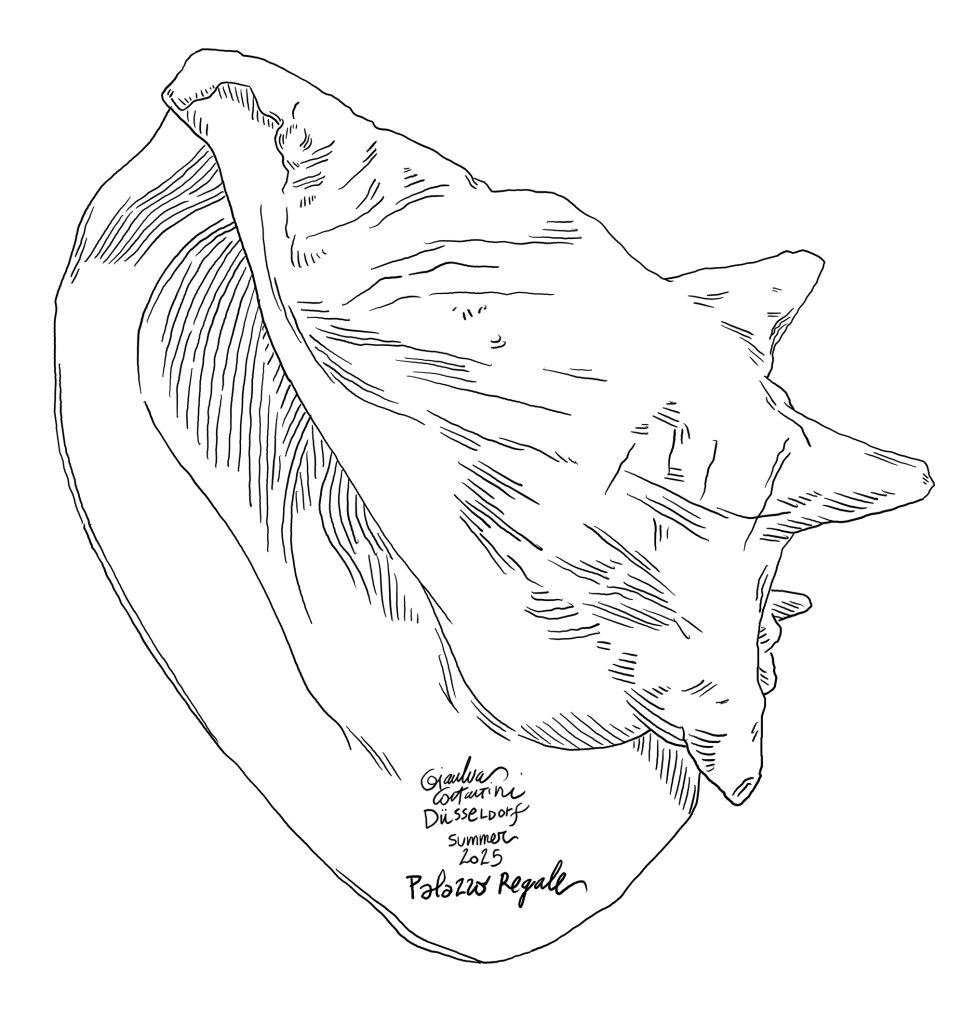
Palazzo Regale belongs to the final phase of the artist’s research, when his ideas about art as a social, ethical, and transformative force were fully developed. During this period, Beuys conceived art not as the production of objects, but as a process capable of activating individual and collective consciousness, directly influencing life, politics, and society. From this perspective, the work assumes a strongly self-reflective character and is often interpreted as a synthesis of his entire artistic journey, as well as a farewell piece.
The installation occupies a large, solemn space and consists of seven large brass panels mounted on the walls and two brass display cases positioned at the center of the room. The panels, treated with damar varnish and gold dust, present a reflective yet matte surface, resembling a mirror that does not return a sharp image but evokes a suspended, meditative perception. The display cases contain objects related to Beuys’ biography and performative practice—clothing, tools, and materials used in previous works—which do not function as mere relics or documents, but as symbolic elements charged with energy and meaning.
The title Palazzo Regale does not refer to a specific building, but carries a clear metaphorical value. For Beuys, the “palace” represents the dignity and sovereignty of the human being: each individual is conceived as a “royal palace,” a bearer of creative potential and responsible for transforming the world. In this sense, the work invites reflection on human centrality, consciousness, and the role of art as a tool for spiritual and social elevation, consistent with Beuys’ concept of social sculpture.
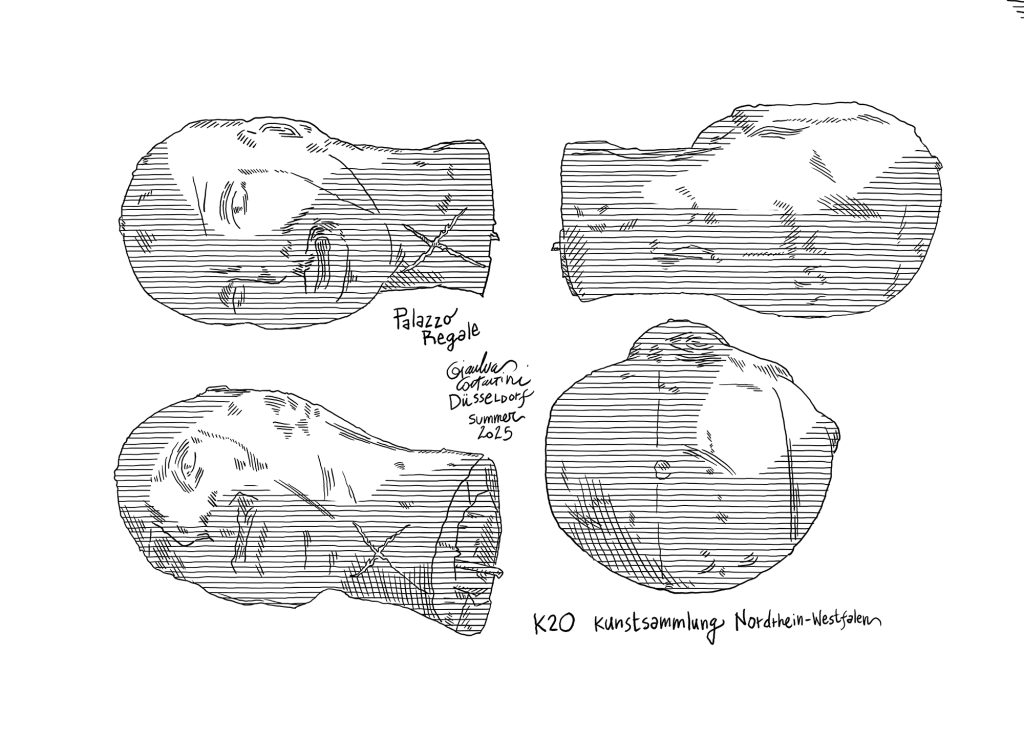
Symbolically, the use of brass and gold evokes notions of sacredness, value, and permanence, while the presence of personal objects introduces an intimate, autobiographical dimension. The result is a space situated between memory, ritual, and meditation, where the visitor is called to confront the ultimate meaning of artistic experience and the individual responsibility inherent in creating art and living life.
After its first exhibition in Naples, Palazzo Regale has been recognized as one of the most significant works of Beuys’ final phase and has been permanently installed at the Kunstsammlung Nordrhein-Westfalen since 1992. Considered a true Vermächtnis (legacy), the work remains a powerful synthesis of the artist’s thought: art as a vital process, an act of responsibility, and a concrete possibility for the transformation of both the individual and society.
This article is part of the research I am conducting for the creation of a graphic novel about the life of Joseph Beuys. The articles report on individual stops of the journeys I have undertaken to document my work.
Read also:
- The Bishop’s Door: Beuys, Mataré, and the Echo of History,
A story of mentorship, postwar reconstruction, and the symbolic power of a mirror. Link - Joseph Beuys: The Only Oak in Düsseldorf,
Memory and social sculpture in the urban heart Link - Beuys in Düsseldorf: Visiting K20 with Klee, Beckmann, and Contemporary Art
A journey through the roots of German modernity and the artists’ imprint on public art Link


