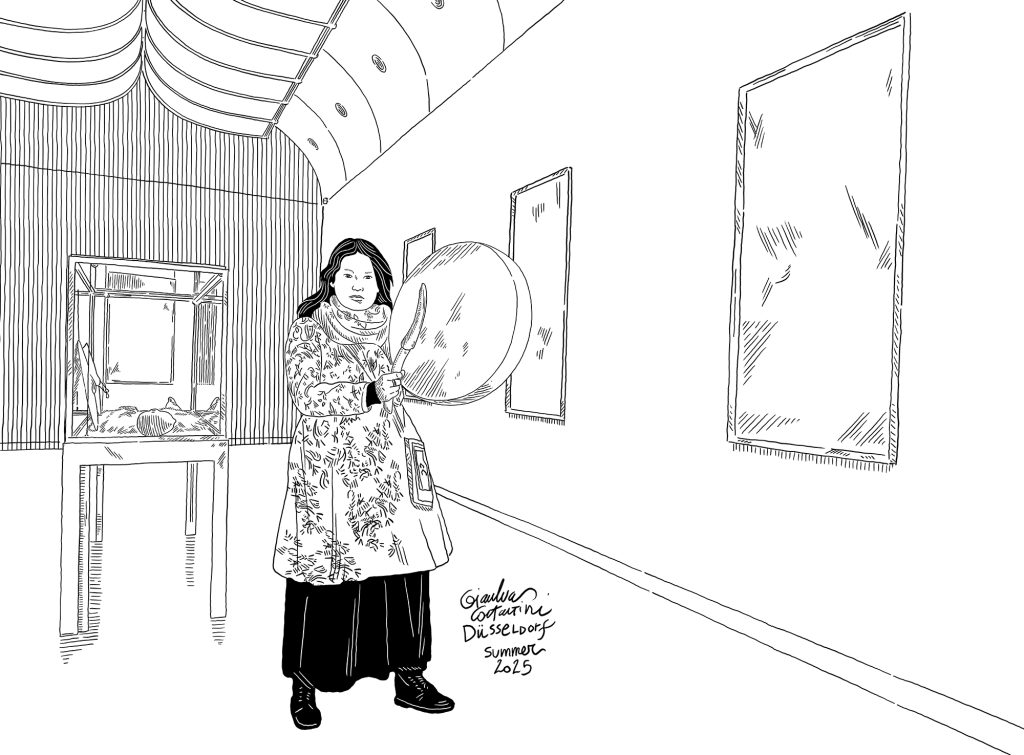
A walk past the home and studio of Joseph Beuys
Text and drawings by Gianluca Costantini
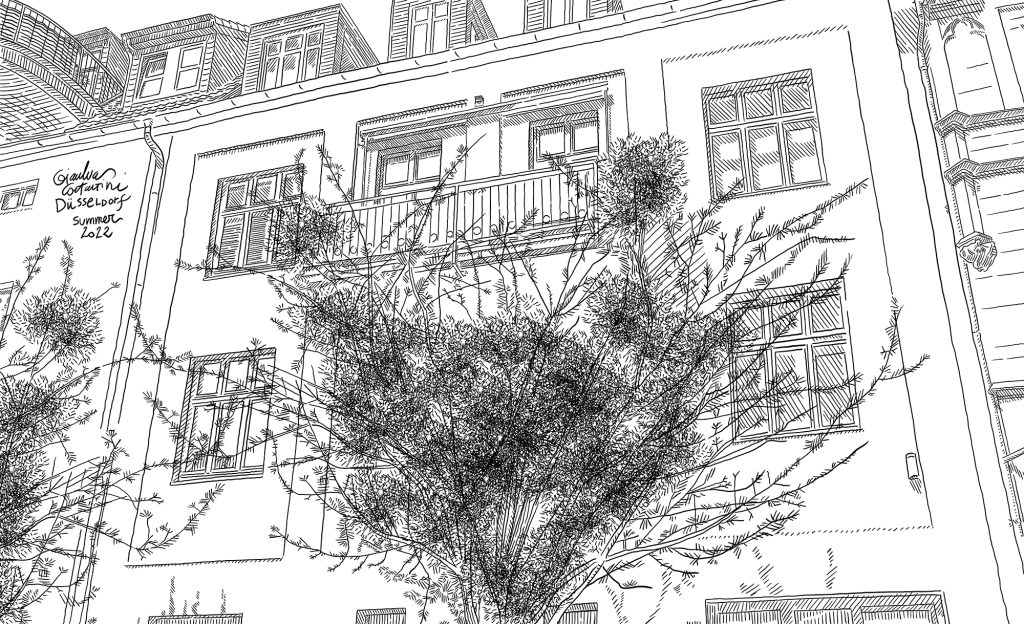
In the summer of 2022, I found myself in Düsseldorf for the first time. I had read that Joseph Beuys’ house was for sale and that the city’s cultural department had decided not to acquire it. The property is located at Drakeplatz 4, in Oberkassel, one of the city’s most elegant and upscale neighborhoods.
Beuys lived in this house from 1961 until his death in 1986. The family sold it to the current owner in 1999: a home of over 200 square meters that had once served both as a residence and a workspace. Crossing the bridge, I found myself walking past the building. Everything was closed, just an ordinary house—but knowing that Beuys had lived, created, and welcomed students and friends here made every detail feel charged with history.
In March 1961, Beuys, with his leather suitcase, and Eva, with a small basket from her grandmother, moved from her student room to Drakeplatz 4, on the left bank of the Rhine. It was essential for Beuys that the studio be there; he would never have moved to the right bank. The living space initially consisted of the entrance and the large main room, with ceilings up to five meters high and a view onto the courtyard. It was at once private and official: the family, children included, learned to navigate the rapid shifts between intimacy and visits from students, discussions, and ongoing work, all with natural ease and respect.
Beuys painted the large room pure white, without skirting boards, creating a neutral backdrop perfect for the photographs Eva would take. They shared a narrow bed and used candles on the windowsill for warmth. In 1962, the basement was converted into a bedroom, and from these renovations came the stone slabs Beuys used to build the courtyard table. In 1963, another room was dedicated exclusively to his work: almost no one ever entered it. The layout of the house—large rooms, high ceilings, and solid floors—was ideal for an artist of his kind.
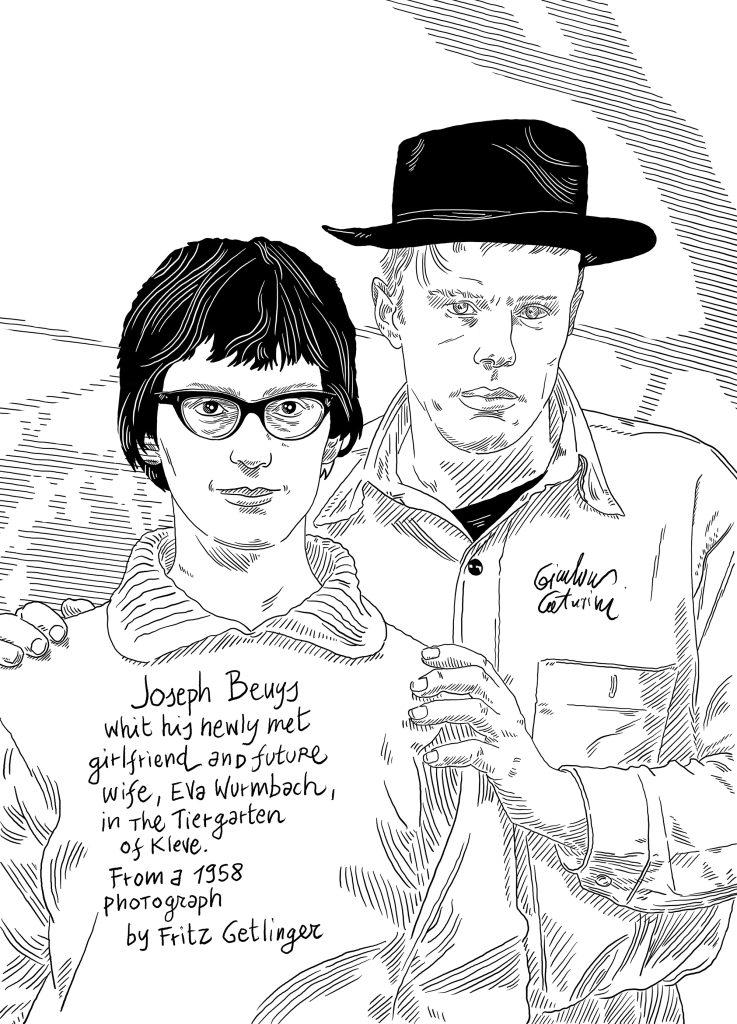
Eva Beuys notes that the family’s professional and personal life was deeply intertwined with the spaces at Drakeplatz 4. The children grew up among sculptures, felt, colored corners, and extraordinary objects, observing the constant interplay of private and official life. Beuys prepared everything with care: every object, every photograph had its place and purpose. Eva’s photographs document these spaces with intimacy and precision: without showing the artist himself, they convey the strength of his work and family life.
After 1975, the family moved to another house, but Drakeplatz 4 continued to host part of Beuys’ creative work, particularly documents, artworks, and conversations.
Two years after my first visit, I discovered that the Brunhilde Moll Foundation had acquired the house and opened it to the public. I walked past the building again, but the foundation was closed for renovations. Standing there, I imagined Beuys, his wife, and children living and creating in those spaces—a place where daily life and art were inseparable. Normally, it is possible to visit the house, see around 60 works from Beuys’ creative period, and photographs of his life at Drakeplatz. Some original details have been preserved, such as the small courtyard pond and the pink bathroom. In the future, the house will host art fellows and become a place for meetings, debates, and performances.
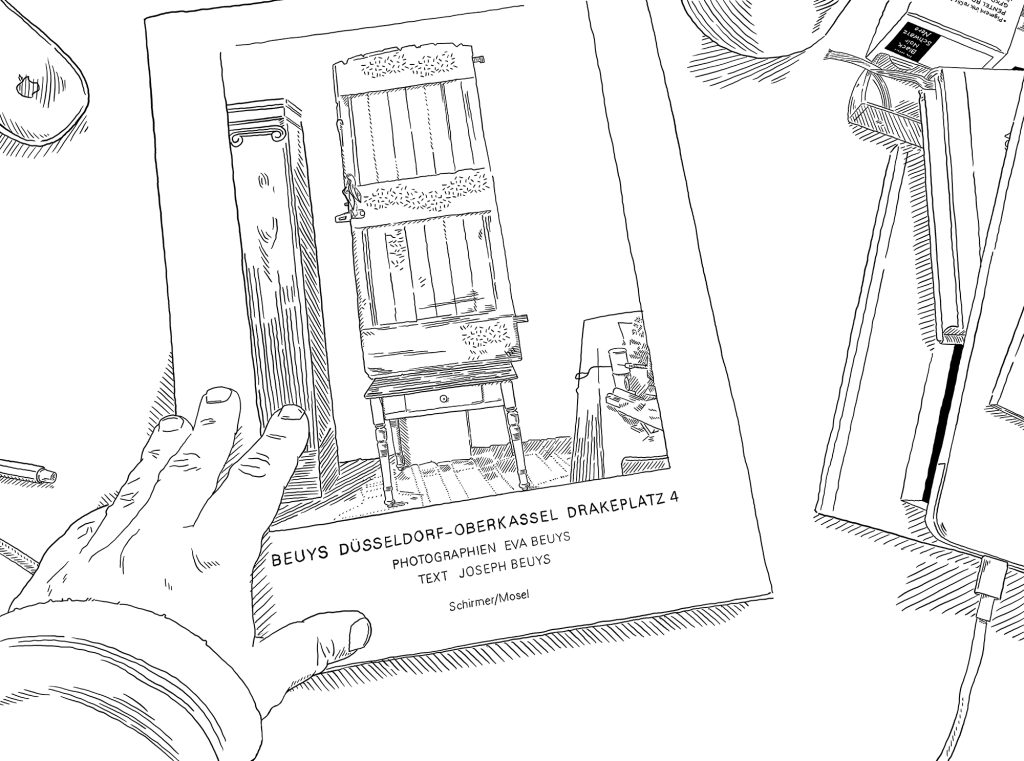
At the Kunsthalle Düsseldorf bookstore, I bought a beautiful book, Beuys: Düsseldorf-Oberkassel. Drakeplatz 4 (schirmer-mosel), by Friedolin Reske and Dieter Hülsmanns, with photographs by Eva Beuys. Reske and Hülsmanns conducted interviews with young Düsseldorf artists, including Beuys, Richter, and Polke, for articles published in the Rheinische Post and Aachener Nachrichten. Their publishing house, Eremiten Presse, released part of this material. Eva’s photographs, accompanied by detailed notes, offer a unique portrait of Drakeplatz 4: the life of an artist, his family, his objects and sculptures, a world documented without the need for Beuys’ physical presence.
These images, along with the interviews and accounts, are invaluable for my book, as they capture the everyday life and magic of a space that shaped an artist and, through him, contemporary art.
This article is part of the research I am conducting for the creation of a graphic novel about the life of Joseph Beuys. The articles report on individual stops of the journeys I have undertaken to document my work.
Read also:
- The Bishop’s Door: Beuys, Mataré, and the Echo of History,
A story of mentorship, postwar reconstruction, and the symbolic power of a mirror. Link - Joseph Beuys: The Only Oak in Düsseldorf,
Memory and social sculpture in the urban heart Link - Beuys in Düsseldorf: Visiting K20 with Klee, Beckmann, and Contemporary Art
A journey through the roots of German modernity and the artists’ imprint on public art Link - Joseph Beuys – Palazzo Regale: Art as Transformation
The artist’s testament between memory, symbolism, and social consciousness Link