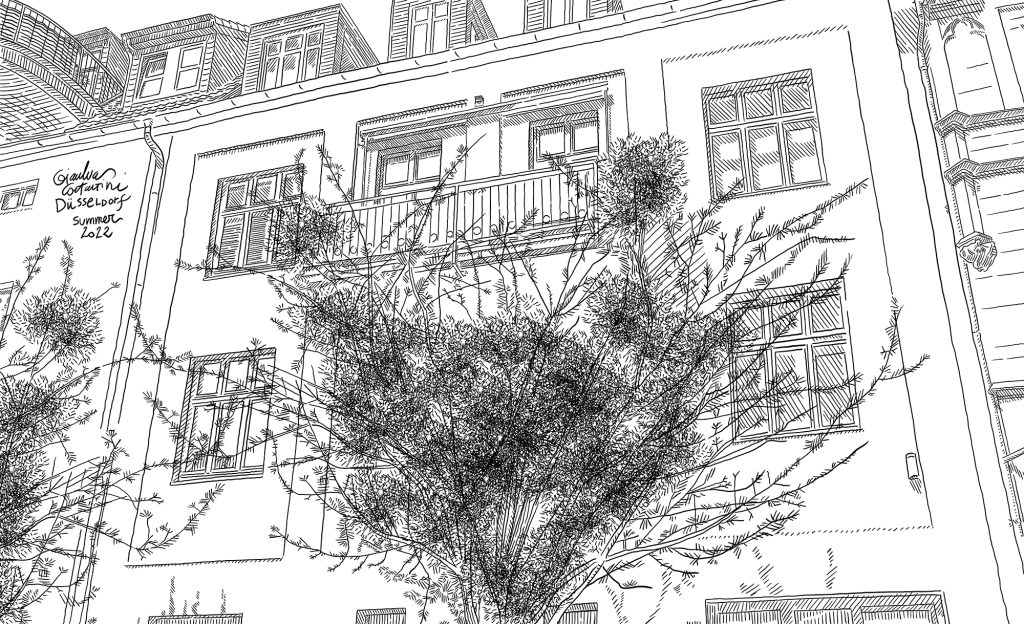
Art, memory, and modernism in a city of silk
Text and drawings by Gianluca Costantini
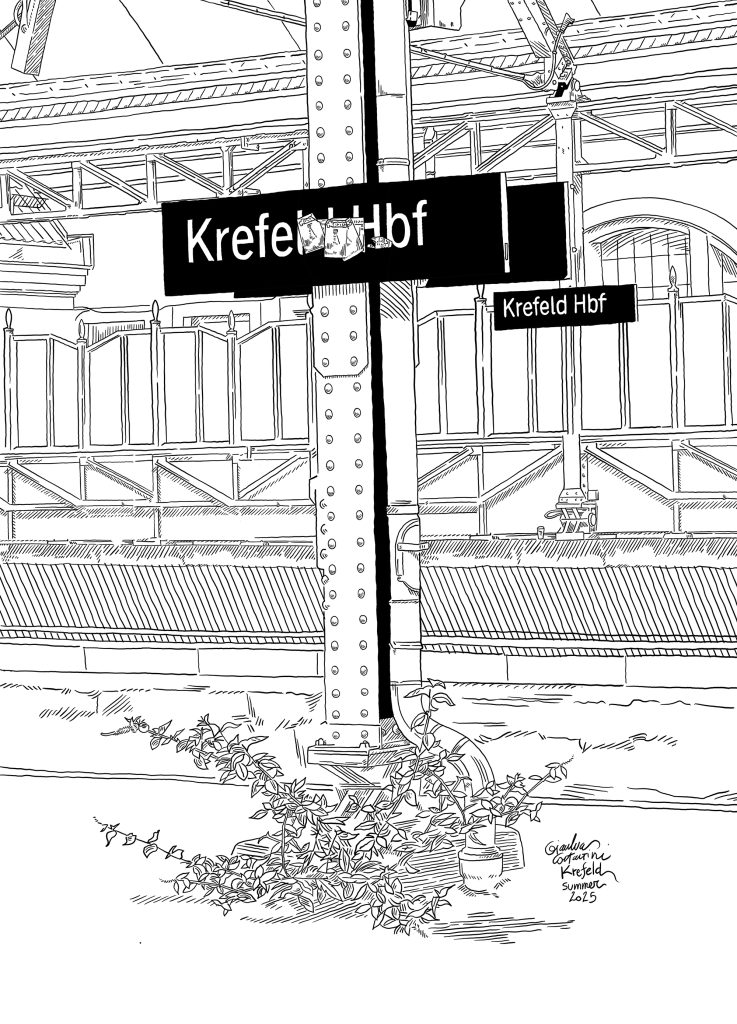
It is a warm morning when I walk toward the central train station in Düsseldorf. From there I take an overground metro heading to a nearby city: Krefeld. I am always searching for new images, new traces connected to Joseph Beuys.
Beuys was from Kleve, although for medical reasons his mother gave birth in Krefeld. He often insisted that he was born in Kleve, as if trying to place a certain distance between himself and this city.
And yet Krefeld plays an important role in his artistic history. The Kaiser Wilhelm Museum is the only art institution in North Rhine–Westphalia that preserves the sculptural complex “Barraque d’ull odde” exactly as Beuys installed it. With its Beuys Rooms, permanently arranged and still accessible today, the museum contains one of the most significant presentations of his work. But that encounter deserves its own story.
Krefeld is historically known as the “city of silk.” Between the eighteenth and nineteenth centuries it was one of the most important centers of the textile industry in Europe. Even today the city carries traces of that past prosperity. Industrial areas coexist with quiet residential districts and generous green spaces, all within the vast metropolitan landscape of the Rhine–Ruhr region.
I came here to visit the Kaiser Wilhelm Museum. From the station I walk through the city center. Like many German cities, the streets reflect a layered migration history: Turkish, Greek, Italian communities are everywhere. The German residents seem to live mostly in quieter neighborhoods beyond the center — at least that is the impression one gets while walking.
In any case, I find the city pleasant.
I stop for breakfast just in front of the museum at Café Geschwisterherzen. Sitting outside, I watch people crossing the square: parents with children, cyclists, elderly couples moving slowly through the morning light. I imagine Beuys walking here decades ago, perhaps pausing to look at the large tree standing in the middle of the square. The place is now called Joseph-Beuys-Platz.
The Kaiser Wilhelm Museum was founded in 1897 thanks to the initiative of local citizens and industrialists, many of them connected to the flourishing textile industry. Named after Emperor Wilhelm II, the museum originally aimed to promote applied arts and encourage dialogue between art, craftsmanship, and industrial production.
At the beginning of the twentieth century the institution became an important center for design and decorative arts, reflecting Krefeld’s role in the silk trade. Over the course of the twentieth century its collections gradually expanded to include modern and contemporary art. After the Second World War the museum was reorganized and integrated into the network of the Kunstmuseen Krefeld, together with other exhibition spaces across the city.
Today it stands as one of the most significant cultural institutions in the region, with collections ranging from historical decorative arts to twentieth- and twenty-first-century painting, sculpture, and design. The museum also hosts temporary exhibitions dedicated to contemporary artistic research and to the intersections between art, architecture, and design.
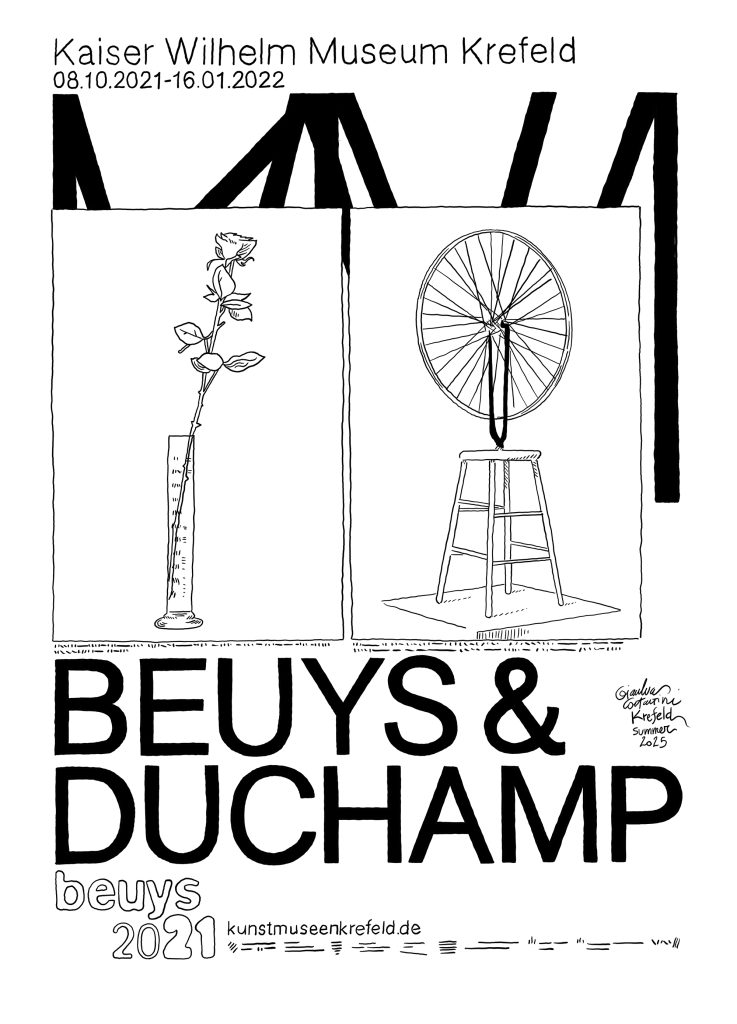
Inside the entrance hall, near the ticket desk, I notice the poster for the major exhibition organized in 2021, the year dedicated to Beuys. For the first time, the work of Joseph Beuys (1921–1986) was placed in dialogue with that of the French-American artist Marcel Duchamp (1887–1968), creator of the readymade and one of the pioneers of conceptual art. Beuys referred to Duchamp many times, often treating him almost as a conceptual adversary.
Beyond the temporary exhibitions, the museum’s three buildings contain permanent installations by artists such as Yves Klein, Elmgreen & Dragset, and of course Beuys himself. In the gardens of Haus Lange and Haus Esters stand sculptures by international artists including Richard Serra and Claes Oldenburg.
Another gallery presents works created in collaboration with the Adolf Luther Foundation, focusing on the relationship between light, color, and transparency. Luther’s characteristic compositions of concave and convex mirrors transform light into something almost tangible, making the movement of illumination visible in space.
Some rooms are dedicated to modern art and Rhenish Expressionism, featuring artists such as Heinrich Campendonk, Helmuth Macke, and Heinrich Nauen, as well as to twentieth-century avant-gardes with works by Piet Mondrian, Anni Albers, and László Moholy-Nagy. These are the rooms I find myself returning to most often. Many of these artists, after all, must have been part of the cultural atmosphere that surrounded Beuys in his early years.
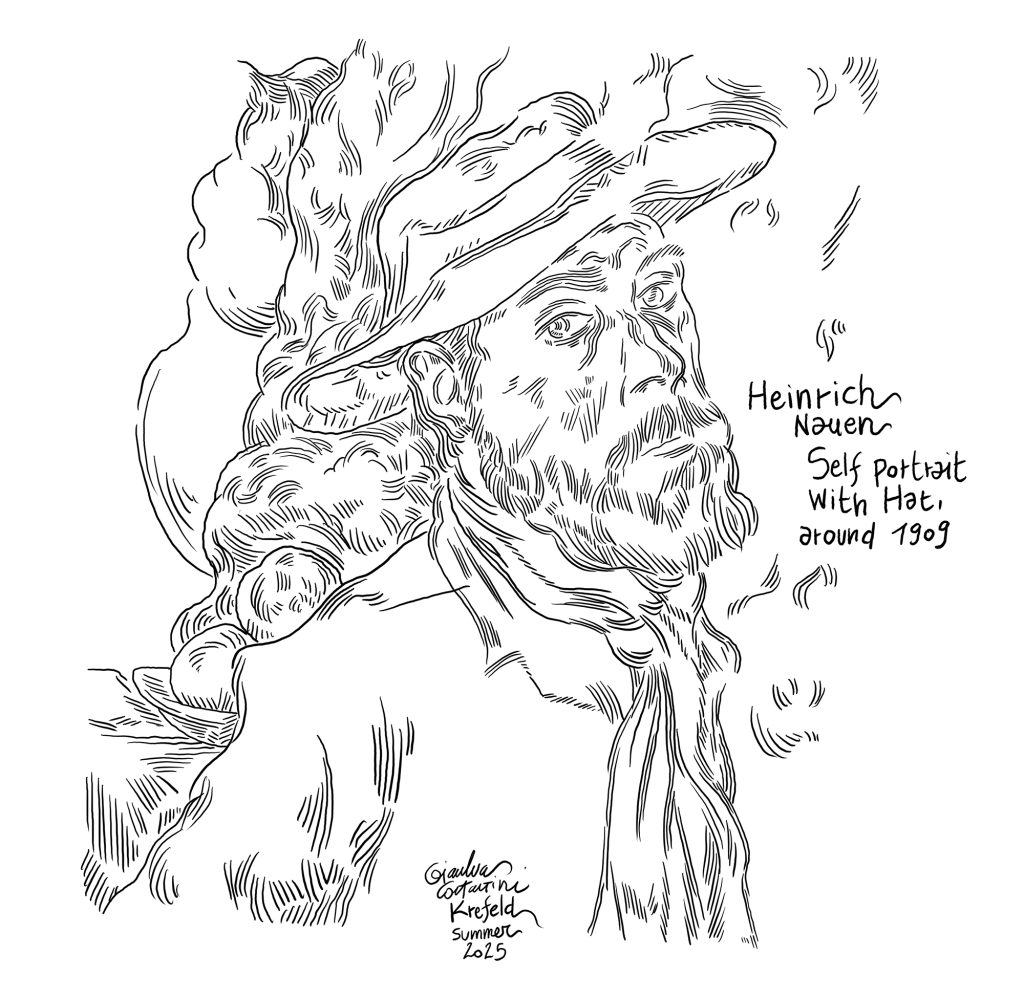
The self-portrait by Heinrich Nauen is striking. The brushwork almost recalls Van Gogh. Painted around 1909, it is a medium-sized oil on canvas that now forms part of the museum’s permanent collection. Nauen, born in Krefeld and one of the key figures of Rhenish Expressionism, developed a painterly language in which color and light become tools for expressing a deeply personal vision of the subject. His studies in Düsseldorf, Munich, and Stuttgart, followed by stays in Belgium and Paris, placed him within a European network of artistic experimentation.
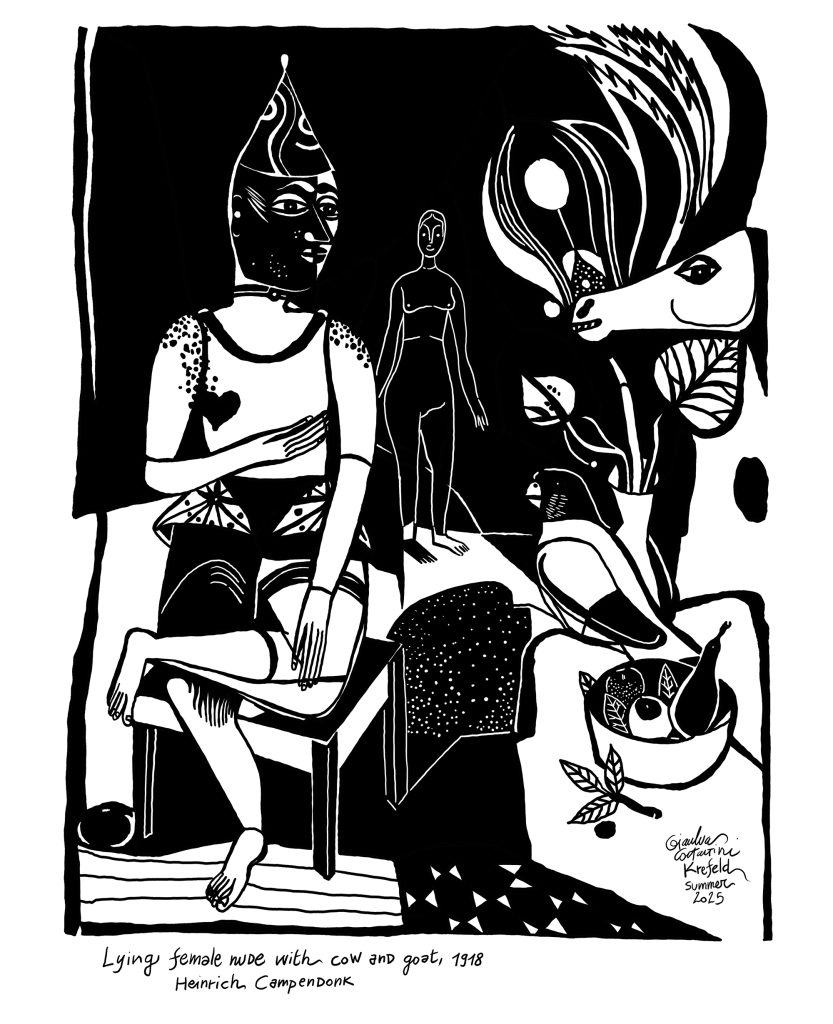
Nearby I encounter a woodcut titled Lying Female Nude with Cow and Goat by Heinrich Campendonk. The work exemplifies the expressive language he developed in the early decades of the twentieth century. Campendonk, born in Krefeld in 1889, was one of the youngest members of the Expressionist group Der Blaue Reiter, active in Munich around figures such as Wassily Kandinsky and Franz Marc. His imagery often explores the symbolic relationship between humans, animals, and nature.
A large section of the museum is also dedicated to Dan Graham, an American artist, writer, and curator who has been one of the most influential figures in contemporary art since the 1960s. His work moves fluidly between conceptual art, performance, video, photography, and architecture. He is particularly known for his glass and steel pavilions, structures that explore the relationship between space, perception, and the behavior of the viewer.

Graham developed a significant connection with Krefeld through his collaboration with the Kunstmuseen Krefeld. In the 1980s and 1990s the museum invited him to respond to the modernist architecture of the city, especially the famous Haus Lange and Haus Esters, designed in the 1920s by Ludwig Mies van der Rohe.
Here Graham created installations that engage directly with the surrounding architecture and landscape. His glass pavilions reflect and multiply the space around them, involving visitors in subtle perceptual games of transparency and reflection. In Krefeld these works establish a dialogue between the utopian ideals of modernist architecture and a contemporary awareness of how space shapes human experience.
At some point I pass quickly in front of the door of the installation “Barraque d’ull odde.” I do not realize that behind that door lies the work I had actually come here to see.
I am about to leave the museum.
Then I stop.
I turn around.
And finally I step inside Beuys.
This article is part of the research I am conducting for the creation of a graphic novel about the life of Joseph Beuys. The articles report on individual stops of the journeys I have undertaken to document my work.
Read also:
- The Bishop’s Door: Beuys, Mataré, and the Echo of History,
A story of mentorship, postwar reconstruction, and the symbolic power of a mirror. Link - Joseph Beuys: The Only Oak in Düsseldorf,
Memory and social sculpture in the urban heart Link - Beuys in Düsseldorf: Visiting K20 with Klee, Beckmann, and Contemporary Art
A journey through the roots of German modernity and the artists’ imprint on public art Link - Joseph Beuys – Palazzo Regale: Art as Transformation
The artist’s testament between memory, symbolism, and social consciousness Link - Drakeplatz 4: Joseph Beuys’ Home and Studio
A walk past the home and studio of Joseph Beuys Link